Dan ranking, a delusion

Dan ranks are mass produced these days and they no longer prove any real skill level or proficiency.
Around 1880, Jigoro Kano started transforming his Jujutsu method into what is now referred to as Judo. At the same time, a movement was underway to transform Kenjutsu into a competitive martial art called Kendo.
Kano gave some of his students their first rank “Shodan” in 1883.

To standardize and nationalize the martial arts, the Dai Nippon Butoku Kai (1895) was established. The Dai Nippon Butoku Kai awarded titles (Shogo) such as Renshi, Kyoshi, and Hanshi in Shogo. Later, the system of Dan-ranking was introduced.
The DAN-I (段位), a ranking system borrowed from GO or Japanese Chess was obviously heavily influenced by the system used in Judo that was instigated by Kano and used at Kodokan.
Shogo (称号) in Japanese translates simply as “title” or “rank,” and the word can be used in many areas, for example formal titles of nobility, military ranks, scholarly ranks, etc, and informally in the sporting world, between friends, etc.
Renshi was promoted to 4th-5th Dans, Kyoshi was promoted to 7th Dans, and Hanshi was promoted to 8th-9th Dans. The Shogo and Dan ranks were not automatically linked. Some were awarded Dan grades but not Shogo, while others were awarded Shogo but not Dan grades.

After the Dai Nippon Butoku Kai was dissolved as a result of defeat in WWII in 1946, the Dai Nippon Butoku Kai was reestablished again in 1953.
Even though the same name organization was established it is not related to the original Dai Nihon Butoku Kai though they probably wish to claim as such as the prewar organization received a lot of respect and honor as it was sponsored by the Japanese government. The current organization is no longer well known or large in membership as it is only a private organization without any sponsorship from the government.

Shodan, most important rank

初段 Shodan: The meaning of the first kanji “first time, beginning”, the second kanji “grade, steps, stairs”. Is it a mistake to translate “shodan” as “first dan – black belt”? Literally it is a mistake, but it is not a mistake because it is the first “dan” you can receive.

1917: Kenjutsu, starts using the Dan-i system similar to judo. At this point the system went only as far as godan, after that the titles of seirensho (renshi), kyoshi, and hanshi are awarded. In 1919, the Dai Nippon Butoku Kai changed the name Kenjutsu into Kendo.

The dan-i system was gradually adopted by other martial arts, including Aikido, which Morehei Ueshiba adopted around 1940. Some of Ueshiba’s senior students were quickly promoted to high dan grades, e.g. Kenji Tomiki 富木 謙治 was awarded the first ever 8th dan in the same year.

It is very difficult to find out level-explanation. Most of the dan-ranking requirements are just a list of techniques, kata and/or getting points by entering shiai.
Nevertheles, some Martial Arts can give you a glimpse of the differentiating in the dan-levels. For example Japanese Archery.
Someone who starts Kyudo has to shoot the arrow into the target. Someone of a high level has to shoot the arrow in the same target. Fundamentally there is no difference, both they shoot the arrow.

Kyudo – Japanese Archery

  • Shodan: The shooting form (Shakei) and the formal movement (Taihai) should be consistent with the standard form. There should not be disarray in the placing of the arrows (Yadokoro).
  • Nidan: Both the shooting form (Shakei) and formal movement (Taihai) should have good arrangement with evidence of spiritual energy (Kiryoku) in the application of the shooting technique (Shajitsu). There should be less uncertainty in the placing of the arrows (Yadokoro).
  • Sandan: The shooting form (Shakei) is better established and the formal movement (Taihai) is more stable. The breathing is ordered and the application of the shooting technique (Shajitsu) follows the principles of shooting (Shaho). The arrow should fly straight and there should be more consistency in hitting the Mato (Tekichu).
  • Yondan: The shooting form (Shakei) is better established and the formal movement (Taihai) is more stable. There should be correct breathing, the application of the shooting technique (Shajitsu) should be consistent with the principles of shooting (Shaho) and Hanare should be sharp. Consistency should be reached in hitting the Mato (Tekichu).
  • Godan: The shooting form (Shakei), the shooting technique (Shajitsu) and the formal movement (Taihai) should be consistent with the principles of shooting (Shaho) and refinement (Shahin) should be apparent. In particular, progress should be shown over the previous levels.
  • Rokudan: Shooting form (Shakei), shooting technique (Shajitsu), and formal movement (Taihai) have reached the stage of excellence. The shooting shows a high level of refinement (Shahin).
  • Nanadan: Shooting form (Shakei), shooting technique (Shajitsu), and formal movement (Taihai) are evident naturally in the body. The shooting has reached a high level of refinement (Shahin) and mastery.
  • Hachidan: There should be perfection in the technique, the highest level of refinement (Shahin) and embodiment of skill in the art of shooting.
  • Kyudan: The truth of Kyudo should be transparent.
  • Judan: 😉

Shodo – Non-Martial Arts Dan-Ranking

Shodo 書道, sometimes also called shuji 習字, is one of Japan’s oldest traditional art forms. It is the art of Japanese Calligraphy and can be translated into something like “the path of writing”.
It transforms kanji, the Japanese script based on Chinese punctuation marks, into true works of art. The point is to put the kanji on paper as beautifully as possible.
Each kanji consists of several “strokes” that must be placed in the correct order and in the correct manner. Pay attention to the length and width of your strokes, the way they extend, connect, and flow into each other.

In most of the Shodo schools, they use the concepts of “fundamentals”, “beginners model” and “advanced models”. Models are basically different kinds of scrips how to paint the kanji, hiragana and katakana, the 3 diiferent methods of Japanese writing.

To be graded to shodan, you must master the fundamentals of Shodo and make a painting based upon the beginners model.
From shodan students must start painting kaisho script using the advanced model, instead of the beginner’s model. From sandan students can start using the reisho and tensho styles. Also, from sandan students may submit works to the shoyuu gallery (書友ギャラリー), which is a relatively free form opportunity. The gallery model is only words in printed text: the submitting artist must decide which style to use.

As with Martial Arts, Shodo has several schools and styles and each of them are using different models in their dan-i system.
But every school is painting the kanji, the hiragana and the katakana. Fundamentally it is like Kyudo, everybody is shooting the arrow.

Aikido, a generic term

The definition of Aikido will be shaped by the question of who created it. There are those who claim that Aikido was created by Morihei Ueshiba, while others will talk about Sokaku Takeda. Some of the followers of those teachers created their own system. In most cases the name Aikido was used to identify their method.

The word “Aikido” must be regarded as a generic term for all “Yawara” based method. The list did not include Kodokan Judo, which was considered a unique martial art.
Of course, some methods are not using the term Aikido and prefer other terms like “Aiki (Ju) Jutsu”.
The name Aikido is adopted around 1940 by the Dai Nippon Butoku Kai. After WW2. In an interview with Minoru Hirai (Korido Ryu) and member of Ueshiba’s dojo the following is about choosing the name “Aikido”

(Stanley Pranin with Minoru Hirai).« “Aikido,” rather than being a specifically selected name, was the term used to refer to “Butokukai-Ryu” aiki budo within the Dai Nippon Butokukai. The headquarters of the Dai Nippon Butokukai was located in Kyoto and Butokuden centers were set up in all prefectures. Tatsuo Hisatomi from the Kodokan, and Shohei Fujinuma from kendo, were close friends of mine. The Butokukai was an independent, umbrella organization for the martial arts, and it also was in charge of martial arts in the police departments.
It was very difficult to create a new section in the Butokukai at that time. Mr. Hisatomi proposed the establishment of a new section including arts for actual fighting based on jujutsu techniques. The techniques of yawara (an alternate term for jujutsu) are comprehensive and also include the use of the ken and jo. I also made a number of suggestions and Mr. Fujinuma and Mr. Hisatomi understood my ideas. However, had I insisted on these things nothing would have been decided.
There was discussion within the Butokukai about the choice of a name for this new section. It was discussed many times in meetings of the Board of Directors, and particularly in the judo and kendo sections. We had to consider all of the different individual arts encompassed when we tried to come up with an all-inclusive name. It was decided to select an inoffensive name to avoid future friction among the different martial arts. »
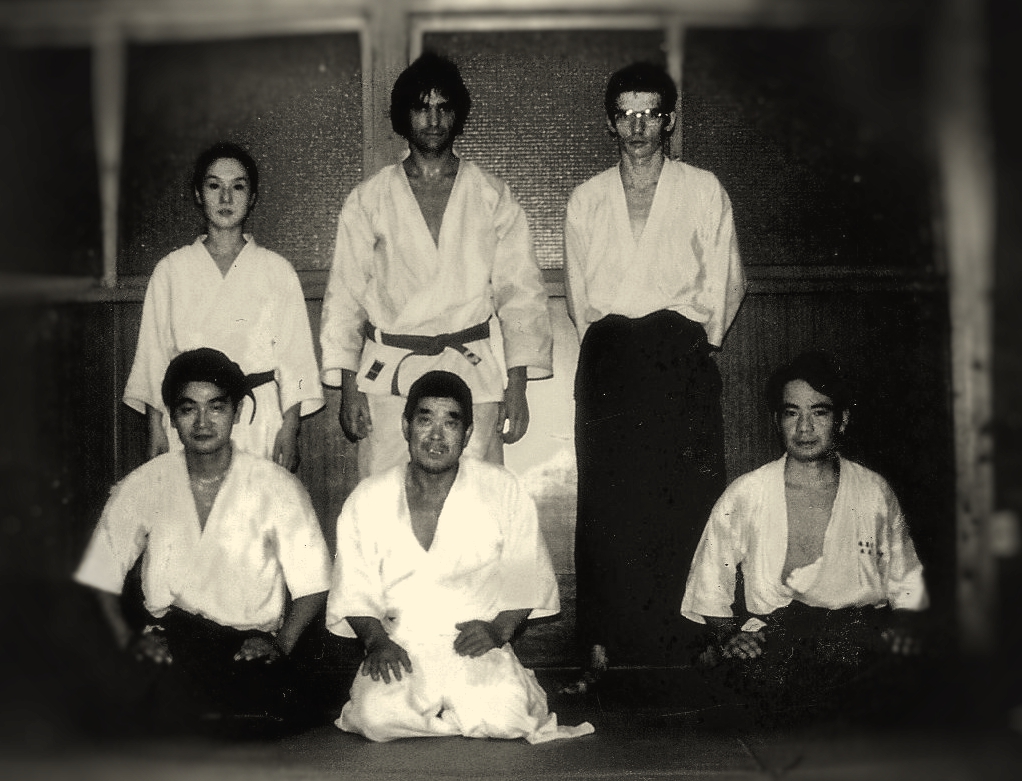
1976 – Practising Korindo Ryu “Aikido” with Hakamatsu Shihan at his private dojo in Shizuoka. Hakamatsu Shihan was a disciple of Minoru Hirai.

Aikido is typically promoted as a martial art and can be utilized for self-defense reasons. On the other hand Aikido became also popular as a method to create “harmony”. Regrettably, the word ‘harmony’ is poorly defined and frequently interpreted as a ‘new age’ concept.

Another form of Aikido is the controversial “Sports Aikido” system. A method for competing that utilizes the technical foundations of Aikido, influenced by Kodokan Judo and Sports Kendo.

Fundamentals of Aikido

The Dan-I system is being used as a ranking method in Aikido, just like other martial arts.
To obtain the rank of Shodan, you must become proficient in the fundamentals of the art. The arts previously discussed, such as Shodo and Kyudo, also express this.

The fundamentals of Aikido must be based on how to use your mind and body under pressure in the environment. To perform at the best, your posture must be optimal and your mind must be focused on the task you are performing.

Tomiki’s Aikido Fundamentals

In Tomiki Aikido, the fundamentals are expressed through the concepts of:

  • Shizentai no ri – the concept of natural posture – a natural and unrestricted posture for attacking and defensive actions
  • Ju no ri – the concept of defensive power – do not oppose the offensive power of attacker
  • Kuzushi no ri – the concept of disturbing balance – creating an opportunity to attack with as little force as possible

The methods of kata and randori are employed to demonstrate these concepts.

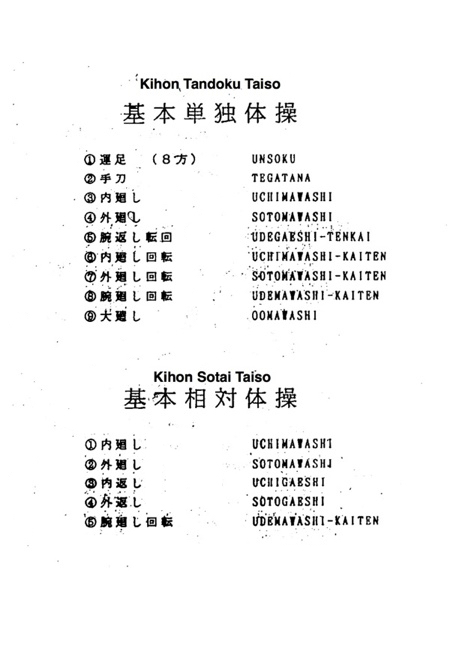
An example of an early Tomiki Aikido Syllabus – Senta Yamada
The JAA syllabus
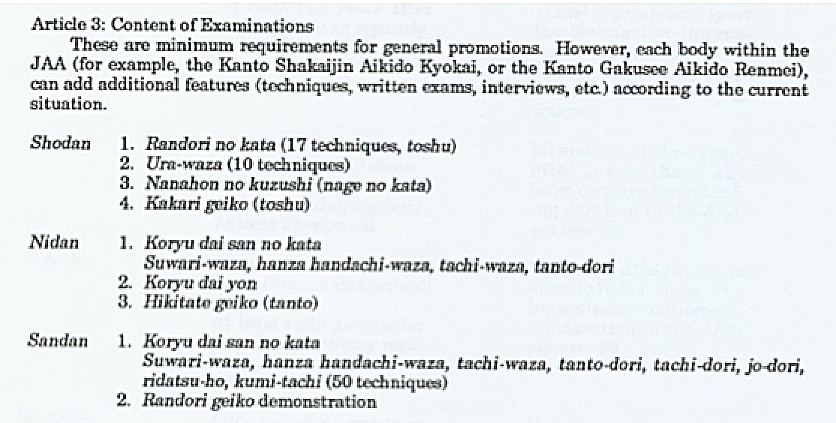
Shodan is built around the randori concept in Tomiki Aikido. The Principles (shizentai no ri, ju no ri and kuzushi no ri) are an integral part of the grading demonstration.
Nidan grading focuses on traditional pre-war techniques and a kata based on the concept of kuzushi. Demonstrating the randori concept requires the opponent to demonstrate a flexible resisting action.
Sandan’s grading demonstration is based on pre-war techniques. Weapons such as tanto, bokuto, and jo are demonstrated at a fundamental level. The randori concept is demonstrated with a flexible resistance action by the opponent, who can try to take over the actions of the defender.

The Fundamental Principles are the core of the grading demonstration. Without these fundamentals, the candidate will be failed by the panel or examiner.

If a candidate wins 1st place in a major tournament, they can climb up in the dan-I ranking without a formal grading demonstration.

Higher levels are a matter of technical proficiency demonstration or promotion for special services.

The Dark Side of the Dan Ranking

The Dan ranking system has a financial aspect. Promotion fees must be regarded as income for the organization.
The organization’s prestige has a significant impact. Being promoted by a well-known organization is what most people prefer. Regrettably, this is not always a proof of understanding and skills.
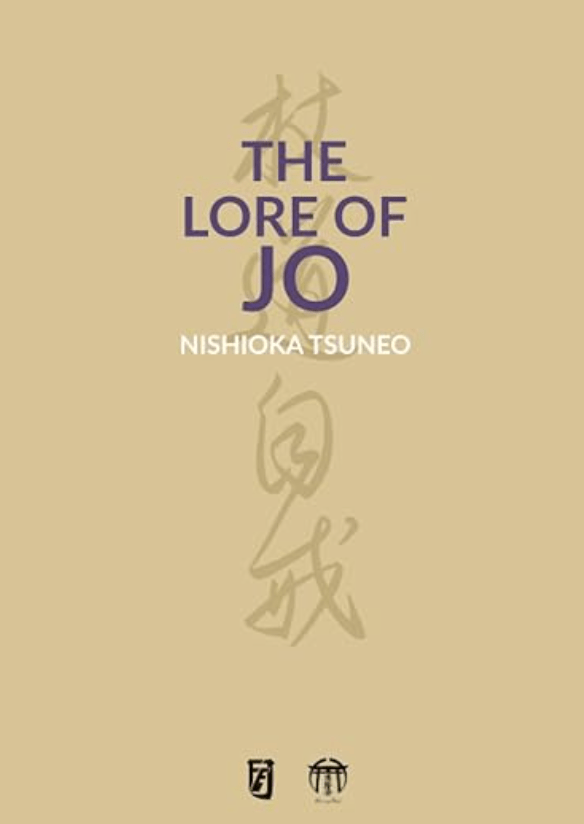
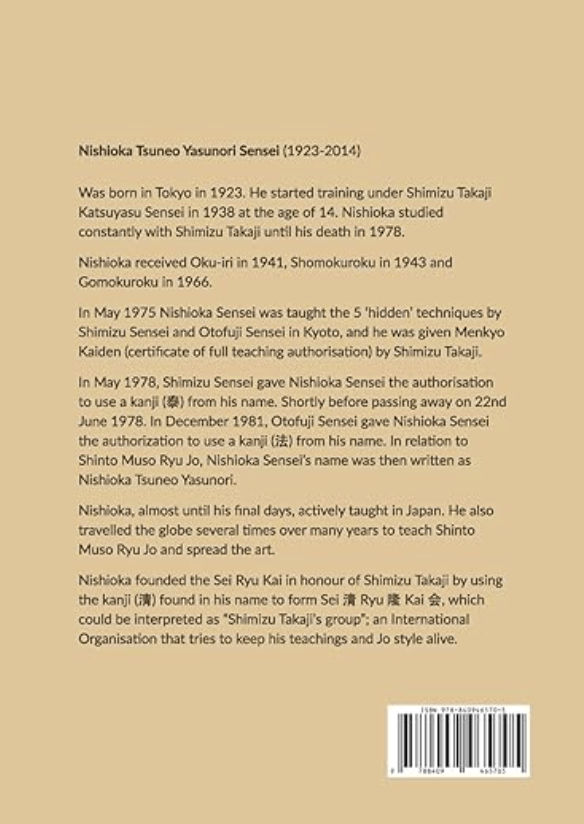
Nishioka Tsuneo’s book focuses on the compromised aspect of dan ranking.
A cure?

Finding a cure is not a problem. But accepting the cure is for most of the people the obstacle.

Do you have a passion for improving your skills? Your training is all about having enthusiasm. To enhance your skills, you need this secret ingredient. Even at a certain age, enthusiasm remains necessary.

A piece of paper can look beautiful on your wall, but it is not guaranteed that you have the necessary skills to demonstrate your art.
The “Sensei” Enigma

Author: Eddy Wolput °1948 – 7th dan Aikido (JAA-Tokyo/Japan) – 5th dan Iaido – 5th dan Jodo.
In collaboration with Tim Wolput……as the illustrator and provider of ideas .
Part of the material in this article is not directly linked to the Japan Aikido Association (NPO) program or Shodokan approach. Other concepts are incorporated into the study of the subject presented.

Enigma comes via Latin aenigma from ancient Greek ainigma. Hidden in this is the word ainos “narrative, fairy tale”.
Enigma mainly translates as “riddle” but it is also referred to a coding device.

The Enigma machine is a cipher device developed and used in the early- to mid-20th century to protect commercial, diplomatic, and military communication. It was employed extensively by Nazi Germany during World War II, in all branches of the German military. The Enigma machine was considered so secure that it was used to encipher the most top-secret messages.

Wikipedia

The purpose of being a Sensei

Sometimes you will read that a Sensei is a rolemodel. But what rolemodel?
Defining rolemodel is as muddy as the relationship of Sensei-Tori/Uke.

In the past when Japanese martial arts were introduced into Western society, a Sensei was a superhuman. Sensei could beat everyone and had an answer to all the questions.
When Chinese martial arts were imported, the same happened with the equivalent of a Sensei. The Chinese use the word Sifu.

Nowadays, Sensei became more human and is not any more superhuman. Although some groups still rever their Sensei almost in a divine manner.


So, what is a Sensei?

A Sensei is an educator and a motivational role model. This is the starting point.
To become an educator and a motivator, you need to have knowledge and skills of the subjects you like to teach. This is the first item to take into account.

Do you know your subject and do have have skills?

Although in the beginning of this post the definition of Sensei:
“person born before another” or “one who comes before”
As a Sensei you must believe in yourself and you need the knowledge and practical skills of the subject you like to teach.

Teaching Japanese martial arts is mostly done by the “Kata” method.
Knowing and practising the Kata is a lifetime work. The study of a Kata is never finished, you will always find something new .

But what is a “Kata”?
Kata an be seen as “the method” to teach people how to perform a certain task or job. We can distinguis 2 kinds of kata.

  • Kata in a narrow sense
  • Kata in a more broader sense

In Kodokan Judo, 2 kinds of Judo were mentioned by Jigoro Kano.
The cultivation of a strong physical body (through rentai-ho) and the development of contest skills (through shobu-ho) together resulted in kyogi judo, or judo in the narrow sense. Kano intended that judo practitioners were also to go on to achieve a higher level of self-actualization through shushin-ho and thus achieve kogi judo, or judo in the wide sense.

Kano’s ideas are not unique because on other fields we can see the same concepts, the method in a narrow sense and the method in a wider sense.

It is believed that Budo can cultivate both the mind and body. However, if the meaning of Budo is unclear, then it is impossible to know what to train and indeed what method to utilize. In identifying Budo, it is important to understand why Judo (“the way of Yawara/Jujutsu”), Kendo (“the way of the sword”), Kyudo (“the way of the bow”), Aikido (“the way of Aiki”) and the like, are considered to be Budo (“martial ways”). To aid this clarification, the difference between “Michi (way)” and “Jutsu (technique)” should be known. Good guidelines and tuition have become indispensable for this aim, but if each person does not grasp what Budo is individually during practical training, then focus, concentration and discipline in Budo is not achieved.

Meiji Jingu – Tokyo

Relationship Sensei and Tori/Uke

Sensei is literally translated as “person born before another” or “one who comes before”. In general usage, it is used, with proper form, after a person’s name and means “teacher”; the word is also used as a title to refer to or address other professionals or persons of authority.
Tori is the one who performs the technique –
Uke is the one who receives the technique.

Sensei and martial arts

In modern Japanese martial arts, specifically Kodokan Judo or similar systems, tori is the one who performs a technique against the training partner, or uke. Sometimes tori is associated with winning, while uke is associated with losing.
The difference between the two people is very obvious during “Kata” or so-called formal exercises. During “Randori” or sparring, the difference becomes misty because each person may be Tori/Uke as an individual.

When one of the practitioners is also the teacher or the Sensei, the situation becomes more muddled. How the teacher gets to be the loser if the sensei act as Uke?
Such a situation is the perception of someone who don’t understand the classical methods of Japanese martial arts. It is very difficult to compare martial arts seen as a sportive activity (for example aikido-kyogi or sports-aikido) and martial art (Budo/Bujutsu) as a development of your body and mind.
Some martial arts of course, can be practised as a sport activity and as a method for selfdevelopment.

Martial arts with a strong Budo/Bujutsu connection have a different name for Tori and Uke, but from an educational point of view the words have the same meaning when a teacher is involved.

  • Shidachi – someone who performs the technique
  • Uchidachi – someone who receives the technique

Uchidachi is leading shidachi with sincere attack. This allows to learn proper body movement, battle distance, appropriate mindset, and perception of possibilities. In the past, the role of Uchidachi was reserved exclusively to expert practitioners who were able to carry out meticulous techniques and possessed the right spirit and an understanding of their role.
The roles of uchidachi as senior and shidachi as junior are always maintained, though the role of uchidachi is played by someone at a lower level. The mindset of uchidachi is always sincere but humble. Kata is practised so that they can learn to give and receive together. This is what makes possible the improvement of technique and the development of the mind.

Shu-Ha-Ri & Jo-Ha-Kyū

Shu-Ha-Ri roughly translates to “to keep, to fall, to break away”. (From Wikipedia)

Shu (守) “protect”, “obey”—traditional wisdom—learning fundamentals, techniques, heuristics, proverbs
Ha (破) “detach”, “digress”—breaking with tradition—detachment from the illusions of self
Ri (離) “leave”, “separate”—transcendence—there are no techniques or proverbs, all moves are natural, becoming one with spirit alone without clinging to forms; transcending the physical

Shu-Ha-Ri is related to another Japanese phrase -Jo-ha-kyū (序破急)- to define the strategy someone uses during practising his art in his life. This concept has to be seen as a macrocosmic and microcosmic event.

Jo-ha-kyū (序破急) is a concept of modulation and movement applied in a wide variety of traditional Japanese arts. It essentially means that all actions or efforts should begin slowly, speed up, and then end swiftly. This concept is applied to elements of the Japanese tea ceremony, to the samurai sword art of Kenjutsu, to the bamboo sword training art of kendō, and to other martial arts, to dramatic structure in the traditional theatre. (From Wikipedia)

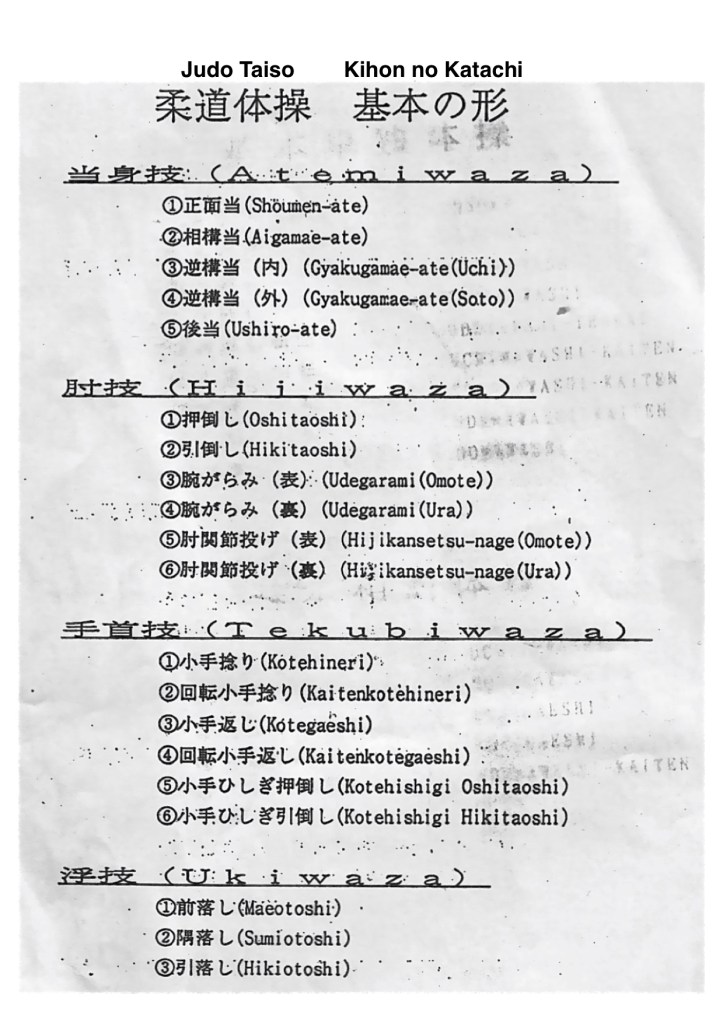
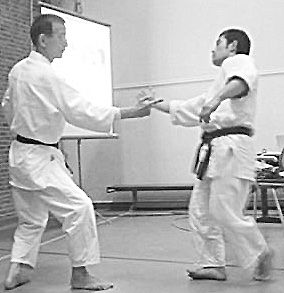
Shomen-ate Kata

When performing kata, there is a structure that we cannot ignore. This structure contains all the basic concepts for performing an effective movement related to an opponent.

Jibun no tsukuri and aite no tsukuri are the building blocks proposed by Kenji Tomiki. Each method of “tsukuri” can also be divided into more distinct parts necessary for an effective technique. These elements have to be integrated in your actions.
The danger exists of giving too much attention to an item with the result of less efficiency due to a lack of fluidity and integration in the overall action.

For instance, the first technique of “Basic 17” in the Aïkido Tomiki system.
When Tomiki wrote “Judo and Aikido”, the first movement with the front hand is just a sweeping action.

A Sensei’s duty, explaining the alternative

Alternative in this case is another view about executing a certain technique. This is a different use of the term ‘alternative’. In another article, the term “alternative” is used in a different sense: The simplification of Ueshiba Aikido.

After striking Uke’s arm, the opponent is destabilized as in the picture. The danger exists of having a too mechanical technique as a result of a tunnel vision.

“Tunnel Vision”, a  metaphorically way of expressing the reluctance to consider alternatives to one’s preferred line of thought.

Original or alternative?

Look at the picture of Tomiki and Ohba when executing sweeping the front arm as explained on the page of Tomiki’s new method of randori (Judo and Aikido). Uke’s balance is directed more forward.
The posture of Uke is different as in the picture with Shishida. Uke’s balance is directed to the side and slightly back.

Hitting the wrist or sweeping the wrist are 2 alternatives of many solutions. A good sensei will insist on one method for beginners. Later on, multiple possibilities can be used for advanced persons.

Senta Yamada is clearly demonstrating a sweeping action.

Practising – The Sensei Way

As said before, a Sensei acts mostly as Uke in the traditional way of martial art training. Unfortunately, many sensei only perform “mouth” waza or embu with a willing partner. In order to be a Sensei, you have responsibilities to your students. You should communicate with them through your mind and body. Teaching your student is a bodily experience and speaking is just an add-on to give some additional guidance.
Many Sensei are older than their students and as a result, the “personal” training program is slightly different from that of the student.

From a western point of view, we have to take into consideration that an older body needs a different physical training program.
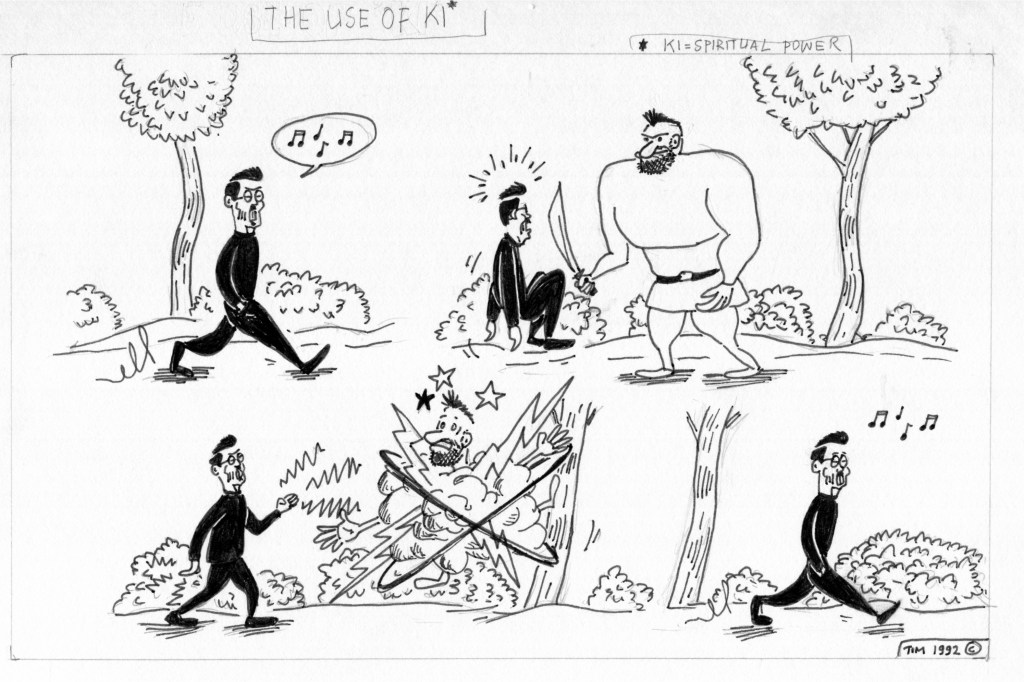
From a more holistic perspective, the concept of “Ki” has to be taken into account. We cannot deny the existence of bioelectricity (Ki) and the ability to manipulate Ki in some exercise programs.
Hachi Danken or eight brocade exercises is but one example. Another important training tool for senior and experienced practitioners is the Ritsuzen method, the way to stand like a tree.

And keep in mind, Tomiki’s Tandoku Renshu*. Of course, a deeper understanding is needed to understand and acquire the skills of this unique training method.
Tomiki’s Tandoku Renshu is not performed as college students do. It is practiced according the older methods, for example, taught by Senta Yamada.
And of course, you must take into account your own experience.

*Original Tandoku Renshu

Aiki-Do, the way to Aiki?

Aikido or Aiki-Do?

There are many explanations for Aiki-Do and from a historical point of view we have to look a the lineage of the many educational lines of Aiki-Do.
Morihei Ueshiba can be credited to be the founder of Aikido and was a student of Sokaku Takeda, the founder of modern Daito Ryu Aikijutsu (or Aiki-Jujutsu). Morihei Ueshiba modernized Daito Ryu and therefore changed the mechanical but also the philosophical concepts.

Is there a difference between Aikido and Aiki-Do?
The distinction between the two can be summarized as follows:

  • Aikido: the martial art created by Morihei Ueshiba, based upon a concept of natural rhythm, a free flow of personal expression that offers no conflict with nature.
  • Aiki-Do: a method to learn the skill of aiki which is to provide a method of hand-to-hand combat.

According to Japanese Martial Arts scholar Don Draeger, the personal view of Sokaku Takeda on aiki is:

The secret of aiki is to overpower the opponent mentally at a glance and to win without fighting.

Morihei Ueshiba modernized Aiki-Do, sometimes called Aiki-Budo or other names, in such a way that the concept of Aiki is different from the Daito Ryu Aiki concept. The concept of Aiki by Morihei Ueshiba is explained in “Aikido” by Kisshomaru Ueshiba, the son of Morihei Ueshiba. This book is written under supervision of Morihei Ueshiba.

Aiki is the expression of Truth itself. It is the way of calling people together and reconciling them with love whenever they may attack us.

Our interest of course is in the lineage of Kenji Tomiki. He was a student of Morihei Ueshiba for his Aikido (previously AikiBudo or other names) and this is the reason why there is a link with the Daito Ryu lineage. But can we conclude Tomiki Aikido is Daito Ryu? In my opinion, Tomiki Aikido has some Daito-Ryu influence via Morihei Ueshiba, but is not following the Daito-Ryu syllabus and therefore the movement patterns will be very different.

Another person who has an influence on Tomiki’s Aikido is Hirokazu Kobayashi from Osaka. Some of his student are claiming Kobayashi was a Daito Ryu shihan. But this seems a controversial assertion. To learn more about the link between Kobayashi and Daito Ryu, you can read an article by Guillaume Erard.
Tetsuro Nariyama, shihan of the Shodokan Dojo in Osaka has a great influence on the modern version of Tomiki’s Aikido and he was for many years a student to Hirokazu Kobayashi. During the time he learned from Kobayashi, he introduced Tomiki’s randori method to university aikido clubs under Kobayashi’s control.

Explanation by Kenji Tomiki

Kenji Tomiki gave an explanation for 2 important words, Aikido & Aiki.

  • Aikido: the old saying goes, “It is the spirit that carries the mind and controls the body.” The people of ancient times believed that man’s mind and body and consequently his strength were under the control of the spirit.

  • Aiki means making your spirit “fit in” with your opponent’s. In other words it means bringing your movements into accord with your opponent’s. After all it means the same thing as the “principle of gentleness,” for it is an explanation of the principle from within.

The perception of Kenji Tomiki is a “pragmatic” one, and most people approach his method very technically. In my opinion, Tomiki explained Ueshiba’s Aikido according the ideas of Kodokan founder Jigoro Kano, but tried to keep the spiritual message of Morihei Ueshiba. Tomiki seems to use almost non-religious words to explain a spiritual message. By using a non-religious language, some Western people are very highly attracted by the logic he used to explain his Aikido understanding. Other people regret the absence of a kind of aiki-mystery in the method.

But is this just a perception or maybe we don’t understand Tomiki’s message?

gleeson judoThere is an interesting quote of Tomiki in Geof  Gleeson’s book: Judo Inside Out:
  • When training in aiki jitsu under Professor Tomiki he often used the symbol of prayer, the placing of two hands together as signifying the purpose of prayer and religion – the duality of God and man, the yin and yang, becoming one.


Human Lifelong Activity

If we try to understand Aikido in a pragmatic way but as a lifelong activity, we cannot just build our understanding on techniques, exercises or technical kata. We have to find out the elements which can be used as criteria for Aikido as a human lifelong activity. I am not referring to the 3 principles of Judo used by Tomiki (Natural posture, Breaking the posture & Principle of Gentleness) because they are included in the Fundamental Elements.

Yōso – Fundamental elements

Yōso literally translated as “principle”, but in the context of our study we use “essential element”. Of course this is already discussed in other articles on this blog. But I would like to stress the importance of this way of thinking: A human lifelong activity.

This is only possible if we change our way of thinking from raw muscular power into a method based upon physical & mental skills, creating an Aikido method for everybody. This method is using technical skills to control attacking power of an opponent by using fundamental elements without raw muscular power.

What are the fundamental elements in the method which can be practised by everyone?

  • Ma
  • Hyoshi
  • Aiki

Ma : distance & time interval

Distance :

  • distance between 2 opponents or more
  • the distance to step to the opponent to control him, for example grasping the wrist

Time Interval :

  • the relation between distance and time
  • big and small movements and time relationship

Controlling the distance and the time to bridge the distance doesn’t need excessive muscular power, only our natural way of moving is needed. The relationship with the principle of natural posture is evident.

The exercises unsoku-ho & tandoku undo are a very basic training tool to practise how to move in a natural way. When a training partner is involved, we are confronted with the distance and the relationship with time when moving into a safe zone after a movement of the opponent. The concept of “rikakutaisei” is her involved.

Hyoshi : cadence, rhythm, tempo

  • cadence : Cadence is the total number of repeated movements (cycles) taken within a given period of time.
  • rhythm : creating movements within a pattern (waza). You create rhythm by repetition of similar movements with a variations pattern
  • tempo : the speed of a movement cycle

Learning the skill to change hyoshi with the purpose to control the opponent. There are 2 opportunities:

  • Changing the own hyoshi to create an opportunity to control the opponent.
  • Changing opponent’s hyoshi to create an opportunity to control the opponent.

Repetitive training is a basic method to learn the concept of hyoshi an includes the following parameters:

  • cadence : the total number of repetitions in a certain time
  • rhythm : repetitions of a movement pattern without changing the choreography
  • tempo : the time to perform 1 movement pattern, which is repeated several times at the same speed

Combinations of cadence, rhythm and tempo can be used.

Aiki

Aiki (in aikido) is the skill to read correctly the Ma & Hyoshi of the opponent and controlling his actions. Reading the opponent is called “yomi”* and comes from “yomu” which is “to read”. We can read before or during the actions of the opponent. When this reading is correctly done, the use of power will follow the laws of natural movements with the body. No tension is required to apply power. Therefore it becomes a lifelong activity.

The concept of reading goes far beyond the use of the eyes. The total body can be seen as a sense organ and will be used to “yomi” correctly the Ma & Hyoshi of the opponent. It is most important to “un-tension” the body if we use it as a “yomi” sense organ.

Shigeru UemuraSome advice by Shigeru Uemura, former ShitoRyu karateka
In internal martial arts we advance by releasing the muscles, in other words by falling. When we release the muscles, an energy linked to gravitation is released. With the muscular relaxation, the movement is immediate, in a single time, this movement is much faster than with the muscular system which is done in two stages.
It is by releasing the weight of the body that we move. By synchronizing the muscular system, the tendinous system, the nervous system and the bone system, which makes it possible to move with high efficiency.

By following this advice the skill how to move is improving which has a great influence on reading and anticipation of opponent’s movements.

* Sometimes Yomi is referring to a kind of fortune-telling.