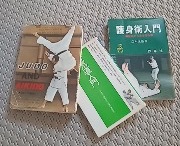
Kenji Tomiki wrote several books about Japanese martial arts. In his books he describes his view of Aikido as an integral part of Kodokan Judo. Especially in his earlier books he described the necessity of preserving the old Aiki-no-jutsu in a modern educational system.
His earlier work is less focused on the competitive format for which Tomiki’s Aikido is known worldwide. One of his early students is Senta Yamada, who introduced Aikido to the UK and also expressed Tomiki’s view of Aikido as a complement to Kodokan Judo.
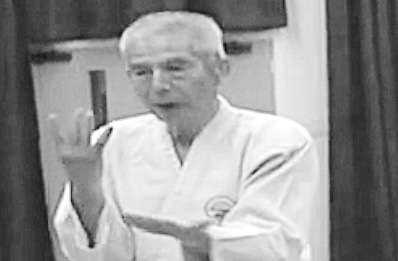
Senta Yamada came to the UK to teach judo between 1960 and 1965 and introduced Tomiki’s Aikido to some of his judo students. At the end of the 20th century he returned to the UK on several occasions and expressed the view of some benefit of Aikido Tanto randori.
Kenji Tomiki’s books are written in Japanese, with the exception of “Judo & Aikido”, a book published by the Japan Travel Bureau.
Here is a short summary of his early books on Aikido.
I have translated these books, but unfortunately there is still a copyright on his books. There is some discussion with the copyright holders to use some parts as an English translation as an educational tool.
Short summary of the books:
Both texts represent Tomiki’s pioneering effort to create a rational, systematic approach to martial arts training that preserves traditional techniques while making them accessible through modern educational methods. His work bridges the gap between Judo and Aikido, emphasizing their shared principles and complementary techniques.
Judo Taiso (1954)
This work introduces Tomiki’s innovative “Judo exercises” system, designed to:
- Systematize atemi-waza and kansetsu-waza (striking and joint techniques) that weren’t emphasized in competition-oriented Judo
- Create a structured training method accessible to a broader range of practitioners
- Establish a bridge between traditional Aikido techniques and modern Judo principles
- Develop solo and paired movements as foundational exercises for self-defense
- Provide comprehensive instruction on arm and wrist techniques for practical application
Aikido Nyumon (1958)
This introductory text presents Tomiki’s systematic approach to Aikido, emphasizing its relation to Judo principles. Key aspects include:
- Historical context positioning Aikido as an evolution of traditional Daito-ryu Aiki Jujutsu
- Philosophical framework integrating Aikido techniques into modern physical education
- Detailed explanation of fundamental principles: natural posture (shizentai), flexibility/yielding (ju), and balance breaking (kuzushi)
- Fifteen basic forms focusing on atemi-waza (striking techniques) and kansetsu-waza (joint techniques)
- Technical applications for both unarmed scenarios and defense against weapons
- Introduction of “rikaku” (distance) educational system for practicing techniques from a separated stance rather than grappling
 Study Group Tomiki Aikido