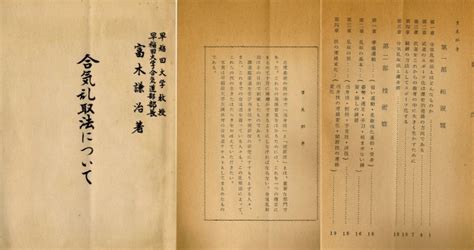
Kenji Tomiki was a prominent Japanese martial artist known for his contributions to both judo and aikido. He was also a pedagogue of martial arts theory, known as “Budoron” in Japanese. This term refers to the study and philosophy of martial arts, encompassing the principles, ethics, and educational methods associated with these disciplines.
Tomiki’s work in Budoron focused on integrating the philosophical and practical aspects of martial arts to create a comprehensive system of training and personal development. He believed in the importance of blending physical techniques with mental discipline and ethical considerations, reflecting the broader goals of budo, which emphasizes self-cultivation and personal growth through martial arts practice
Tomiki’s approach to Budoron influenced the development of Kyogi Aikido, which incorporates elements of both aikido and judo. This system emphasizes the importance of randori (free-style practice) and includes a competitive element, setting it apart from other aikido styles. Tomiki’s contributions to martial arts theory and practice continue to influence practitioners and educators in the field.
Budoron
This book is a collection of martial arts theories put together from the writings of Kenji Tomiki (1900-1979), who was totally devoted to the practice and research of martial arts from before to after the war, pouring his passion into martial arts education and developing outstanding martial arts theories.
His take on martial arts is both deep and wide-ranging, exploring the philosophy and practical use of Japanese martial arts. If you want to get his writing, you need to know about the key concepts of Japanese Budō.
Key Terminology Review
Budō (武道) and Bujutsu (武術)
In the Budoron texts, both terms are translated simply as “martial arts,” but it’s important to distinguish between them:
- Budō refers to the “martial way” with emphasis on personal development and spiritual cultivation
- Bujutsu refers to practical “martial techniques” focused on combat effectiveness
The text moves between discussing traditional martial skills (bujutsu) and their evolution into modern martial ways (budō). For instance, when discussing the historical development in the Edo period, the text is primarily referring to bujutsu, while the post-Meiji educational focus is more aligned with budō.
Kata (形) vs. Katachi (形)
The translation correctly conveys kata as prescribed training forms or patterns, but could more explicitly note that kata in martial arts refers to the structured sequence of movements that embody technical principles rather than merely external shapes.
Kyogi (競技)
The translation accurately renders kyogi as “competition,” but could emphasize that this specifically refers to the structured, rule-based competitive format that allows for the testing of skills in a controlled environment.
Wa (和)
The concept of wa (harmony) is central to the text and is properly translated. This concept represents not just peaceful coexistence but an active state of balanced interaction, particularly important in the martial arts context where it refers to achieving resolution without unnecessary conflict.
Buryoku (武力) vs. Bōryoku (暴力)
The distinction between these terms is well-translated:
- Buryoku (military/martial power) is controlled force with proper rules
- Bōryoku (violence) is uncontrolled, rule-less force
This distinction forms a central argument in the text about the ethical core of martial arts.
Randori (乱取り)
While mentioned in the text, randori could be more explicitly defined as “free practice” or “free sparring” – a training method that allows practitioners to apply techniques in more dynamic, unscripted situations than kata practice permits. The author mentions randori as a crucial innovation in judo that allows for testing techniques without the mortal danger of older “matches.”
Content Accuracy
The translation effectively captures the author’s key arguments:
- The historical evolution from battlefield techniques to self-defense arts and finally to educational disciplines
- The ethical progression from combat effectiveness to spiritual cultivation
- The balanced approach that values both competitive practice (kyogi) and formal patterns (kata)
- The central distinction between controlled martial power (buryoku) and unrestrained violence (bōryoku)
- The concept of “the way” (道/michi) as the integration of technique and spiritual development
Overall, the translation accurately conveys both the technical terminology and the philosophical depth of the original text, emphasizing the author’s argument that Japanese martial arts represent a unique cultural heritage that balances practical effectiveness with ethical and spiritual development. The key contribution of the text is its explanation of how traditional martial arts can be modernized through competition while preserving their essential characteristics through continued kata practice.
Understanding Randori and Kyogi in Japanese Martial Arts
Randori (乱取り)
Randori literally means “chaos taking” or “free seizing” and represents a fundamental training method in several Japanese martial arts, particularly judo and aikido.
Key Characteristics of Randori:
- Unscripted Practice: Unlike kata (predetermined forms), randori involves spontaneous, dynamic interaction between practitioners.
- Controlled Resistance: Partners provide genuine resistance, but within parameters that maintain safety while allowing techniques to be applied with realistic effort.
- Learning Application: Randori bridges the gap between kata (theory) and actual combat by teaching practitioners how to apply techniques against an actively resisting opponent.
- Development Focus: It develops timing, reflexes, adaptability, and situational awareness that cannot be cultivated through kata alone.
- Safety Framework: Unlike historical duels or challenges, randori provides a framework for testing techniques without mortal danger.
As Kenji Tomiki explains in his texts, randori was a crucial innovation in martial arts pedagogy. In traditional martial schools, practitioners would learn through kata but then might immediately test their skills in potentially lethal duels or challenges. Randori created an intermediate practice space where techniques could be tested against resistance without the life-threatening consequences.
In judo, Jigoro Kano systematized randori as a core training method, allowing practitioners to develop and test throwing and grappling skills through free practice. Tomiki later applied similar principles to aikido, developing a randori system for practicing aikido techniques safely against resistance.
Kyogi (競技)
Kyogi means “competition” or “sport” and refers to the structured, rule-governed competitive format of martial arts.
Key Characteristics of Kyogi:
- Formalized Rules: Clear regulations that define permissible techniques, scoring methods, and victory conditions.
- Safety Considerations: Restrictions on dangerous techniques to prevent injury while maintaining the essence of the art.
- Objective Evaluation: Provides a framework for measuring skill development and technical proficiency.
- Educational Purpose: Transforms the “place of victory” into a “place of education” where practitioners can develop moral qualities like fairness, respect, and self-control.
- Cultural Adaptation: Represents the adaptation of martial arts to modern educational values and social contexts.
Tomiki viewed kyogi as essential for modernizing martial arts, particularly for:
- Making techniques objectively testable
- Developing practitioners’ ability to perform under pressure
- Creating a framework for martial arts as physical education
- Preserving the martial arts’ educational value in a democratic society
The Relationship Between Randori and Kyogi
While closely related, randori and kyogi serve different functions:
- Randori is a training method focused on learning through free practice
- Kyogi is a competitive format focused on testing skills in a formalized environment
In Tomiki’s vision, both elements are necessary for complete martial arts education:
- Kata provides the theoretical foundation and preserves comprehensive technical principles
- Randori develops application skills through free practice
- Kyogi tests these skills in a structured competitive format
Tomiki’s significant contribution was recognizing that neither approach alone was sufficient. Traditional schools that focused solely on kata risked developing techniques that couldn’t be applied against resistance (what he calls “flower-style swordsmanship”). Conversely, focusing only on competition risked losing the comprehensive technical curriculum and deeper principles preserved in traditional forms.
By integrating both approaches—competition-based training for dynamic application and kata-based training for comprehensive technical study—Tomiki sought to preserve what he saw as the essence of Japanese martial arts while adapting them to modern educational contexts.
 Study Group Tomiki Aikido