written and/or compiled by Eddy Wolput °1948 – 7th dan Aikido (JAA-Tokyo/Japan) – 5th dan Iaido – 5th dan Jodo. Part of the material in this article is not directly linked to the Japan Aikido Association (NPO) program or Shodokan approach. Other concepts are incorporated into the study of the subject presented.
The use of excessive power is always a concern when practicing ‘randori’. Although we stress the importance of softness during practice, sometimes it is necessary to use all your human resources, including muscular strength.
Effective use of controlling techniques requires a solid grip. Your opponent will overpower you during randori practice if your grasping method lacks the strength to keep your grasp solid. A grip that is strong must also have the ability to be flexible. Your techniques will become static and tension-filled if you lack movement skill.
The skill of ‘ju-and-go’ is to balance power and flexibility.
Basic Grip
Exercise to create a solid grip
To create a solid grip, we use a set of two sticks (tanjo, jo or bo). A solid grip is necessary to keep the two sticks together. Without a strong grip, the two sticks will move freely and there won’t be any transfer to your training partner. A solid grip and movement is based upon 2 basic methods:
Inside rotation of the arm
Outside rotation of the arm
The use of a solid grip
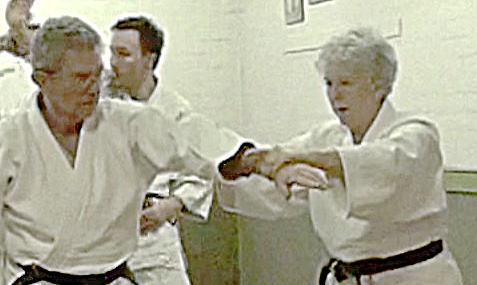
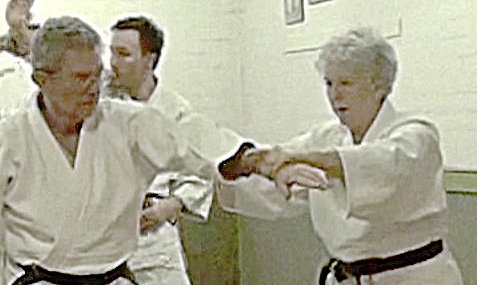
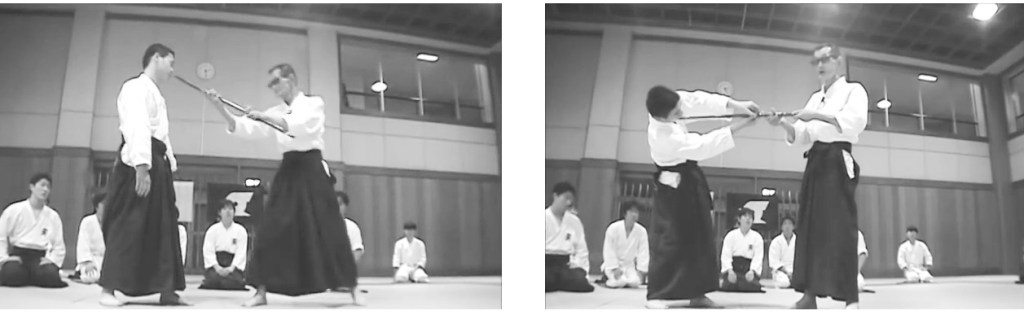
Developing a basic grasping method by using a solid grip. Different ways of grasping the wrist and hand to control the opponent’s arm. Three fingers (middle, ring and little finger) are grasping the hand. Index and thumb are holding the wrist.
Solid grip and stretching or bending the arm
A basic grip on the wrist can be used for various applications. By understanding the fundamentals of a simple controlling technique, one can gain a better understanding of the complexity of the old Aikido techniques (Koryu no kata).
Timing – Hand-Body-Foot
Timing is crucial for controlling the distance between you and your opponent. Your actions can be more powerful and efficient by controlling the distance. To get a solid grip on your opponent, it’s crucial to have the correct distance. Your actions will become more effective if your distance control is more precise. Your opponent will block or evade your hand action when you start with your foot. Before making any attempts with it, make sure to establish the distance before starting with the hand. At the appropriate distance, use offensive movements like thrusting, striking, or solid grasping techniques. The best timing is when your hand touches the opponent and you don’t have to step. When you reach the target with your hand, utilize the body and power from your feet without taking a step. When using your front foot to step towards the target, the time it takes to use your power will be much longer. This is a weakness in your strategy, but your actions can still be efficient. Using both feet to step to touch the target takes a significant amount of time, and your opponent can exploit this weakness in your strategy. A clever strategy can still give you a chance to win the confrontation.
Power is always absent when touching the target with the hand. The only way to use power after touching the target is by standing correctly.
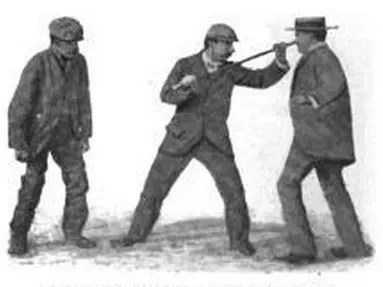
Historically, the majority of bladed weapons were used for military or police interventions. Of course, those who like to walk on the wild side are also using bladed weapons. While bladed weapons are not allowed to be carried by civilians in most countries, they can carry a walking stick and use it as a weapon if needed.
The Western walking stick or cane became a popular item in Japan at the beginning of the 20th century. Some martial art experts transferred the Western method of using the self-defence “Cane” into a Japanese style of martial art method called “sutekki-jutsu” or “tanjo-jutsu”. The length of a “cane” or “tanjo” is about 3 shaku and the diameter is about 10 bu. Shaku, sun, and bu are traditional Japanese measures of length, with a shaku measuring approximately one foot. One shaku equals ten suns, and one sun equals ten bu. One bu is equivalent to 3.03022 mm. Today, the shaku-sun-bu unit system is almost exclusively used for old-fashioned measurements such as measuring the length of swords and other traditional weapons, such as the roku-shaku bo.
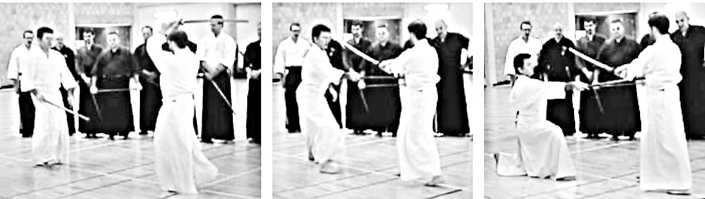
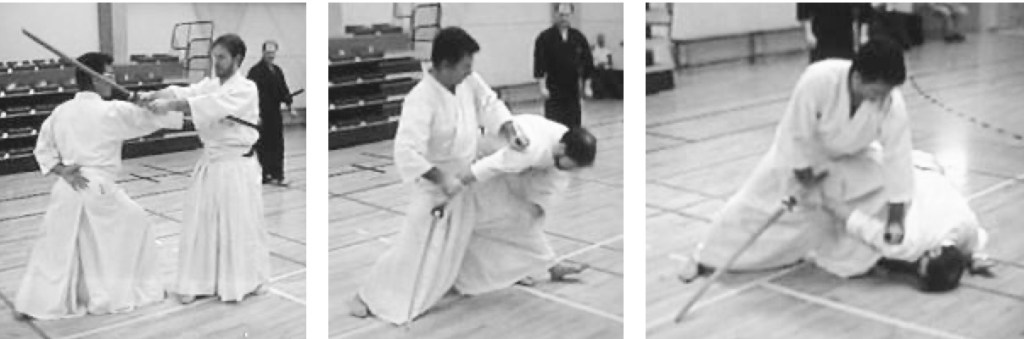
Shindo Muso Ryu Jo-jutsu, one of the Japanese traditional Jo or staff schools contains a kata or sequence with a walking stick length weapon: Uchida Ryu Tanjo Jutsu
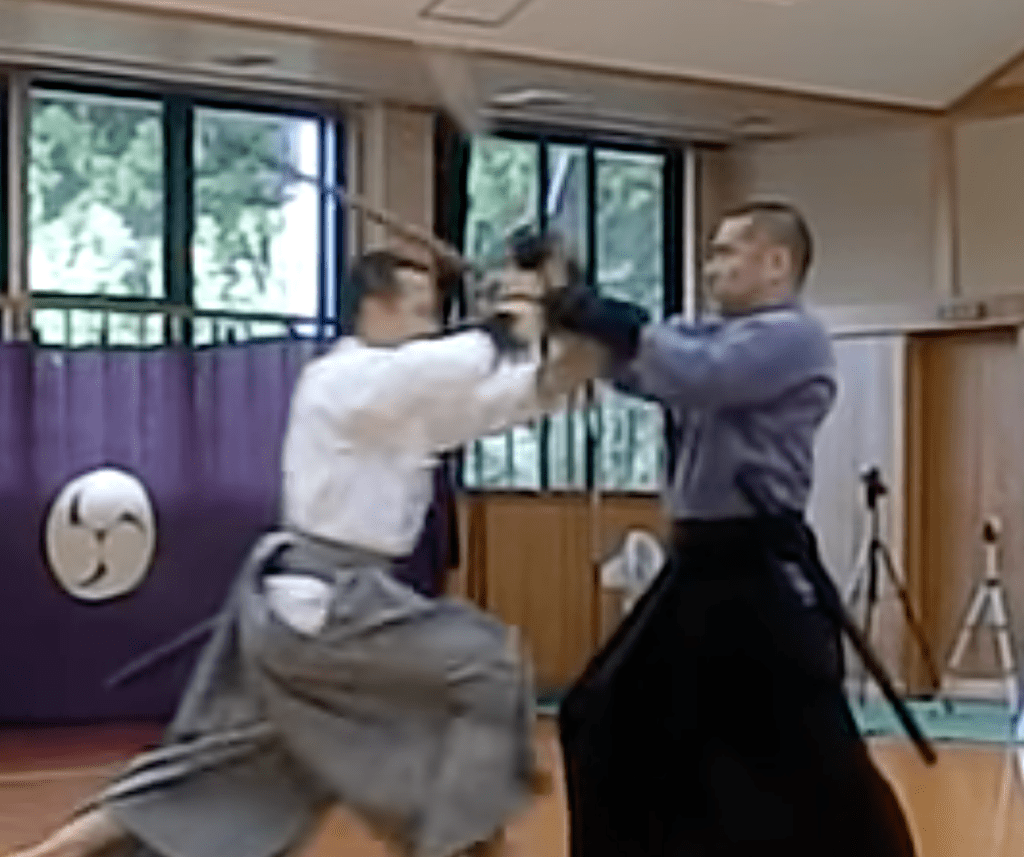
The picture above clearly shows a technique commonly used in Aikido. Of course, the question arises whether we can incorporate the “Shindo Muso Ryu Tanjo-jutsu” kata into our Aikido training. The Tanjo-jutsu kata is basically a formalized training sequence based on the use of the ‘Jo’, a 4-shaku, 2-sun (about 128cm) staff against a swordsman. Jodo is a specialized martial art that requires many years of training to become proficient in the use of the Jo and other weapons like the tanjo.
Introducing “suteki” into Aikido
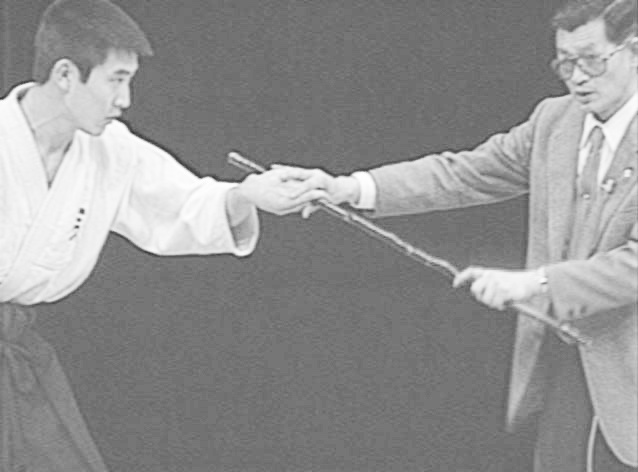
There has been a few efforts to incorporate suteki, tanjo, or walking sticks into the practice of Aikido. One of the AikiKai teachers who uses a walking stick as a training tool is Kurowai Yoshio.
Kuroiwa Yoshio was a unique figure within the Aikikai. Although one of the senior postwar shihan, he refused rank past sixth dan. In fact, he simply refused rank all the way up the ladder until Ueshiba Kisshomaru (Nidai Doshu) personally requested that he accept a sixth dan, because dispatching him to teach in dojos without any rank was getting embarrassing. Kuroiwa was provocative, almost rebellious, but he remained within the organization — functioning at times like a grain of sand underneath an otherwise smooth mantle, but otherwise, largely ignored. He was technically original, with an utterly unique style of movement. Had he been a different man, and perhaps, if his health had been better, he could have started his own aikido group independently, like Shioda or Tomiki. Instead, he remained within the fold – but just barely.
In Memory of Kuroiwa Yoshio — 1932- 2010 by Ellis Amdur
The “stick” in Kuroiwa’s method has 2 main applications:
using the stick as an attacking tool in combination with “atemi” based upon boxing theory
using the stick to explain “basic techniques”, fundamentally the stick is used to visualise the traject of the movement.
Tambo or short stick
Another type of stick that can be used during Aikido training is the Tambo. The length of the ‘Tambo’ is 1 shaku 2 sun, approximately 37 cm, and is of course too short to use as a walking stick.
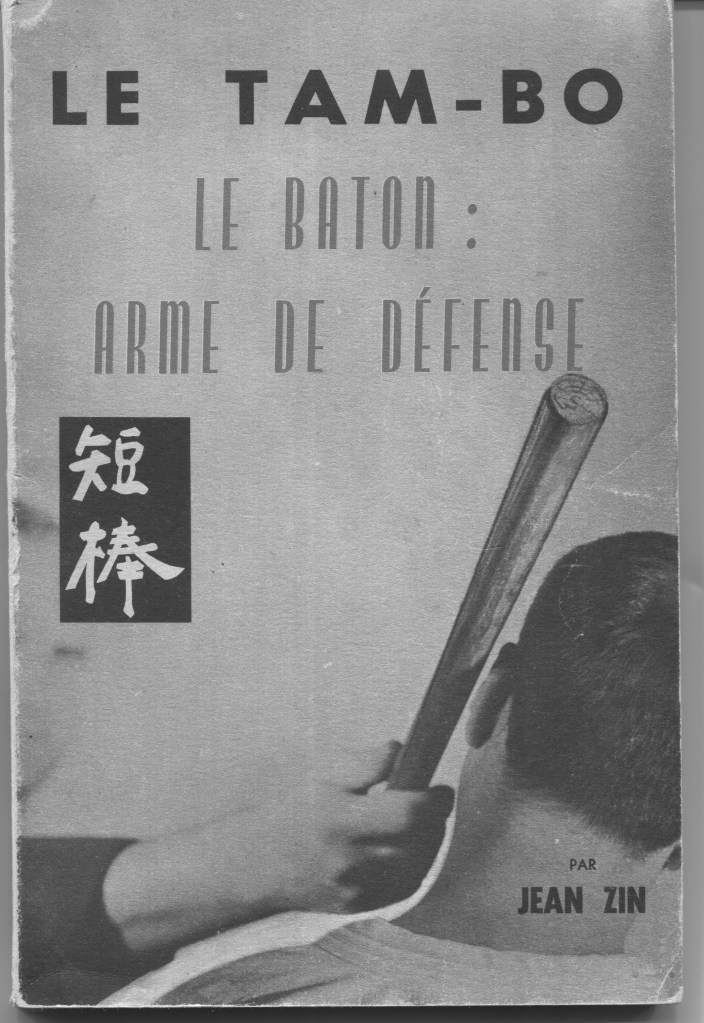
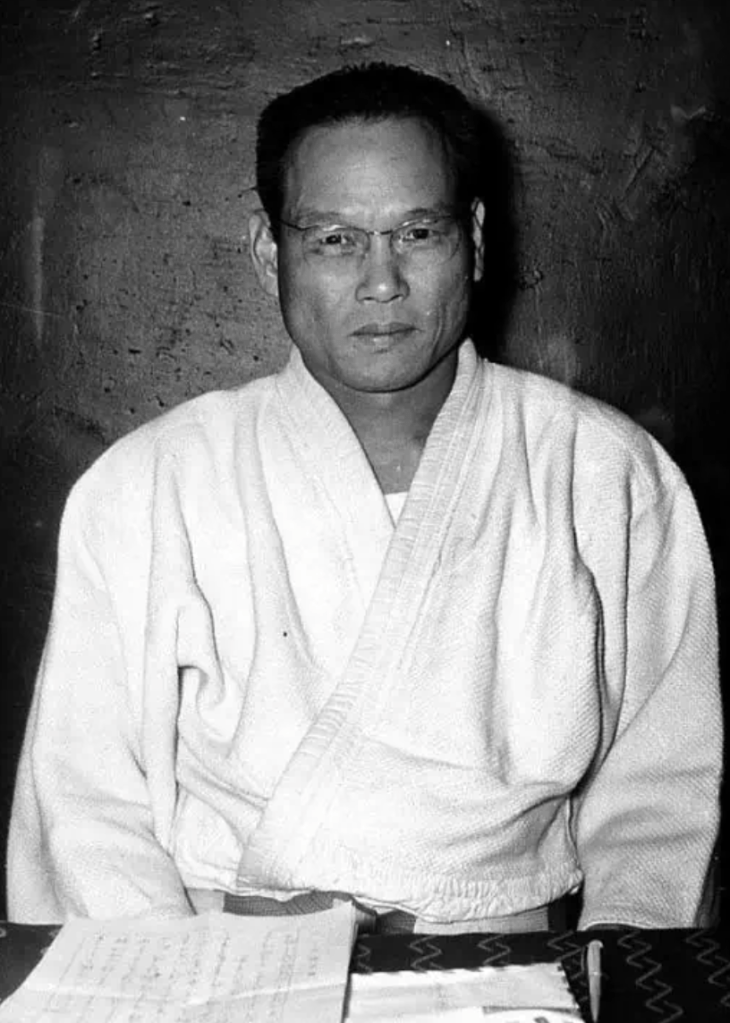
Jean Zin’s study with Tadashi Abe, known as a pioneer of Aikido in France, resulted in his writing two books about using a tambo.
Tadashi Abe
Name
Dimension (Jap)
Dimension (Eur)
Equivalent (bladed) weapon (Eur)
Hassaku-bo
8 shaku
±240cm
Spear
Rokushaku-bo
6 shaku
±180cm
Halberd (axe)
Jo
4 shaku 2 sun
±128cm
Saber sword
Ham-bo/Tan-jo
3 shaku
±95cm
Saber/Canne
Tam-bo/Tant-to
1 shaku 2 sun or more
±37cm/±45cm
Dagger
The wrist movement
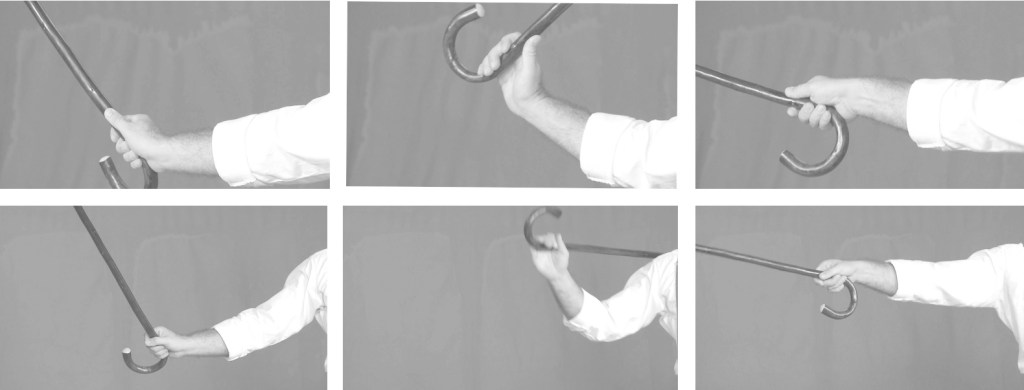
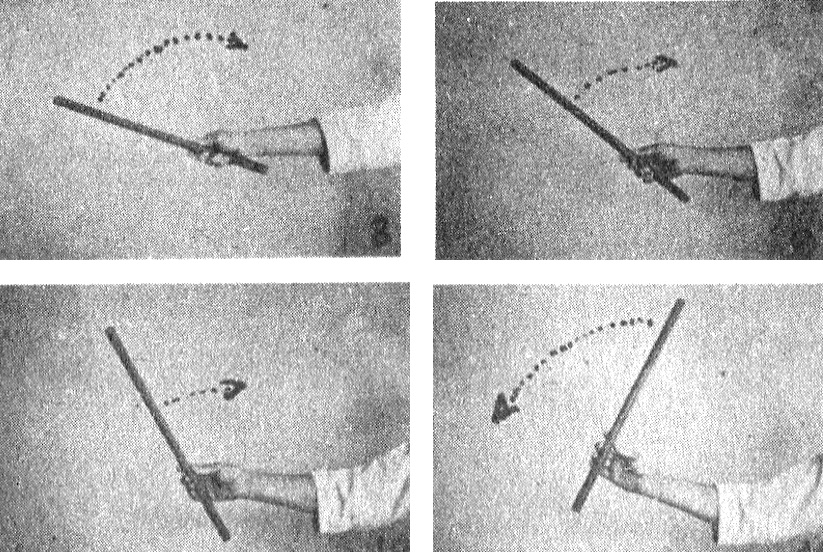
Using a stick with wrist movements requires the correct grip. When the thumb is on top of the stick, it serves as a support for wrist movement. The wrist movement is more initiated by squeezing the 3 fingers (little finger, ring, and middle finger) when the thumb is folded. Usually, the thumb will be held in a folded position.
Manipulation of a tambo is almost the same as using a tanjo and a walking stick.
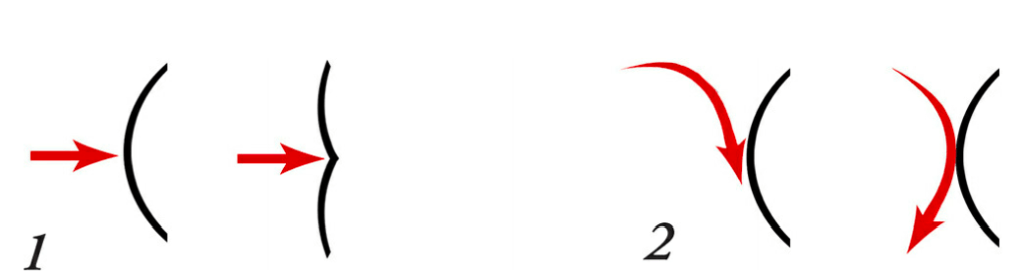
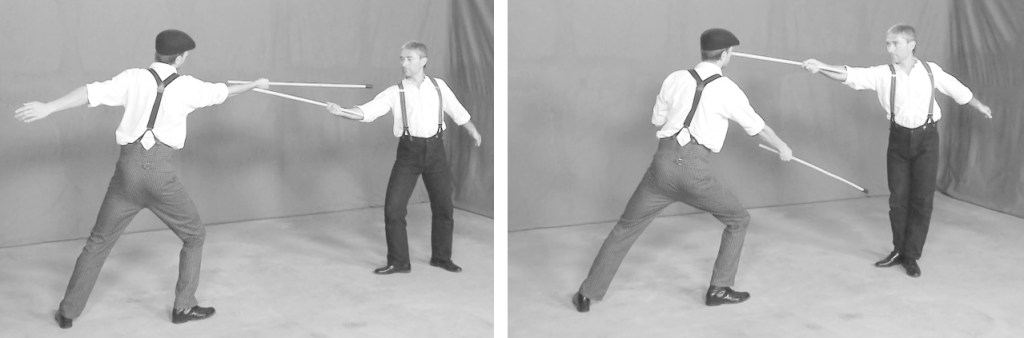
In order to impart the most kinetic energy into the target, you have to hit at a right angle (1). Anything else, the energy will dissipate in different directions.
As usual, every action has 2 sides. When you want to deflect an incoming force with your stick, you must change the angle, there will be a lesser impact (2). The kinetic energy of the attack can be used when you strike or stab the opponent.
Range of efficiency with “suteki”
The range of efficiency is similar to the kind of ranges used in traditional Japanese martial arts The efficiency range is comparable to those used in traditional Japanese martial arts, particularly sword fighting. Generally speaking, there are three levels of fighting distance: toma, issoku-itto, chikama.
Toma is the far distance when one’s sword is not touching the opponent’s sword in any way.
Issoku-itto is the distance from which one can strike correctly with a single large step.
Chikama is the close distance when the swords are crossed near, but not at, the tsuba.
In reality there is a fourth distance. Tsubazeriai is the extreme close distance when the tsubas are pressed together. You can compare it with clinching in boxing.
Offensive and defensive footwork
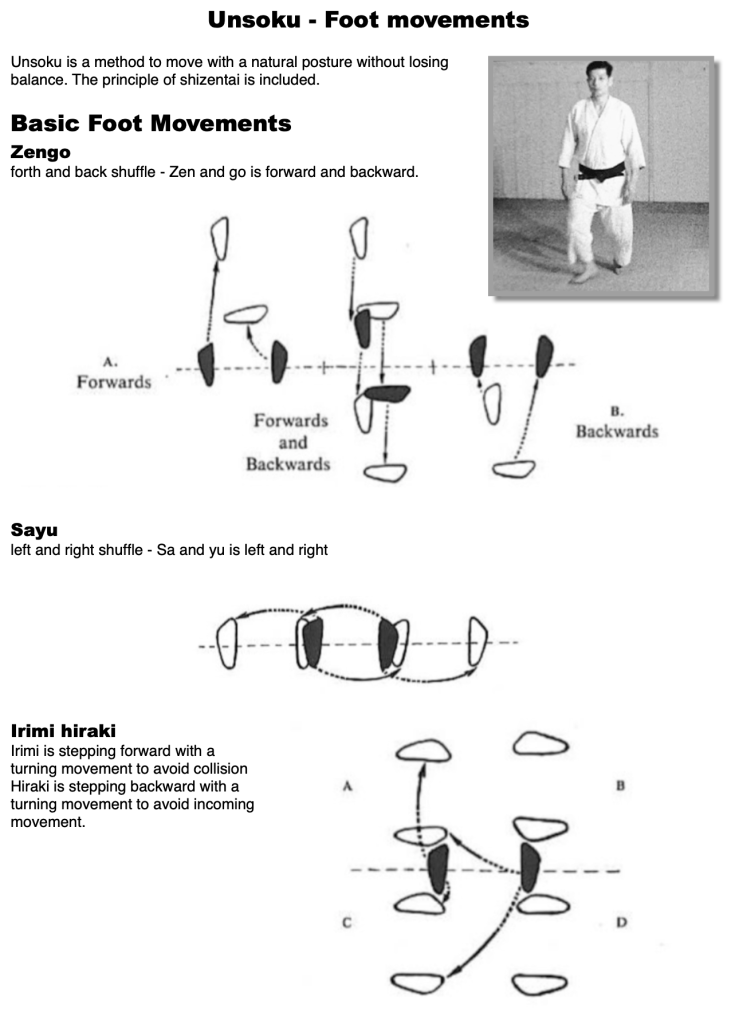
Footwork is an important element in training to optimize the efficiency of techniques. Offensive footwork is mostly done when stepping forward towards the opponent and using an offensive technique, such as striking or stabbing with a stick. To avoid an incoming attack, defensive footwork is usually done by stepping back with one or both feet. Defensive footwork can be used to practice different types of blocking with a stick. But certainly, defensive footwork can be used to us offensive striking or stabbing. These are just some basic formats, of course. Various formats can be explored during the training.
The footwork can be practiced using an isolated method. Tomiki’s basic footwork pattern demonstrates both offensive and defensive footwork.
Striking and stabbing
A stick can be used to perform basic arm and hand movements. Tomiki’s Tegatana Dosa is a training method that can be applied with a stick or other weapon.
Shomen uchi – vertical striking with the weapon
Shomen tsuki – stabbing with the weapon
Uchi mawashi – circular inside striking
Soto mawashi – circular outside striking
Uchi gaeshi – circular inside blocking
Soto gaeshi – circular outside blocking
These movements can be practiced in a variety of formats. Here is a sample.
Partner training
This type of training can be done after someone has sufficient skill in manipulating a stick. Different types of training can be used depending on the goal you want to achieve with such training.
Using a ‘chambara’ stick is an ideal method for practicing without the danger of inflicting an injury on the opponent.
“If you wish to see the truth then hold no opinions for or against anything. To set up what you like against what you dislike is the disease of the mind. Do not search for the truth; only cease to cherish opinions.
When the mind exists undisturbed in the Way, nothing in the world can offend, and when a thing can no longer offend, it ceases to exist in the old way.”
~Seng Tsan, Third Patriarch of Zen Hsin Hsin Ming 信心銘 – Verses of Faith in Mind
There is certainly something positive about lockdown during the Corona-COVID-19 pandemic. Our life has changed completely, especially our time schedule is different. If you are a martial art instructor, during lock down the dojo is closed and the contact with the students or practitioners is reduced to online meetings or occasional meetup outside the dojo. As an instructor, you get more time for yourself and study concepts beyond basic and advanced training.
There are several stories of people who have been isolated for quite a while. They developed a method to practice their martial art. For instance, Kenji Tomiki was imprisoned after the war for a few years and created solo exercises from his experiences with several martial arts experts. These solo exercises formed the nucleus of an Aikido method focused on basic movements and techniques applicable in randori.
The result of investing time in personal training
If you do “personal training” as an instructor without students due Corona problems, the result of investing time can be very different from the thoughts you had when you embarked on your martial art journey. Your mind and body are not the same as a few years ago when you were a beginner.
One must accept that “change” is an all-pervasive concept in one’s life. Cultivating “curiosity” cannot be neglected in your training. Looking beyond all you have learned is a skill that should be cherished to the fullest.
Beyond existing methods
From a scientific standpoint, the research process basically follows a certain pattern.
The research process consists of eight steps: choosing a topic, studying the literature, developing theoretical and conceptual frameworks, formulating the research question, research design, data collection, data analysis and drawing conclusions.
In martial art, the process of research as part of our training follows also a certain pattern. But we are in a situation (pandemic) comparable to that of Tomiki during his time of imprisonment. Of course, we have more options because we can search the digital world for information, but the situation of not having training opportunities is the same. Some of us don’t even have a training partner.
Topic of research
Two topics may serve as an example to other research.
Physical and fitness training
Martial art movements
The question is whether to choose scientifically proven methods or methods based on mystic beliefs without any scientific proof. In this blog about martial arts training, some methods are discussed with respect to physical training, but also to a more metaphysical type of exercises primarily based on Japanese and Chinese methods with backgrounds in Taoism, Zen-Buddhism and similar philosophical ways of thinking.
The following methods are up-to-date, scientifically studied and the effects of these exercises may be repeated in a scientifically approved situation. The research process serves to formulate a conclusion, with physical and mental exercises resulting from the research.
Especially competitive martial sport is extensively researched for better performance. Scientifically tools are used to increase efficiency power and or speed. The Kodokan Judo Institute has published since 1958 a scientific report on Kodokan Judo on a regular base. The 1969 report has an item written by Kenji Tomiki.
An extract of 1969 report
Zhangzuang or Ritsuzen ( standing exercises) are a kind of exercises researched in hospitals with qualified personnel.
Some of the health-exercises like Qigong or Kiko can be executed on different levels from a pure physical point of view to a more metaphysical or a combination of physical and metaphysical. You can find many scientific studies on the internet. These studies are executed under scientifically rules and the results are published in academic magazines for professional metal health and physical body workers.
There is also a crossover concept using martial art movements useful as physical and fitness training. Plenty of examples can be found in modern fitness methods linked with popular music.
The “traditional” dilemma
When you enter the world of martial arts, you will see mane different views on how martial art has to be practised. As martial arts have always a flavour of conservatism and some of the practitioners are trapped into a “traditional” dilemma.
The question is about understanding the traditional elements in a martial art. Most martial arts have some traditional culture as a part of their training. Some “traditional” elements have no meaning in our Western way of thinking and are practised just as a kind of mannerism, doing something without knowing the origin and meaning of the action or movement. Trying to understand the traditional elements with an open mind is not easy, and sometimes there is a tendency to dogmatism in your martial art.
Removing traditional elements of a martial art need a deep understanding of the traditional culture. On the other hand, some instructors are adding cultural elements with or without understanding the content. Removing and adding elements with understanding sometimes creates a “new” martial art or sport with of without cultural value. The choice is up to you.
Understanding the technical syllabus
As a high level instructor we can choose to research the existing methods of our founders with the tools based upon scientifically proven methods. Of course, there are metaphysical or psychological elements which are difficult to measure with our tools. Take for example the concept of “sen” or “hyoshi“, as explained by Miyamoto Musashi.
The barrier between science and pseudoscience is not clearly defined and can create problems when we seek for the Truth.
The “Truth” dilemma
This post started with a quote by Seng Tsan, Third Patriarch of Zen (Hsin Hsin Ming 信心銘 – Verses of Faith in Mind).
I believe most practitioners are not looking for the “Truth”, but they found a method for practising a martial art. If they never have a confrontation, mentally or physically, there is no need to find the “Truth”, because they found the truth in their method. Unfortunately, some of the practitioners became “True Believers” and are not open for the “Truth”. During a confrontation, maybe they will win, maybe they will lose.
“The True Believers” – The critically acclaimed true story about the human cost of hero worship in martial arts. The term “True Believers” is inspired by a book by Eric Hoffer.
Eric Hoffer (July 15, 1902 – May 21, 1983) was an American moral and social philosopher. He was the author of ten books and was awarded the Presidential Medal of Freedom in February 1983. His first book, The True Believer (1951), was widely recognized as a classic, receiving critical acclaim from both scholars and laymen. (Wikipedia)
Finding your Way
Again, finding the “Truth” is letting go all pro- and contra- opinions. Martial Art is not a cult, but it is a tool to become aware of the world around you and inside you. Dogmatism will disturb your progression, on the other side, if you are happy………


 Study Group Tomiki Aikido