Koryu no kata – Dai Yon (2)

There are different opinions on the meaning of ura-waza.

  • reverse or counter technique, also called kaeshi-waza.
  • alternative performance of kuzushi with application
  • ……….

7-hon no kuzushi ura-waza

In Koryu no kata Dai Yon, the 2nd section is called Ura-waza. This section is build upon the omote-waza discussed in a previous article.
The start of the 7 waza are the 7-hon no kuzushi without the throw of the omote-waza, followed by an alternative action. Some of these actions are applications for randori (restricted free fight) or goshinho waza (aiki self-defence). The “kuzushi” element is a prime factor for a non-muscular approach.

Non- muscular actions

Movement is based upon muscular actions. When we say “non-muscular action”, we are talking about extending muscular actions, and not flexing muscular actions.
For a technical explanation see Encyclopedia Britannica.

Pulling and pushing are 2 different movements, but from a non-muscular point of view both are using an extensor action. Basically all “kuzushi” movements are based upon the non-muscular concept. The moment when we use a flexor action, opponent will intercept and can do a counter movement.

All non-muscular actions in koryu no kata dai yon are movements away from the centre to the outside.

Jodan aigamae & gyakugamae


Chudan aigamae & gyakugamae


Gedan aigamae & gyakugamae


Ushiro

Koryu no kata – Dai Yon (1)

A main component of Dai Yon is the (un)famous 7-hon no kuzushi. The 1st part of the Dai-Yon is about throwing an opponent after acquiring a perfect “kuzushi”. This possibility in a fighting situation will be very rare….although it can happen if…..

Koryu no kata Dai  Yon

  • Nage no kata – omote waza – 7 waza
  • Nage no kata – ura waza – 7 waza
  • Oyo waza* – applications – 11 waza

*Oyo waza designates applications build upon 7-hon no kuzushi basics. 

Nage no kata – omote waza

The 1st part of the kata is build upon the 7-hon no kuzushi. A throwing action is added after the kuzushi.
The focus is on the action of the hand and arm doing the kuzushi. The efficiency of the throw is depending on the elasticity of Tori’s body. When the body is stretched power is stored and can be released into uke’s body.
The dynamics of the kuzushi (loss of balance) will undergo the influence of gravity.
There is a mechanism we have to take in account when we use stretching and release.
With the muscular relaxation, the movement is immediate, in a single time, this movement is much faster than with the muscular system of contraction. If we try to throw with muscular contraction, opponent will sense your intention and will block your movement.
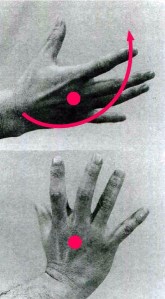
Using meguri and tenshi-kei is necessary to create efficient kuzushi.

aiki age sage009Jodan aigamae & Jodan gyakugamae

Kuzushi is created by using a rotational movement of the hand, followed by a body movement with the elbow as a transfer joint.
When you try to lift the hand and arm, Uke will feel and block your movement.
Jodan aigamae & gyakugamae are actions on the inside of Uke’s arm.


Chudan aigamae & Chudan gyakugamae

Kuzushi is created by using a rotational movement of the hand, followed by a body movement with the elbow as a transfer joint.
The skill is to turn opponent’s arm in hineri fashion without stretching opponent’s arm. Rotating the arm is the message.
Chudan aigamae & gyakugamae are actions on the outside of Uke’s arm.


Gedan aigamae & Gedan gyakugamae

Using downward power. No pulling action.


Ushiro

Keep centerline when rotating.


Ura-waza see in another article soon