written and/or compiled by Eddy Wolput °1948 – 7th dan Aikido (JAA-Tokyo/Japan) – 5th dan Iaido – 5th dan Jodo. Part of the material in this article is not directly linked to the Japan Aikido Association (NPO) program or Shodokan approach. Other concepts are incorporated into the study of the subject presented.
The use of excessive power is always a concern when practicing ‘randori’. Although we stress the importance of softness during practice, sometimes it is necessary to use all your human resources, including muscular strength.
Effective use of controlling techniques requires a solid grip. Your opponent will overpower you during randori practice if your grasping method lacks the strength to keep your grasp solid. A grip that is strong must also have the ability to be flexible. Your techniques will become static and tension-filled if you lack movement skill.
The skill of ‘ju-and-go’ is to balance power and flexibility.
Basic Grip
Exercise to create a solid grip
To create a solid grip, we use a set of two sticks (tanjo, jo or bo). A solid grip is necessary to keep the two sticks together. Without a strong grip, the two sticks will move freely and there won’t be any transfer to your training partner. A solid grip and movement is based upon 2 basic methods:
Inside rotation of the arm
Outside rotation of the arm
The use of a solid grip
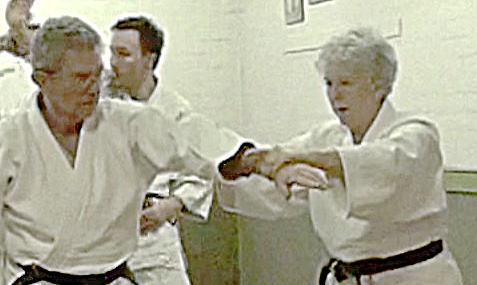
Developing a basic grasping method by using a solid grip. Different ways of grasping the wrist and hand to control the opponent’s arm. Three fingers (middle, ring and little finger) are grasping the hand. Index and thumb are holding the wrist.
Solid grip and stretching or bending the arm
A basic grip on the wrist can be used for various applications. By understanding the fundamentals of a simple controlling technique, one can gain a better understanding of the complexity of the old Aikido techniques (Koryu no kata).
Timing – Hand-Body-Foot
Timing is crucial for controlling the distance between you and your opponent. Your actions can be more powerful and efficient by controlling the distance. To get a solid grip on your opponent, it’s crucial to have the correct distance. Your actions will become more effective if your distance control is more precise. Your opponent will block or evade your hand action when you start with your foot. Before making any attempts with it, make sure to establish the distance before starting with the hand. At the appropriate distance, use offensive movements like thrusting, striking, or solid grasping techniques. The best timing is when your hand touches the opponent and you don’t have to step. When you reach the target with your hand, utilize the body and power from your feet without taking a step. When using your front foot to step towards the target, the time it takes to use your power will be much longer. This is a weakness in your strategy, but your actions can still be efficient. Using both feet to step to touch the target takes a significant amount of time, and your opponent can exploit this weakness in your strategy. A clever strategy can still give you a chance to win the confrontation.
Power is always absent when touching the target with the hand. The only way to use power after touching the target is by standing correctly.
Fast movements can conceal flaws and mistakes can slip by. One does not do the movements slowly for the sake of doing them slowly, and it is most certainly untrue that the slower it is done, the better. There has to be a purpose for doing them slowly; there has to be “substantially” to those movements or progress will not come. It is about “Ishiki”
Ishiki 意識
Ishiki has 2 kanji, 意 = I, and 識 = shiki. “Shiki” means identification, it is the act of recognizing someone or something. “I” means intent, it is the determination to do something.
Why slow movements?
Posture and Health
Slow movements help you with the help of intentional thinking (Ishiki= 意識) to raise awareness of your posture. This will allow your posture to be adjusted to make the body function better and improve energy efficiency.
Slow movements with the whole body will affect and help the micro-circulation in the capillaries. It goes much deeper than fast movements.
Mindfulness training
Martial arts in Japan refer to a variety of physical and mental practices developed based on historical combat techniques. Nowadays, martial arts are considered not only as sports and/or fighting methods, but also as activities aimed at obtaining a unity between mind and body.
Aikido is a Japanese martial art that includes multiple components, such as musculoskeletal training and improvement of both interoceptive and exteroceptive consciousness.
Aikido and related styles include practices (randori – sparring) that are considered elements similar to those of sport, although these practices (randori – sparring) are not aimed at winning the competitions as typical sports do.
Aikido essentially emphasizes the importance of paying attention to one’s own breath and body, and the awareness of both internal and external environments.
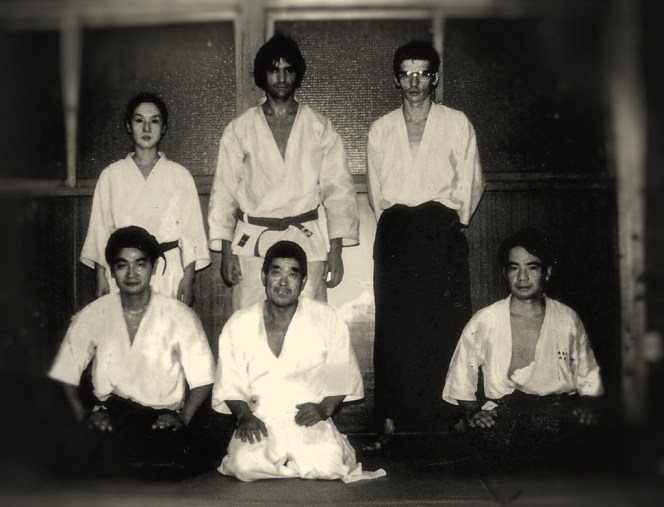
In 1976, I stayed for several weeks in Shizuoka Japan and practised mostly Korindo Ryu Aikido with Hakamatsu sensei, a Shihan of Minoru Hirai Korindo Ryu. I didn’t really understood very well the principles and concepts of this martial art. But I made a lot of notes in my martial art diary. From time to time I am re-reading my notes and I discovered some secrets which I didn’t understood very well in that time.
The ideas and concepts taught to me in 1976 by Hakamatsu sensei are not opposing the ideas and concepts of Kenji Tomiki sensei and Hideo Ohba sensei. I was thaught by Hideo Ohba in Okubo Tokyo a few years later and I didn’t realize the similarities at that time.
It was a shocking idea to discover the concept of “Matrix* Budō “. One of the most important principles is to apply a single set of basic forms of exercise, which contains all vital movement elements, to all types of combat. These forms are contained in the developed taisabaki (tandoku undo). This taisabaki is the basis of all forms of movement, from which all techniques arise. A botai-budō or matrix-budō.
This concept was in the mind of Kenji Tomiki, when he was rationalizing Ueshiba’s Aikido. He formulated unsoku-ho and tandoku undo, containing the basic information for further development of the practitioner. Together with some other fundamental principles, a unique system is created which included kata and randori.
*Matrix = Botai (母体) = whomb, uterus
Don’t become fixed on techniques. Create your own waza.
Matrix
Matrix: an environment or material in which something develops; a surrounding medium or structure.
Matrix Budō
Minoru Hirai was the founder of Kōrindō Aikidō, a martial art based upon older forms of Jujutsu, Kenjutsu and other Japanese martial arts. He was also during World War II a director of Kobukan, Morihei Ueshiba organisation. Minoru Hirai introduced the word aikido as a generic term for Japanese martial arts not associated with Judo or Kendo. Basically it can be said, aikido is a term to define martial arts auround the “aiki” principle. (see also Minoru Hirai Korindo Aikido). As usual, the information on Wikipedia is based sometimes upon the view of one person or group and can be controversial for other persons.
Hirai’s martial art developed over time into what he calls “Matrix Budō “, which is not based on a multitude of different techniques, but is based on a single principle practised during taisabaki movements:
The harmoniously round circle (enten) and ball rotation (kyūten) expressed by koshi-mawari in a number of forms of movement called taisabaki.
Koshi-mawari taisabaki serve as the basis in order to acquire efficient natural movement.
From koshi-mawaritaisabaki, you develop a natural, rotating-flowing movement mode. Out of this, techniques are created unintentionally and adapted to the constantly changing situation, with which the attacker can be controlled and thrown because one does not oppose the attacking force. In order to acquire the movement of koshi-mawaritaisabaki the following forms of exercise are practiced in training:
7 or 8 forms of movement (taisabaki), which are initially trained individually, then in combination, and finally with a partner;
Partner forms to deepen the correct posture and the approach of every movement;
Randori means free attack and free movements in order to spontaneously realize the principle of koshi-mawari.
The principle of giving movements a circular, flowing, non-okori course. The circular movements can be thought of as horizontal and vertical rotations.
Okori: The approach or initial impetus that usually initiates a movement. As a result, an attack usually reveals itself at the moment it arises. This happens often when attacker lauch a strike by stamping his back leg into the ground to create momentum or using a stamping front leg to give more power in the (tanto)strike. This can be avoided by using ashi no korobi or rolling feet or using a short tsugi-ashi after adjusting ma-ai.
Kyūten
球転 Ball rolling, ball rotation
In Chinese martial arts, the concept of Dantian and Chan Si Gong (silk reeling exercises) is related to kyūten and tenshi & tenshikei (discussed earlier).
from: Narita Shinjūrō – Kōrindō Aikidō
The ball rotation is perfectly round at all times. It has no corners or edges. Thanks to the rotations of the ball with this form of movement, continuous changes in direction are always possible. One could also describe the rotations as the sum of all angles of a circle. In Budo, the angles at which the two opponents meet play a critical role for victory or defeat, since each of the opponents tries to avoid the attack of his opponent in some way in order to get to the target with his blow. How to design the relationship of the angles to an attack line for your own advantage is therefore one of the decisive questions in every style.
Hirai came to the conclusion that it was not necessary to deliberately choose an angle of attack or defense against an opponent, but it was enough if one acted on his rotational movements from the angular fullness of the rotations of a 360 degree circle. Because when you implement the circular principle in your actions, you move completely freely and unhindered, because every movement always includes all contact points as they lie on a 360-degree circle. The sum of the angles of a circle remains the same, regardless of its size, although the smaller the circular movements, the more favorable it is for our purposes. In the thousands of possibilities, any one of the opponents will always be captured.
Since a circle encompasses a total of 360 degrees, any other shape, no matter how polygonal, would be less favorable in any case, since it must inevitably always have blind spots. As a result, gaps arise in defense, where one is inevitably defeated. Without this principle as a matrix, there can hardly be any effective taijutsu, kenjutsu or jojutsu. If it is possible to acquire koshi-mawashi, everything else will follow naturally.
To illustrate the effect of the koshi-mawashi principle, one can imagine the following: hold a sword horizontally sideways and turn from the center, i.e. koshi. Each angular point of the circle will be full of energy.
This effect can also be shown by a partner exercise from 7hon no kuzushi
This is something that every human being is able to accomplish. Every student has the opportunity to learn aikido with sufficient effort, since everyone is naturally capable of these circular or spherical movements with their 360 degrees.
With this form of movement, you have an unlimited number of hit points on the 360 degree circle, at least one of which inevitably contains the opponent’s hit point location. With the circular or spherical movements (Kyūten), you reliably reach the crucial point. Everything depends on the skill of moving the body with a circular or spherical pattern and able to to generate power to the opponent from each point of circle created by koshi-mawaritaisabaki.
An opponent who fixes his attack on only one point only has this one chance. On the other hand, if you trust in the infinite number of angular possibilities, you are definitely in an advantage, because you can generate power from any point of your circle to an opponent’s vulnerable point.
Beyond that, no further considerations or techniques are required. Because of the fact that, in contrast to the opponent attacking with only one possibility, you have this unlimited number of angles, and you are able to master it completely, you can overcome it. Since this can hardly be achieved with rehearsed, fixed and therefore rigid techniques (katachi), it is better to work with the kyūten principle. This in turn is inextricably linked to the term yawara (suppleness).
Kyūten can be considered as a yōso or fundamental principle and is used under different names.
Basic Tomiki Aikido Kata (Basic15 or 17…) can only be considered as an effecient method, when taking in consideration fundamental principles (yōso) and the evolution from katachi to kata. The different waza cannot be considered as techniques, but as an expression of fundamental principles of Budō. By using randori, waza becomes alive. As Tomiki sensei mentioned: we need randori to paint in the eye of the dragon.
Achieving smooth movements must be regarded as one of the most important prerequisites for successful Budō. Jerky, forcefully applied techniques have the disadvantage that each new movement starts from a standstill. The absence of circular or spherical movements needs a forcefully start of a linear movement, which is easily detected by an opponent. Remember, kyūten is a skill for instant power generation and movement. This type of movement cannot be learned solely through the appropriately determined handles and tricks
These rotational and smooth movements are inseparable linked to the concept of yawara (suppleness). Rather, this idea of yawara* (JU in JU-do or JU-jutsu) is the physical expression of an inner attitude, which is often expressed in terms of harmony. Internal tension and aggressiveness would prevent the development of suppleness. As it is free from tension, it represents the most natural of all forms of movement and finds its equivalent in the concept of enten-mukyu**, the endlessly flowing and spherical twists.
*The kanji for yawara and ju in jujutsu is the same (柔). For Tomiki sensei “ju or yawara” is the principle of gentleness and it is similar to “aiki”, which is an explanation of the principle from within.Remember it was Minoru Hirai who introduced the word “Aikido” to make a separate division in Dai Nippon Butokukai. The word “aiki” was used by different Ryuha and it was difficult to bring them under the banner of Kodokan Judo.
**Endless circular movements. Can be considered as a Buddhist concept of Karma. After Buddhism was introduced to Japan, people easily accepted the notion of karmic retribution but not the literal belief of rebirth as animals or lower life forms. Transmigration of the soul focused more on the practical path to liberation.
Koshi-mawari
Koshi
Physiologically the pelvic area of the human body. It is also related to the lower back and sometimes it is referring to the waist. It is often translated by “hips” and referring to the hip joints although this is not completely correct. See “Koshi or other blog post and do a search with “koshi”.
Koshi-mawari or koshi-mawashi
The difference between the two terms koshi-mawari and koshi-mawashi is a grammatical one and consists in the fact that this is a question of a transitive and an intransitive verb form.
In practical use, the transitive form “koshi mawashi” means that the rotations are deliberately started, while koshi-mawari points to automatic, naturally occurring rotations by koshi.
Taisabaki
Some practitioners believe taisabaki is just avoiding an attack. This is only a small part of taisabaki. Basically it means a moving body.
Taisabaki has 3 elements;
Ashi-sabaki – concerning the feet and legs
Te-sabaki – concerning the hands and arms
Koshi-sabaki – concerning the central body, especially the lower part
How to……?
In fact, your training is not about winning or losing a match or a combat. It is about your attitude towards an unknown territory named Budō. In Budō-land are no rules or descriptions how to do a technique. There are only Yōso or fundamental principles. If you cannot see them and understand, you will not be a real Budō-ka (a martial art practitioner). You will rely on brute force and driven by primitive desire to win.
In these blog-posts, there are many indications how to master fundamental principles. If you can integrate them into your martial art practise, I believe you are on the right path of Budō.

 Study Group Tomiki Aikido