The Paradox of “Martial Arts” Without Combat

Introduction: Beyond the Mat – Exploring the Deeper Dimensions of Tomiki Aikido

It has been a while since I wrote about my thoughts on martial arts, particularly on Tomiki Aikido. Recent challenges regarding the use of Kenji Tomiki’s books as study tools have forced me to reconsider my involvement in this martial art. I find myself at a crossroads: I could simply disappear from the Tomiki Aikido scene, or I could take a different path—one that explores and articulates the ideas and concepts within Tomiki’s work that extend far beyond its competitive format.

This alternative approach views Tomiki Aikido not merely as a sport, but as a form of “performance art”—a practice that transcends the physical techniques and competitive aspects to touch something deeper about the nature of movement, conflict resolution, and human interaction. In this exploration, I aim to uncover the philosophical and artistic dimensions that make this martial art a vehicle for personal transformation and understanding.

Martial arts without Combat

The term “martial arts” contains an inherent contradiction that becomes increasingly apparent in modern practice. “Martial” derives from Mars, the Roman god of war, explicitly referencing violence and combat. Yet “art” suggests creativity, beauty, and human expression. This tension becomes acute when martial arts are practiced primarily as methods of self-defense, personal development, or artistic expression rather than actual combat preparation.

Does martial art belong to the realm of artistic experience, or is it fundamentally a sporting pursuit? From a purely functional standpoint, terms like “fighting system” or “combat method” might be more accurate, though these carry the negative associations of violence and aggression. However, when the fighting element is removed from “martial arts,” the functional foundation disappears entirely. What then remains of the original practice?

What remains when you remove the fighting:

1. Movement Philosophy

  • Acting without forcing
  • Spatial-temporal harmony
  • Aesthetic and spiritual concepts that transcend the functional origin

2. Physical Culture

  • Codified movement languages
  • Ritual movement forms
  • Aesthetics of precision, power, and grace

3. Philosophical Concepts

  • Ethical codes in movement
  • Contemplation through repetition
  • Meditation in action

The Core of the Question

When you remove the fighting, an abstracted movement language remains – just as abstract painting no longer depicts “things” but becomes pure form.

The Different Approaches

Eastern Traditions

Eastern martial arts often owe their popularity to the abstracted movement language where movement is central and the functional aspect is a vague reflection of the original fighting method. As examples, we can mention Taichi, Aikido and Iaido. These movement forms still retain a vague perception of what was once a deadly fighting method. The functionality that must be characteristic of an efficient fighting method has practically disappeared entirely.

Performance Art

Performance art is a temporal, physical artistic practice in which the artist themselves is the primary medium. The body becomes a living artwork, time becomes material, and the liveness of the moment is essential.

Performance art remains radical because it resists the commodification of art by placing presence and temporality at its center. It is art that only exists in the moment of the encounter between performer and audience.

Demonstration Sport

Characteristics:

  • Competitive but functionally not focused on efficiency in combat
  • Spectacular for the audience through acrobatic actions
  • Technical virtuosity in choreographed sequences
  • Cultural legitimacy by referencing the origin

Sport Logic:

  • Standardized rules and scoring systems
  • Comparable performances
  • Objective measurement systems

The Delusion of Efficiency in Martial Arts

A critical issue emerges when examining the claims of effectiveness made by various martial arts systems. It is important to distinguish dangerous-and-efficient fighting from safe-and-inefficient fighting, so that practitioners can easily understand what kind of activity they are engaging with, and can have realistic expectations about the effectiveness of it.

Many traditional martial arts that have undergone philosophical transformation continue to claim combat effectiveness while simultaneously removing the very elements that made them functional in real conflict. This creates a fundamental contradiction: systems marketed as “self-defense” or “martial arts” that have been systematically stripped of their martial applications.

The efficiency paradox manifests in several ways:

  • Traditional forms performed with combat narratives despite having no pressure-testing against resistance
  • Demonstration techniques that work only under choreographed conditions being presented as combat-applicable
  • Philosophical frameworks used to justify the absence of realistic training while maintaining claims of martial effectiveness
  • Cultural authority substituting for empirical verification of techniques

This delusion becomes problematic when practitioners genuinely believe they possess fighting skills that have never been tested under realistic conditions. The transformation from functional fighting system to performance art or personal development practice is legitimate, but the continued claims of combat effectiveness without corresponding training methodologies represents a fundamental misrepresentation of the art’s capabilities.

Do you like testing this way?

Some martial arts advertise a method useful for the street—brutal techniques tested and approved. The question arises in this case: are you ready to perform such a cruel action?

Tanren-shugi and Goraku-shugi in Kenji Tomiki’s Budō Philosophy: A Brief Introduction

In Kenji Tomiki’s comprehensive framework for understanding martial arts in the modern world, two contrasting yet complementary philosophical approaches to physical education emerge: tanren-shugi (鍛錬主義) and goraku-shugi (娯楽主義). These concepts represent different dimensions of how physical activity, particularly martial arts, can be approached in educational settings.

Tanren-shugi (鍛錬主義): The Discipline-Oriented Principle

Tanren-shugi literally translates as “discipline-centered principle” or “forging doctrine.” The term draws on metallurgical imagery—just as metal is tempered through fire to become stronger, the human character is forged through rigorous training.

Key characteristics:

  • Emphasizes rigorous, systematic training that develops mental fortitude alongside physical skills
  • Values the cultivation of perseverance, focus, and self-control through challenging practice
  • Prioritizes long-term character development over immediate enjoyment
  • Maintains the traditional essence of martial arts as paths for self-cultivation
  • Views struggle and difficulty as essential elements of meaningful growth

Goraku-shugi (娯楽主義): The Recreation-Oriented Principle

Goraku-shugi translates as “recreation-centered principle” or “entertainment doctrine.” This approach emphasizes the enjoyment and leisure aspects of physical activity.

Key characteristics:

  • Focuses on making physical activity pleasurable and accessible
  • Emphasizes participation, social interaction, and enjoyment
  • Recognizes the value of physical activity as leisure in modern society
  • Addresses the need for healthy recreational outlets in increasingly mechanized lifestyles
  • Makes physical education more approachable for a broader population

While traditionally some Japanese physical education discourse viewed goraku-shugi with suspicion (associating it with indulgence or frivolity), Tomiki recognized its legitimate place in modern physical education.

Kenji Tomiki’s View


What makes Tomiki’s philosophy noteworthy is his recognition that both approaches have value in modern education. Rather than seeing them as mutually exclusive, he advocated for their integration:
Complementary Functions: Tanren-shugi provides depth and character formation, while goraku-shugi ensures accessibility and sustainability of practice.
Educational Balance: A complete physical education system requires both the discipline to develop character and the enjoyment that makes practice sustainable.
Cultural Bridge: By acknowledging both principles, Tomiki created a conceptual bridge between traditional martial arts values and modern educational needs.
Adaptability to Different Life Stages: The balance can shift throughout a practitioner’s life—perhaps more goraku-shugi elements for beginners and children, with deeper tanren-shugi emphasis for advanced practitioners.


Tomiki argued that school martial arts (gakkō budō) should primarily embody tanren-shugi while incorporating enough goraku-shugi elements to make them accessible in modern educational settings. This balance allowed traditional martial arts to find a place in post-war Japanese education while preserving their essential character-building qualities.
By recognizing both dimensions, Tomiki created a framework that helped martial arts evolve from war techniques into valuable educational tools that contribute to developing well-rounded individuals in a peaceful, democratic society.e.

Professional athletes and recreational athletes

The distinction between “tanren-shugi” (鍛練主義) and “goraku-shugi” (娯楽主義) in Japanese physical education philosophy does closely resemble the Western distinction between elite/professional athletes and recreational athletes.

Top/Elite Athlete ≈ Tanren-shugi Approach

  1. Dedication Level:
    • Rigorous, systematic training regimens
    • Sport as a primary life focus
    • Willing to endure significant hardship and discomfort
  2. Mindset:
    • Pursuit of excellence and mastery
    • Constantly pushing boundaries of performance
    • Development of mental fortitude alongside physical skills
  3. Purpose:
    • Transcends mere enjoyment
    • Embraces challenge and difficulty
    • Views sport as a path for self-development and self-actualization
  4. Philosophical Elements:
    • Character development through discipline
    • Cultivating resilience and determination
    • Striving to reach human potential

Recreational Athlete ≈ Goraku-shugi Approach

  1. Engagement Level:
    • Casual, flexible participation
    • Sport as a supplementary activity
    • Primarily seeks enjoyable experiences
  2. Mindset:
    • Focus on fun and social aspects
    • Maintains comfortable level of challenge
    • Balances sport with other life priorities
  3. Purpose:
    • Primarily for enjoyment and health benefits
    • Social connection and entertainment
    • Stress relief and work-life balance
  4. Philosophical Elements:
    • Sport as a healthy leisure activity
    • Emphasis on participation over performance
    • Physical activity as life enrichment

Key Similarities in the Comparison

  1. Spectrum of Engagement:
    • Both cultural frameworks recognize a spectrum of involvement
    • The same sport can be approached either way
    • Individuals may shift between approaches at different life stages
  2. Societal Value:
    • Both Western and Japanese perspectives recognize value in both approaches
    • Each serves different but complementary functions in society
    • Both contribute to physical and mental wellbeing in different ways
  3. Educational Applications:
    • Both frameworks inform how physical education is structured
    • Schools in both contexts struggle with balancing enjoyment and discipline
    • Both recognize the developmental potential of physical activity

Cultural Nuances

Despite these parallels, there are some cultural nuances that distinguish the Japanese concepts:

  1. Spiritual Dimension:
    • Tanren-shugi often incorporates spiritual and moral development more explicitly than Western elite sport philosophy
    • The concept of “do” (道/道) or “way” emphasizes lifelong pursuit of mastery as a spiritual path
  2. Historical Context:
    • Japanese martial arts tradition brings unique historical context to tanren-shugi
    • The “life force” (生命力) concept mentioned in the text has specific cultural resonance
  3. Philosophical Framing:
    • The Japanese concepts are more explicitly framed as philosophical approaches or “-isms”
    • In Western contexts, the distinction is often described more in terms of participant categories or levels

Bibliography

Kenji Tomiki wrote many books and essays, all in Japanese. He wrote only one in English: Judo and Aikido.
His most famous work is of course Budoron, a collection of essays on Budo, Judo and Aikido.

Please email me if you are interested in his writings and would like more information.

Kenji Tomiki – Early Life (1900-1948): Pioneer of Modern Aikido

Early Life and Education (1900-1929)

Kenji Tomiki was born in March 1900 in Kakunodate, Akita Prefecture in northern Japan. He progressed through Kakunodate Elementary School and Yokote Prefectural Middle School before attending Waseda University’s Second Higher Academy. He ultimately graduated from Waseda University’s Faculty of Political Science and Economics.

Tomiki began practicing judo from elementary school and distinguished himself in Waseda University’s judo club, obtaining his 4th dan rank while still a student. After his university years, he began studying under Morihei Ueshiba, who was establishing himself as independent from Daito-ryu Aiki-jujutsu. This connection with Ueshiba would continue throughout his life.

After graduating from university, Tomiki worked at Tohoku Electric Power and then taught for three years at Kakunodate Middle School. In 1929, he represented Miyagi Prefecture in the Imperial Martial Arts Tournament. Later, to intensively study Ueshiba’s techniques, he moved to Tokyo and lived close to Ueshiba’s dojo, training intensively for two years.

Philosophical Development and Teaching in Manchuria (1930-1945)

In May 1928, Tomiki wrote a letter to Kaizan Nakazato expressing his views on martial arts. He identified shortcomings in Kodokan Judo compared to Daito-ryu, particularly noting that judo practitioners experienced decline in ability after age forty, while Daito-ryu’s subtle breathing power seemed to remain effective into old age. He also observed that Kodokan Judo was extremely limited in scope due to competitive rules, while Daito-ryu was unrestricted and aligned better with swordsmanship and spearmanship principles.

In 1935, Tomiki traveled to Manchuria where he introduced aikibudo to Hideki Tojo, then commander of the Kwantung Military Police. This led to teaching positions at the Kwantung Army Military Police Training Unit, Daido Academy, and the Shinkyo Police Department from 1936. In February 1939, he became an associate professor at Kenkoku University.

On February 11, 1940, Ueshiba implemented a dan ranking system, granting Tomiki the first 8th dan in aikibudo. The following year, in April 1941, Tomiki also received 6th dan in judo. During this period at Kenkoku University, he worked to systematize, theorize, and popularize Aikido, with the goal of eventually making it competitive.

Teaching Style and Philosophy

Tomiki’s teaching approach at Kenkoku University was described as “rationalist” compared to Ueshiba’s “irrationalist” method. While Ueshiba’s teaching emphasized intuition, embodiment, and enlightenment without detailed explanations, Tomiki focused on theoretical and systematic instruction. He explained the mechanics of techniques through principles like shizentai no ri (natural posture), kuzushi no ri (balance breaking), and ju no ri (flexibility).

Students characterized Tomiki as gentle, mild-mannered, with “warm, soft, large hands.” He was described as always smiling, with a solid build but extremely gentle demeanor. Despite sometimes appearing “cold at first glance,” he was surprisingly attentive to his students, even bringing home-cooked meals to hospitalized students.

Tomiki was not only accomplished in martial arts but also in traditional Japanese arts. He enjoyed dancing and would teach students the Sado Okesa dance. He was talented in calligraphy and painting, particularly in creating ink paintings of bamboo. This artistic ability came from training with his uncle, the Japanese painter Hyakuho Hirafuku.

Theoretical Contributions

Tomiki developed a systematic theoretical framework for aikido, connecting it to Jigoro Kano’s achievements in modernizing jujutsu. He named techniques with descriptive terms like “oshi-taoshi” (push down) and “hiki-taoshi” (pull down) rather than using jargon, making the art more accessible. He emphasized the connection between martial arts and other Japanese arts, noting that the principles of body and power were common across disciplines like kabuki, dance, calligraphy, and painting.

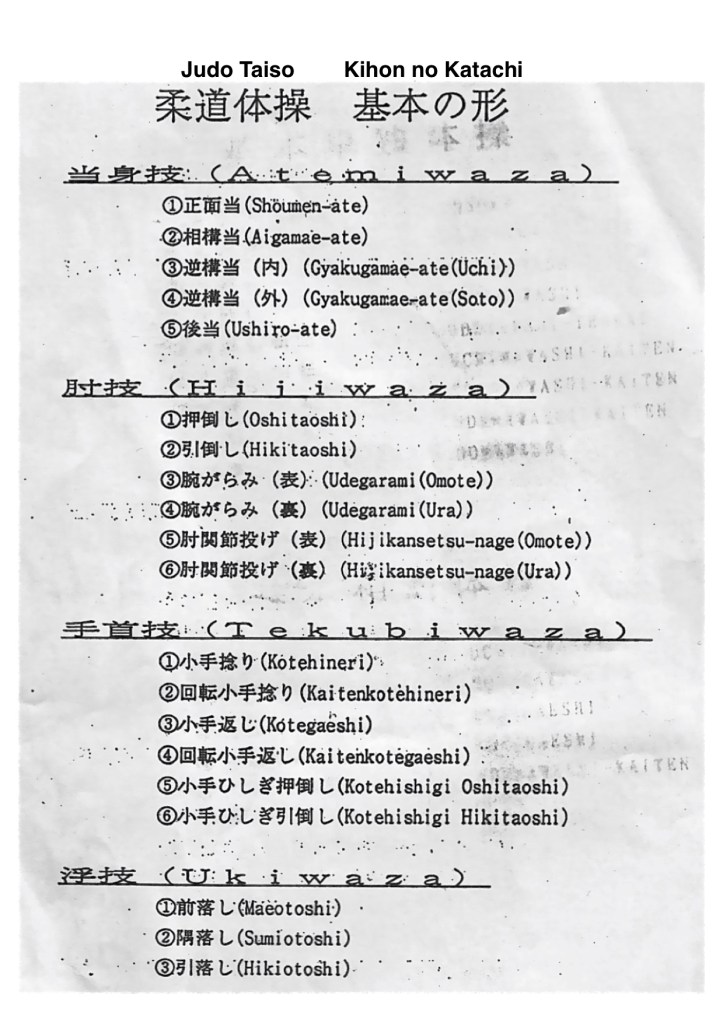
In his 1954 book “Judo Taiso,” Tomiki explained his rationale for systematizing aikido techniques. He noted that while judo had successfully reorganized throwing and ground techniques (randori techniques), there was still a need to develop a structured approach to atemi-waza (striking techniques) and kansetsu-waza (joint techniques). Through his 30 years of study, he recognized the deep connection between judo and aiki jujutsu principles.

By 1943, Tomiki had published works exploring the relationship between form and principle in martial arts. He explained that principles could only be understood through techniques and forms, emphasizing the importance of kata training and referencing the Buddhist stages of shu-ha-ri (preserve, break, leave). He connected martial arts principles to Chinese painting theory, particularly the concept of “bone method,” concluding that understanding these principles allows one to “respond to circumstances and changes, and work freely without hindrance.”

The “Bone Method” Concept in Tomiki’s Martial Arts Philosophy

The concept of “bone method” (骨法) is a profound philosophical principle that Kenji Tomiki incorporated into his martial arts theory, drawing parallels between traditional East Asian painting theory and martial arts practice.

Origins in Chinese Painting Theory

The “bone method” originally comes from traditional Chinese painting theory, specifically from the “Six Laws” (六法) of painting established by Xie He in the 5th century CE . In this classical framework, the Six Laws include principles like “spiritual resonance and life movement” (气韵生动), “bone method and use of brush” (骨法用笔), and other technical aspects of painting.

Tomiki’s Application to Martial Arts

Tomiki adapted this concept to martial arts in his writings on “Form and Principle” published in 1943. In these texts, he explains that the “bone method” in painting parallels the fundamental principles that exist behind martial arts techniques. Just as the “bone method” gives structure and life to a painting, the underlying principles animate martial arts techniques.

According to Tomiki, “spiritual resonance and life movement” represents the life essence of painting, while the other five laws (including bone method) are means to bring this life movement to the painting. He saw a direct parallel to martial arts, where the visible techniques express deeper underlying principles.

Practical Meaning in Martial Arts

In practical terms, the “bone method” in Tomiki’s martial arts philosophy represents:

  1. Essential Structure: Just as the bone structure gives form to a body, the “bone method” provides the essential structure to both painting and martial arts techniques.
  2. Freedom Through Structure: Tomiki concludes that “Only those who understand the bone method can freely express their conceptions on paper. It is like those who understand the principles of martial arts can respond to circumstances and changes, and work freely without hindrance.”
  3. Beyond Mere Technique: The concept suggests that true mastery goes beyond learning shapes or movements, requiring an understanding of the underlying structural principles that give life to technique.

Connection to Tomiki’s Overall Philosophy

This concept reflects Tomiki’s broader approach to martial arts as a systematizer and theorist. By incorporating concepts from Chinese aesthetics into martial arts theory, he demonstrated his intellectual breadth and his commitment to placing martial arts within a larger cultural and philosophical framework.

The “bone method” exemplifies Tomiki’s rationalist approach to martial arts, where understanding the fundamental principles (the “bones”) allows practitioners to express techniques with both structure and freedom, adapting fluidly to changing circumstances.

Post-War Years (1945-1948)

After Japan’s defeat in 1945, Tomiki was detained by Soviet forces at Lake Balkhash in Siberia. This internment lasted three and a half years, during which time Manchukuo collapsed and Kenkoku University closed. Tomiki finally returned to Japan in late 1948.

During his internment, Tomiki continued to refine his understanding of martial arts. In the preface to “Judo Taiso,” he mentioned that his experiences during internment clarified the significance of maintaining traditional techniques while adapting them for practical use. Upon his return to Japan, he would further develop his systematic approach to aikido techniques.

Legacy and Impact

Tomiki’s contribution to martial arts centered on his synthesis of traditional aikijujutsu with modern educational methods. He established a system to teach striking and joint lock techniques rationally, making them accessible within the framework of physical education. His approach created a bridge between the irrationalist, intuitive training methods of traditional martial arts and a more systematic, principle-based approach suitable for modern education.

Tomiki viewed his work as continuing the legacy of Jigoro Kano, who had successfully adapted traditional jujutsu into modern judo. Similarly, Tomiki sought to transform the “aikido techniques” of Morihei Ueshiba into a structured educational system, preserving their essence while making them accessible to contemporary practitioners.

This period from 1900 to 1948 represents the formative years of Tomiki’s development and his initial contributions to systematizing aikido. His later work at Waseda University would further develop his vision of competitive aikido, creating a distinct branch within the aikido world.

Summary of Source Materials on Kenji Tomiki

The materials provide comprehensive documentation of Kenji Tomiki’s life, philosophy, and contributions to martial arts, focusing on his development of a systematic approach to aikido. Here’s a summary of the key documents:

1. “Kenji Tomiki Budoron” (Document 1)

This extensive text appears to be Tomiki’s major philosophical work on martial arts, containing chapters on the uniqueness of Japanese martial arts, modernization of budo, judo principles, and aikido development. The document explores how traditional martial arts can be adapted to modern educational contexts while preserving their essential character. Tomiki articulates principles like shizentai no ri (natural posture), ju no ri (flexibility), and kuzushi no ri (breaking balance) that form the foundation of his technical system .

2. “Judo Taiso” (Document 7)

This translated work from 1954 details Tomiki’s system of “Judo Exercises” that apply judo principles to aikido techniques. He explains how he reorganized striking and joint lock techniques from Daito-ryu Aiki Jujutsu into an educational framework. The document includes detailed instructions for basic movements, postures, and techniques with accompanying illustrations .

3. “Aikido Nyumon” (Document 8)

Published in 1958, this “Introduction to Aikido” provides a rational method for practicing striking and joint lock techniques. The document outlines fifteen basic forms and their applications, continuing Tomiki’s systematic approach to aikido instruction with detailed explanations and illustrations .

4. “Personal Views on Martial Arts” and “Prewar” (Document 9)

This document contains Tomiki’s 1928 letter to Kaizan Nakazato expressing his views on martial arts and criticizing Kodokan Judo from the perspective of Daito-ryu. It also covers Tomiki’s time teaching at Kenkoku University in Manchuria (1939-1945), detailing his relationship with Morihei Ueshiba and his development of a rationalist approach to aikido instruction .

5. Key Terminology (Document 4)

This document provides definitions of essential concepts in Japanese martial arts, including philosophical terms like Bushido, technical concepts like kata and waza, and educational approaches like goraku (entertainment-oriented) and tanren-shugi (discipline-oriented) training methods .

6. Additional Supporting Documents

Several smaller documents provide supporting information about specific aspects of Tomiki’s work, including his views on competition in martial arts (documents 2-3), his approach to school martial arts education (document 5), and philosophical differences between recreation-oriented and discipline-oriented physical education (documents 3, 5) .

Together, these documents present a comprehensive picture of Tomiki’s life work: creating a bridge between traditional martial arts and modern educational methods by applying scientific principles, systematic organization, and rational teaching approaches to the techniques of aikido.

Translating Tomiki’s Budōron

Translating Kenji Tomiki’s “Budōron” (武道論): Critical Concepts Requiring Clarification

The translation of Kenji Tomiki’s “Budōron” (武道論 – “Theory of Martial Arts” or “Discourse on the Martial Way”) presents unique challenges due to its rich philosophical content and historical context. Several critical concepts in this seminal work require careful clarification to preserve their full meaning and significance.

The ultimate goal in translating Budōron should be to make Tomiki’s innovative martial philosophy accessible to non-Japanese readers while preserving the depth and subtlety of his thought. This requires not just translation in the narrow sense but genuine cross-cultural interpretation that builds bridges between Eastern and Western philosophical traditions.

The Significance of “Budōron” as a Text

The title itself—”Budoron” (武道論)—merits examination:

  • (Bu): More than just “martial,” this character encompasses military matters, combat, and the control of violence
  • (Dō): Beyond “way” or “path,” this indicates a life discipline and philosophical approach
  • (Ron): Signifying “theory,” “discourse,” or “treatise,” this indicates a systematic philosophical exploration

This work represents Tomiki’s comprehensive philosophical framework for understanding martial arts in the modern world, bridging traditional practice with contemporary educational values.

Critical Concepts Requiring Clarification

1. Technical-Philosophical Terms with No Direct English Equivalents

Terms like “waza” (技) and “kokoro” (心) appear frequently in Budoron but resist simple translation. “Waza” encompasses technical skill, practical application, and artistic expression simultaneously. “Kokoro” represents the unified heart-mind-spirit complex that Western languages typically separate.

2. Historical Transitional Concepts

Tomiki writes during a pivotal period in Japanese martial arts history. His discussion of the transition from “jutsu” (術) to “dō” (道) marks not merely a terminological shift but a profound reconceptualization of martial practice from battlefield techniques to paths of personal development.

3. Complex Educational Philosophy

Tomiki’s contrast between “tanren-shugi” (鍛錬主義 – discipline-oriented principle) and “goraku-shugi” (娯楽主義 – recreation-oriented principle) requires careful explanation. These aren’t merely opposing approaches to physical education but represent different philosophical orientations toward human development itself.

4. Religious and Ethical Dimensions

The text contains numerous references to Buddhist concepts (無心 – mushin, 不動心 – fudōshin), Confucian ethical principles, and Shinto perspectives. These require contextualization within Japanese religious traditions to be fully understood.

5. Evolution of Technical Systems

Tomiki describes the systematization and differentiation of martial techniques using terms that carry nuanced meanings in martial contexts. His discussion of the standardization of “kata” (型) and development of “randori” (乱取り) reflects not just technical evolution but philosophical adaptation.

6. Socio-Political Context

Written in the post-war period, Budoron engages with the transformation of martial arts from militaristic training to democratic education. Terms like “minshū kyōiku” (民主教育 – democratic education) carry specific historical connotations related to Japan’s post-war reforms.

7. Metaphysical Concepts

Tomiki frequently references East Asian philosophical concepts like “ki” (気 – vital energy or spirit), “wa” (和 – harmony), and the principles of yin-yang and the five elements. These require explanation of their traditional metaphysical foundations.

Translation Approach Needed

Translating Budoron effectively requires more than linguistic conversion—it demands:

  1. Contextual notes: Providing historical, cultural, and philosophical background
  2. Conceptual mapping: Explaining how Japanese concepts relate to Western philosophical frameworks
  3. Terminological consistency: Maintaining consistent translations while acknowledging the limitations of English equivalents
  4. Explanatory expansions: Sometimes expanding one Japanese term into several English phrases to capture its full meaning
  5. Preservation of ambiguity: Where Tomiki intentionally employs terms with multiple meanings, preserving this richness rather than narrowing to one interpretation

The Book: Budōron

The book appears to be organized into three main chapters plus an introduction, conclusion, and commentary sections:

Major Structural Components

  • Introduction: “What is Budō?” (6 subsections)
  • Chapter I: “The Modernization of Budō…Harmony of Tradition and Modernity” (7 major sections)
  • Chapter II: “What is Judo?…From “Waza” to “Michi”” (6 major sections)
  • Chapter III: “Modernization of Aikido…Creation of Competitive Aikido” (4 major sections)
  • Conclusion: “Educational Love and Physical Education” (4 sections)
  • Commentary section

Essay Count Estimate

Counting each major numbered section as a distinct essay (as they appear to be standalone pieces compiled into this volume):

  1. Introduction: Contains 1 comprehensive essay with 6 subsections
  2. Chapter I: Contains 7 distinct essays
  3. Chapter II: Contains 6 distinct essays
  4. Chapter III: Contains 4 distinct essays
  5. Conclusion: Contains 4 distinct essays

Total estimated essays: Approximately 22 separate essays or articles

This estimate is based on the structure visible in the table of contents. The book appears to be a compilation of Tomiki’s writings on martial arts philosophy, likely published over several years and brought together in this volume. Each numbered section has its own title and appears to be a complete piece that could stand alone, suggesting these were originally separate essays or articles that have been organized thematically into chapters.

The comprehensive nature of the collection, spanning from fundamental questions about the nature of budō to specific discussions of judo and aikido techniques, indicates this is a substantial compilation of Tomiki’s philosophical and technical writings on martial arts.

Mushin Mugamae? What huh?

Mushin Mugamae is a Japanese expression often used in the context of Tomiki’s Aikido. It is usually translated as ’empty mind, no posture’. 

But is this really the case? We need to understand and describe this expression in a much broader context.

A summary of the comments made by Kenji Tomiki regarding Mushin Mugamae


“No mind” (“mushin” 無心) represents the highest mental state in human cultivation. It must be the ultimate goal of martial arts, which reaches the “path” (“michi” 道) through “technique” (“waza” 技). Making martial arts competitive and establishing an arena for winning and losing is an educational “place” to learn “no mind” by transcending victory and defeat. However, competition comes with limitations. One tends to fixate on stances, drift toward specialized techniques, and forget the ideal of “no stance” (“mukamae” 無構). To learn “no stance,” one must repeatedly train in the correct “kata” (形) that emphasize self-defense.Emphasizing kata practice not only approaches the essence of martial arts and avoids the pitfalls of competition but also meets the needs of lifelong physical education in the coming era and greatly benefits the maintenance and promotion of national health through martial arts.

When we read and translate texts by Kenji Tomiki, we will certainly notice that he often uses the same parts of texts in different essays on Japanese martial arts. It is important for us to understand the purpose of the frequent repetition of an explanation of his concepts. Some of the texts (in Japanese) are available at:

(https://www.jstage.jst.go.jp/static/pages/JstageOverview/-char/en)

Translation and understanding confusion

When translating and trying to understand “mushin mugamae”, there is confusion when trying to understand this expression without the necessary background.

Mushin

In the context of martial arts, “無心” (mushin) is a profound concept that translates to “no-mindedness” or “no-mind.” It represents a mental state where the mind is free from distractions, fears, and ego, allowing for instinctive and fluid reactions. This state is highly valued in martial arts because it enables practitioners to respond naturally and effectively to any situation without hesitation or overthinking.

In Martial Arts:

  • Focus and Clarity: Mushin allows martial artists to act with complete focus and clarity, unhindered by conscious thought or emotion. This state is often achieved through rigorous training and meditation, where the practitioner learns to quiet the mind and trust their instincts.
  • Spontaneity: In combat or sparring, mushin enables spontaneous and intuitive movements, making the practitioner more adaptable and unpredictable to opponents.
  • Unity of Mind and Body: It signifies a harmonious unity between the mind and body, where actions flow naturally without conscious interference.

In a Broader Context:

  • Mindfulness and Presence: Beyond martial arts, mushin can be applied to daily life as a state of mindfulness and presence. It encourages living in the moment, fully engaged with the current task or experience without being distracted by past regrets or future anxieties.
  • Flow State: Mushin is akin to the concept of “flow” in psychology, where a person is fully immersed and focused on an activity, leading to a sense of effortless concentration and enjoyment.
  • Creativity and Problem-Solving: In creative endeavors or problem-solving, mushin can help individuals approach challenges with an open and uncluttered mind, leading to innovative solutions and expressions.
  • Emotional Balance: It promotes emotional balance and resilience, helping individuals manage stress and maintain composure in challenging situations.

In essence, mushin is a state of mental clarity and readiness that transcends the boundaries of martial arts, offering valuable insights and benefits for personal growth, creativity, and overall well-being.

Mugamae – Mukamae – Mukō

The term “無構” (mukamae) is composed of two kanji characters:

  1. 無 (Mu): This character means “nothingness,” “none,” or “without.” It represents the absence of something or a state of emptiness.
  2. 構 (Kamae): This character means “posture” or “stance.” In martial arts, “kamae” refers to the physical and mental readiness or posture that a practitioner adopts.

Together, “無構” (mukamae) can be interpreted as a state of “no posture” or “no fixed stance.” This concept is rooted in Japanese martial arts and Zen philosophy, emphasizing a mental and physical state of readiness without preconceived notions or rigid positions. It signifies being prepared for any situation without being confined to a specific form or expectation, allowing for fluid and adaptive responses.

But here is where the confusion comes in:

In martial arts contexts, the term 無構 can be read as either “mukamae” or “mukō”, depending on the specific tradition and context:

  1. “Mukamae” (無構え) – This reading is more commonly used in martial arts discussions about posture and stance. It literally means “no stance” or “no posture” and refers to a state where the practitioner has transcended formal stances, achieving a natural readiness that isn’t fixed in any particular form. In this context, it’s often written with the final え (e) as 無構え to clarify the pronunciation.
  2. “Mukō” (無構) – This alternate reading is sometimes used in more philosophical contexts, particularly in certain traditions of kenjutsu (sword techniques). It maintains the same fundamental meaning of “no predetermined form” but might be emphasized differently depending on the school.

無構 or 無構え

In his texts, Tomiki often uses the abbreviated form 無構 rather than the more explicitly pronounced 無構え when discussing this concept.

This is significant because:

  1. Tomiki is deliberately using the classical, condensed form 無構 that appears in traditional martial arts texts, particularly those from sword schools like the “Book of Five Rings” (五輪書, Gorin no Sho) which he references. This connects his ideas directly to historical martial traditions.
  2. Despite the abbreviated written form, the concept should still be understood as “mukamae” in pronunciation and meaning – referring to the state of “no stance” or transcending fixed postures.
  3. This writing choice reflects Tomiki’s deep connection to traditional martial arts literature while developing his modern perspective on martial arts education.

When Tomiki discusses 無構 (mukamae), he’s emphasizing the paradoxical nature of martial arts mastery – that the highest level of technique appears to have no technique, and the most effective stance appears to have no stance. This aligns with his broader philosophy of moving from form to formlessness, and from technique (waza) to way (michi).

The abbreviated writing style also reflects classical Japanese scholarly tradition, where concepts were often written in condensed form with the understanding that practitioners would know the proper reading and full implications. This approach is consistent with Tomiki’s position as both an innovator and a preserver of traditional martial arts knowledge.

Tomiki Aikidō and La Canne

European Martial Arts Through Time

European martial arts have a rich history that spans thousands of years, with distinct traditions developing across different regions and time periods. Unlike Asian martial arts, which often maintained continuous traditions, European martial arts experienced periods of evolution, transformation, and sometimes discontinuity. Here’s how they can be traced and catalogued through different historical periods:

Ancient Period (800 BCE – 500 CE)

  • Greek Pankration and Wrestling: Documented in pottery, sculptures, and texts like Homer’s works
  • Roman Gladiatorial Combat: Detailed in mosaics, reliefs, and writings by Suetonius and others
  • Celtic and Germanic Tribal Combat: Primarily known through archaeological finds and Roman accounts

Early Medieval Period (500-1000 CE)

  • Viking Combat Styles: Evidenced in sagas, archaeological finds, and burial goods
  • Early Knights and Mounted Combat: Beginning of formalized mounted warfare techniques
  • Byzantine Military Traditions: Preserved much of Roman military knowledge in manuals like the Strategikon

High Middle Ages (1000-1300 CE)

  • Development of Knightly Combat: Formalization of armored combat with lance, sword, and shield
  • Tournament Fighting: Evolution from chaotic melees to more structured combat sports
  • Early Fencing Traditions: Beginning of systematic swordsmanship outside of battlefield contexts

Late Medieval Period (1300-1500 CE)

  • Fechtbücher Tradition: First systematic martial arts manuals appear (I.33 Manuscript, ~1300)
  • Prominent Masters: Johannes Liechtenauer, Fiore dei Liberi, Hans Talhoffer created influential systems
  • Guild Systems: Formation of fighting guilds like the Brotherhood of St. Mark (Marxbrüder)

Renaissance Period (1500-1700 CE)

  • Rapier Fighting: Evolution toward civilian dueling and self-defense
  • National Schools: Development of distinct Italian, Spanish, German, and English styles
  • Scientific Approach: Application of geometric principles and mechanics to fencing (Camillo Agrippa)

Enlightenment to Modern Era (1700-1900 CE)

  • Smallsword and Dueling: Refinement of lighter weapons and emphasis on precision
  • Military Saber Systems: Formalized cavalry combat systems
  • Sport Evolution: Transition toward modern fencing with protective equipment
  • Boxing and Wrestling Codification: Formalization of rules for unarmed combat sports

Modern Period (1900-Present)

  • Olympic Fencing: Standardization of foil, épée, and saber as sport disciplines
  • HEMA Revival: Historical European Martial Arts reconstruction movement based on historical texts
  • Military Combatives: Development of military hand-to-hand combat systems

What makes the study of European martial arts particularly fascinating is the rich documentation through fighting manuals (fechtbücher), artwork, and literary sources that allow modern practitioners to reconstruct these historical fighting systems with considerable accuracy.

La Canne: Walkingstick Fencing

La Canne (or Canne de Combat) would primarily be placed in the 19th and early 20th century European martial arts timeline, though it has roots in earlier periods and continues as a modern sport today.

Historical Placement

Origins (18th Century)

  • La Canne evolved from earlier stick fighting methods used throughout Europe
  • Influenced by French naval tradition where sailors used sticks for training and self-defense

Formalization (19th Century)

  • Primary Development Period: Mid-to-late 19th century France
  • Context: Urban self-defense during a period when gentlemen regularly carried walking sticks
  • Connection to Savate: Often taught alongside French kickboxing (Savate) in the same academies
  • Defensive Focus: Developed as a practical civilian self-defense method, not primarily a sport

Belle Époque Peak (1880-1914)

  • Reached peak popularity during this period
  • Became an integral part of French martial culture
  • Featured in physical education and military training

La Canne represents an interesting transition between traditional European martial arts and modern combat sports, bridging aristocratic fencing traditions with practical civilian self-defense during a time of changing social norms and weapons technology.

Charles Charlemont: Key Figure in French Martial Arts

Charles Charlemont (1862-1944) should be placed in the late 19th to early 20th century period of European martial arts development, specifically within the French martial arts tradition. He was a pivotal figure in both Savate (French kickboxing) and La Canne de Combat (French stick fighting).

Historical Context for Charlemont

Late 19th Century French Martial Arts (1870s-1910s)

  • Period of Systematization: When traditional street fighting methods were being formalized into structured combat systems
  • Belle Époque Paris: Urban setting where martial arts were becoming both combat systems and spectator sports
  • Transition Era: Between purely practical combat methods and modern sport forms

Historical Significance

Charlemont represents a critical juncture in martial arts history when traditional European fighting systems were being preserved through sportification during a period when firearms and changing social norms were making many traditional combat skills obsolete for practical self-defense.

He bridges the gap between the older, more combat-oriented traditions of stick fighting and the modern sport version of La Canne that continues today, making him an important figure in the late period of traditional European martial arts development and the early period of modern European combat sports.Retry

Comparing Tomiki Aikido with La Canne

La Canne (or Canne de Combat) offers a fascinating parallel to Tomiki Aikido when examining Asian and European martial arts systems. La Canne merits specific attention due to its formalized structure and sporting aspects that make it particularly comparable to Tomiki’s approach.

Historical Context and Development

Tomiki Aikido:

  • Developed in the mid-20th century by Kenji Tomiki (1900-1979)
  • Built upon traditional Daito-ryu Aiki Jujutsu and Kodokan Judo principles
  • Systematized for modern educational purposes after WWII
  • Emphasizes both traditional forms and competitive practice

La Canne:

  • Formalized in 19th century France, though with older roots in European stick arts
  • Refined by fencing masters like Charles Charlemont and Joseph Charlemont
  • Developed alongside savate (French kickboxing) as a self-defense system
  • Modernized in the 20th century as a competitive sport through the Fédération Française de Savate et Canne

Both arts underwent significant modernization processes that transformed traditional combat techniques into formalized systems suitable for sporting contexts and physical education.

Technical Characteristics

Tomiki Aikido:

  • Circular movements using the tegatana (hand blade)
  • Techniques categorized into atemi-waza (striking) and kansetsu-waza (joint techniques)
  • Emphasis on ma-ai (distance control) and kuzushi (breaking balance)
  • Techniques flow from a separated stance (rikaku)

La Canne:

  • Linear and circular strikes with a cane
  • Techniques categorized into strikes (coups), parries (parades), feints (feintes) and counter attacks (ripostes)
  • Strong emphasis on distance management and footwork derived from fencing

Competitive Frameworks

Tomiki Aikido:

  • Randori competition with tanto (knife) and empty-handed formats
  • Scoring based on successful application of techniques and control
  • Emphasis on proper form and execution rather than power
  • Rules designed to preserve traditional principles while allowing for objective testing

La Canne:

  • Modern competition (since 1970s) conducted in a marked area
  • Points awarded for clean strikes to valid target areas (head, flanks, legs)
  • Techniques must demonstrate extension, commitment, and control
  • Protective equipment (mask, gloves, padded vest) allows for dynamic exchanges

Both systems developed competitive frameworks that allow practitioners to test skills while maintaining safety. However, La Canne competition more closely resembles fencing with its emphasis on scoring hits, while Tomiki Aikido competition focuses on successful application of controlling techniques.

Educational Philosophy

Tomiki Aikido:

  • Progression from kata (forms) to randori (free practice) to shiai (competition)
  • Techniques taught through “Basic Forms” and “Applied Techniques”
  • Emphasis on understanding principles of balance and body mechanics
  • Goal of personal development through technical mastery

La Canne:

  • Progressive training from basic strikes to combinations to tactical applications
  • Techniques taught through set drills and partner exercises
  • Strong emphasis on athleticism, coordination, and precision
  • Traditionally viewed as complementary to savate training

Cultural Integration

Tomiki Aikido:

  • Explicitly connects practice to concepts like wa (harmony) and mushin (no-mind)
  • Distinguishes between buryoku (military force) and bōryoku (violence)
  • Incorporates traditional etiquette and dojo culture
  • Progression follows shu-ha-ri model of traditional martial learning

La Canne:

  • Embodies values of French physical culture and sporting tradition
  • Less explicit philosophical framework beyond sporting ethics
  • Maintains some traditional salutes and protocols derived from fencing

Methodological Similarities

Despite their different origins and techniques, both Tomiki Aikido and La Canne share significant methodological similarities:

  1. Systematization: Both were organized into coherent systems by educators seeking to preserve and transmit martial knowledge
  2. Pedagogical Structure: Both feature progressive teaching methods that build from fundamentals to advanced applications
  3. Competition as Tool: Both utilize competitive formats as educational tools while preserving technical standards
  4. Distance Management: Both place strong emphasis on proper distancing and timing
  5. Control over Power: Both prioritize precision and control over raw power or force

Conclusion

Tomiki Aikido and La Canne represent fascinating parallels in martial arts development across different cultural contexts. While developed independently and with different technical focuses, both systems demonstrate how traditional combat arts can be systematized, modernized, and adapted for contemporary educational and sporting purposes.

The primary difference lies in their philosophical underpinnings: Tomiki Aikido maintains stronger connections to traditional Japanese martial philosophy with concepts like harmony, balance, and spiritual development, while La Canne evolved more explicitly as a sporting practice with less emphasis on philosophical cultivation.

Both arts, however, successfully balance tradition with innovation, creating systems that preserve martial knowledge while making it accessible and relevant to modern practitioners—a testament to the universal impulse to develop, refine, and transmit martial arts across cultures and generations.

Budoron, Kenji Tomiki’s Masterpiece

Kenji Tomiki was a prominent Japanese martial artist known for his contributions to both judo and aikido. He was also a pedagogue of martial arts theory, known as “Budoron” in Japanese. This term refers to the study and philosophy of martial arts, encompassing the principles, ethics, and educational methods associated with these disciplines.
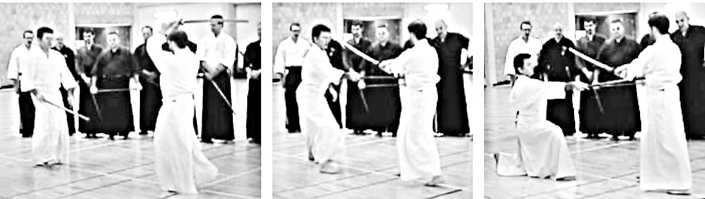
Tomiki’s work in Budoron focused on integrating the philosophical and practical aspects of martial arts to create a comprehensive system of training and personal development. He believed in the importance of blending physical techniques with mental discipline and ethical considerations, reflecting the broader goals of budo, which emphasizes self-cultivation and personal growth through martial arts practice

Tomiki’s approach to Budoron influenced the development of Kyogi Aikido, which incorporates elements of both aikido and judo. This system emphasizes the importance of randori (free-style practice) and includes a competitive element, setting it apart from other aikido styles. Tomiki’s contributions to martial arts theory and practice continue to influence practitioners and educators in the field.

Budoron

This book is a collection of martial arts theories put together from the writings of Kenji Tomiki (1900-1979), who was totally devoted to the practice and research of martial arts from before to after the war, pouring his passion into martial arts education and developing outstanding martial arts theories.

His take on martial arts is both deep and wide-ranging, exploring the philosophy and practical use of Japanese martial arts. If you want to get his writing, you need to know about the key concepts of Japanese Budō.

Key Terminology Review

Budō (武道) and Bujutsu (武術)

In the Budoron texts, both terms are translated simply as “martial arts,” but it’s important to distinguish between them:

  • Budō refers to the “martial way” with emphasis on personal development and spiritual cultivation
  • Bujutsu refers to practical “martial techniques” focused on combat effectiveness

The text moves between discussing traditional martial skills (bujutsu) and their evolution into modern martial ways (budō). For instance, when discussing the historical development in the Edo period, the text is primarily referring to bujutsu, while the post-Meiji educational focus is more aligned with budō.

Kata (形) vs. Katachi (形)

The translation correctly conveys kata as prescribed training forms or patterns, but could more explicitly note that kata in martial arts refers to the structured sequence of movements that embody technical principles rather than merely external shapes.

Kyogi (競技)

The translation accurately renders kyogi as “competition,” but could emphasize that this specifically refers to the structured, rule-based competitive format that allows for the testing of skills in a controlled environment.

Wa (和)

The concept of wa (harmony) is central to the text and is properly translated. This concept represents not just peaceful coexistence but an active state of balanced interaction, particularly important in the martial arts context where it refers to achieving resolution without unnecessary conflict.

Buryoku (武力) vs. Bōryoku (暴力)

The distinction between these terms is well-translated:

  • Buryoku (military/martial power) is controlled force with proper rules
  • Bōryoku (violence) is uncontrolled, rule-less force

This distinction forms a central argument in the text about the ethical core of martial arts.

Randori (乱取り)

While mentioned in the text, randori could be more explicitly defined as “free practice” or “free sparring” – a training method that allows practitioners to apply techniques in more dynamic, unscripted situations than kata practice permits. The author mentions randori as a crucial innovation in judo that allows for testing techniques without the mortal danger of older “matches.”

Content Accuracy

The translation effectively captures the author’s key arguments:

  1. The historical evolution from battlefield techniques to self-defense arts and finally to educational disciplines
  2. The ethical progression from combat effectiveness to spiritual cultivation
  3. The balanced approach that values both competitive practice (kyogi) and formal patterns (kata)
  4. The central distinction between controlled martial power (buryoku) and unrestrained violence (bōryoku)
  5. The concept of “the way” (道/michi) as the integration of technique and spiritual development

Overall, the translation accurately conveys both the technical terminology and the philosophical depth of the original text, emphasizing the author’s argument that Japanese martial arts represent a unique cultural heritage that balances practical effectiveness with ethical and spiritual development. The key contribution of the text is its explanation of how traditional martial arts can be modernized through competition while preserving their essential characteristics through continued kata practice.

Understanding Randori and Kyogi in Japanese Martial Arts

Randori (乱取り)

Randori literally means “chaos taking” or “free seizing” and represents a fundamental training method in several Japanese martial arts, particularly judo and aikido.
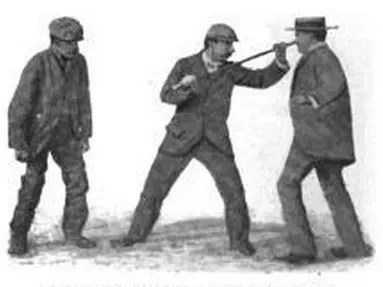
Key Characteristics of Randori:

  1. Unscripted Practice: Unlike kata (predetermined forms), randori involves spontaneous, dynamic interaction between practitioners.
  2. Controlled Resistance: Partners provide genuine resistance, but within parameters that maintain safety while allowing techniques to be applied with realistic effort.
  3. Learning Application: Randori bridges the gap between kata (theory) and actual combat by teaching practitioners how to apply techniques against an actively resisting opponent.
  4. Development Focus: It develops timing, reflexes, adaptability, and situational awareness that cannot be cultivated through kata alone.
  5. Safety Framework: Unlike historical duels or challenges, randori provides a framework for testing techniques without mortal danger.

As Kenji Tomiki explains in his texts, randori was a crucial innovation in martial arts pedagogy. In traditional martial schools, practitioners would learn through kata but then might immediately test their skills in potentially lethal duels or challenges. Randori created an intermediate practice space where techniques could be tested against resistance without the life-threatening consequences.

In judo, Jigoro Kano systematized randori as a core training method, allowing practitioners to develop and test throwing and grappling skills through free practice. Tomiki later applied similar principles to aikido, developing a randori system for practicing aikido techniques safely against resistance.

Kyogi (競技)

Kyogi means “competition” or “sport” and refers to the structured, rule-governed competitive format of martial arts.

Key Characteristics of Kyogi:

  1. Formalized Rules: Clear regulations that define permissible techniques, scoring methods, and victory conditions.
  2. Safety Considerations: Restrictions on dangerous techniques to prevent injury while maintaining the essence of the art.
  3. Objective Evaluation: Provides a framework for measuring skill development and technical proficiency.
  4. Educational Purpose: Transforms the “place of victory” into a “place of education” where practitioners can develop moral qualities like fairness, respect, and self-control.
  5. Cultural Adaptation: Represents the adaptation of martial arts to modern educational values and social contexts.

Tomiki viewed kyogi as essential for modernizing martial arts, particularly for:

  • Making techniques objectively testable
  • Developing practitioners’ ability to perform under pressure
  • Creating a framework for martial arts as physical education
  • Preserving the martial arts’ educational value in a democratic society

The Relationship Between Randori and Kyogi

While closely related, randori and kyogi serve different functions:

  • Randori is a training method focused on learning through free practice
  • Kyogi is a competitive format focused on testing skills in a formalized environment

In Tomiki’s vision, both elements are necessary for complete martial arts education:

  1. Kata provides the theoretical foundation and preserves comprehensive technical principles
  2. Randori develops application skills through free practice
  3. Kyogi tests these skills in a structured competitive format

Tomiki’s significant contribution was recognizing that neither approach alone was sufficient. Traditional schools that focused solely on kata risked developing techniques that couldn’t be applied against resistance (what he calls “flower-style swordsmanship”). Conversely, focusing only on competition risked losing the comprehensive technical curriculum and deeper principles preserved in traditional forms.

By integrating both approaches—competition-based training for dynamic application and kata-based training for comprehensive technical study—Tomiki sought to preserve what he saw as the essence of Japanese martial arts while adapting them to modern educational contexts.

Aikido as a Performance Art: An In-Depth Exploration


A person is identified not just by their name but by the human values they embody. Strip away those values, and the person becomes an object, easily manipulated by dictators, corporations, and social media.
Similarly, a martial art is defined by its name and the human values it imparts. Remove those values, and it becomes vulnerable to exploitation by salespeople, corporations, or worse—it loses its purpose and is discarded as irrelevant.

Introduction

Aikido, a modern Japanese martial art founded by Morihei Ueshiba, is renowned not only for its self-defense techniques but also for its aesthetic and performative qualities. While Aikido maintains its roots in practical combat, it seamlessly integrates elements of performance art, creating a harmonious blend of martial effectiveness and artistic expression. This exploration delves into how Aikido embodies performance art, examining its choreography, theatricality, and the balance between physical technique and mental discipline.

Kata: The Foundation of Aikido’s Performative Aspect

Understanding Kata

At the heart of Aikido’s performative nature lies kata, a collection of structured movements that simulate real combat scenarios. Kata serves as both a training tool and a performance medium, allowing practitioners to internalize techniques while presenting them in a visually engaging manner.

  • Static and Dynamic Structures: Kata comprises static structures (key-pictures) and dynamic structures (transitional movements). Static structures provide a foundational stance or position, while dynamic structures facilitate smooth transitions between these positions. This interplay creates a fluid and aesthetically pleasing sequence of movements.
  • Memetic Naming: Post-World War II, high-ranking students began naming techniques to aid memory retention. These names function as “memes,” triggering mental images and structures that enhance the practitioner’s ability to recall and execute movements with precision.

The Role of Go-Kyo and Basic Techniques

The Go-Kyo system in Kodokan Judo and its counterparts in Tomiki Aikido illustrate the structured approach to teaching and performing techniques.

  • Go-Kyo in Judo: This classification system organizes throwing techniques, providing a systematic framework for learning and demonstration.
  • Basic 15 and Its Evolution: Kenji Tomiki introduced Basic 15, a foundational set of techniques in the 1950s. Although not classified formally as kata, Basic 15 laid the groundwork for subsequent iterations like Basic 17 and Tanto Basic 17, which incorporated more refined and varied movements.
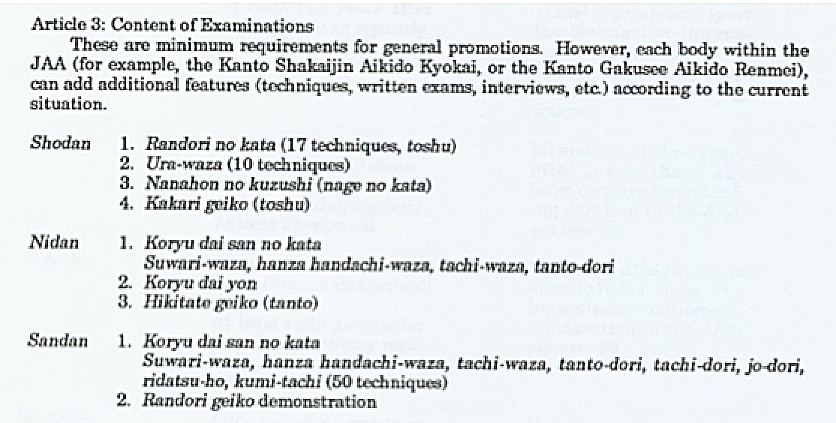
  • Randori no Kata: High-ranking instructors coined Randori no Kata to formalize basic techniques, culminating in its inclusion in the JAA syllabus in 1980. This formalization underscores the performative intent behind kata, emphasizing both technical proficiency and aesthetic presentation.

Theatricality in Aikido

Historical Context of Martial Arts and Theater

The intersection of martial arts and performance art is not unique to Aikido. Historically, martial practices have often been intertwined with theatrical traditions:
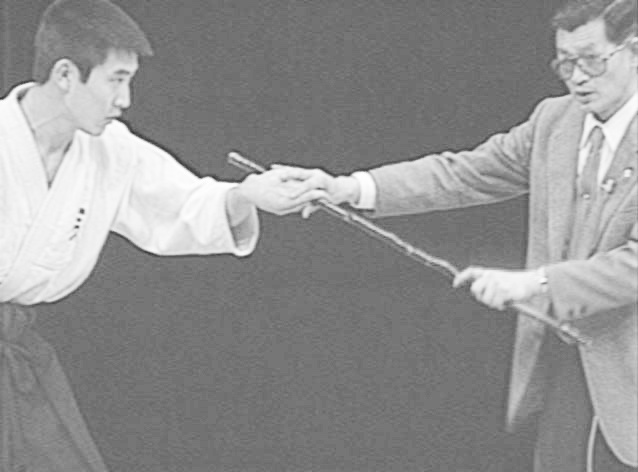
  • European Fencing: Once part of theatrical studies, fencing evolved into both a competitive sport and a performative display.
  • Chinese Opera and Kabuki: These traditional art forms heavily incorporate martial choreography, blending combat techniques with dramatic storytelling.

Aikido’s Theatrical Elements

Aikido adopts similar principles, integrating martial techniques with performative choreography to create a captivating spectacle:

  • Choreographed Performances: Aikido demonstrations often showcase the fluidity and grace of techniques, emphasizing the seamless execution of movements. These performances are meticulously choreographed to highlight the harmony between practitioners.
  • Character Development: Modern Budo (Gendai Budo) emphasizes character development alongside technical skill. In Aikido performances, practitioners embody specific roles—Tori (the attacker) and Uke (the defender)—each with distinct movements and intentions, enhancing the narrative aspect of the performance.
  • Social Interaction: Performances are designed to engage spectators, conveying the “truth of action” by simulating realistic combat scenarios. This interaction fosters a connection between practitioners and the audience, elevating the performance beyond mere technique demonstration.

Balancing Combat Effectiveness and Aesthetic Expression

Combat Roots vs. Aesthetic Focus

Aikido’s dual emphasis on combat effectiveness and aesthetic beauty presents both opportunities and challenges:

  • Combat Effectiveness: At its core, Aikido remains a practical martial art aimed at self-defense. Techniques are designed to neutralize opponents efficiently, emphasizing leverage, timing, and precision.
  • Aesthetic Expression: Simultaneously, Aikido values the visual appeal of movements. The flowing, circular motions not only serve practical purposes but also create a visually harmonious performance.

Potential Conflicts and Solutions

The balance between combat utility and aesthetic form can sometimes lead to conflicting priorities:

  • Neglecting Practicality: An overemphasis on aesthetics may result in the neglect of combat effectiveness, leading to the spread of misconceptions about the applicability of techniques in real-world scenarios.
  • Integrating Concepts: The ideal approach integrates combat principles into the performative aspects, ensuring that aesthetic movements retain their practical origins. This synergy enhances both the visual appeal and the functional integrity of Aikido techniques.

Training Methods and Their Performative Implications

Static and Dynamic Structures in Training

Aikido training incorporates both static and dynamic structures, each contributing to the performative quality of the art:

  • Static Structures: These are foundational stances and positions that provide stability and serve as reference points for movements.
  • Dynamic Structures: These involve transitions and fluid movements between static structures, creating a seamless flow that is both practical and visually engaging.

Role of Instructors and Advanced Practitioners

Guidance from experienced instructors is crucial in bridging the gap between technical proficiency and performative execution:

  • Choreographic Guidance: Instructors help practitioners refine their movements, ensuring that techniques are executed with both precision and grace.
  • Mental Discipline: Beyond physical training, practitioners cultivate mental structures that underpin their movements, enhancing the authenticity and fluidity of their performance.

Use of Media in Enhancing Performative Skills

Modern training methods leverage various media to augment the learning and performative aspects of Aikido:

  • Visual Aids: Books, videos, and digital platforms provide visual representations of techniques, aiding in the comprehension and execution of complex movements.
  • 3D Insights: Video demonstrations offer three-dimensional perspectives, allowing practitioners to observe and emulate the intricacies of dynamic structures.

The Aikido Syllabus: A Blueprint for Structured Performance

Memetic Collection of Techniques

The Aikido syllabus functions as a structured collection of “memes,” each representing a technique’s underlying structure:

  • Memory Aids: Technique names act as mental triggers, facilitating the recall and execution of movements through associated images and structures.
  • Structured Learning: The syllabus organizes techniques in a logical sequence, promoting progressive mastery and enabling practitioners to build upon foundational skills.

Impact on Performative Demonstrations

A well-structured syllabus enhances the performative aspect by ensuring that practitioners have a comprehensive understanding of each technique’s nuances:

  • Consistency in Performance: Standardized techniques allow for uniformity in demonstrations, making performances more coherent and impactful.
  • Depth of Understanding: A thorough grasp of the syllabus ensures that performances are not merely superficial displays but reflect a deep understanding of the art’s principles.

Static and Dynamic Structures Training: Enhancing Performative Excellence

Technique Demonstration and Perception

When demonstrating techniques without specifying the initial action, practitioners reveal their personal interpretation and understanding of the movement:

  • Individual Interpretation: Each practitioner’s unique perception influences how they execute and present a technique, adding diversity to performances.
  • Visual Representation: The balance between static and dynamic structures in demonstrations creates a visually engaging narrative that captivates audiences.

Skill Development: Athletic vs. Martial Skills

Aikido distinguishes between athletic skills (physical prowess) and martial skills (combat effectiveness), both of which contribute to performative excellence:

  • Athletic Skills: These enable practitioners to execute movements with agility and strength, enhancing the visual appeal of performances.
  • Martial Skills: These ensure that techniques retain their combat effectiveness, maintaining the art’s practical integrity.

Integration in Competitive and Performative Contexts

Tomiki Aikido’s emphasis on competitive formats like Randori and Kata illustrates the dual application of techniques in both combative and performative settings:

  • Randori: A free-form practice that emphasizes adaptability and combat readiness, showcasing martial prowess.
  • Kata: A structured form that highlights the aesthetic and choreographic aspects of techniques, emphasizing grace and precision.

Theatricality and Character Development in Aikido

Expressing Narrative Through Movement

Aikido performances often convey a narrative, portraying the interaction between Tori (the attacker) and Uke (the defender):

  • Role Embodiment: Practitioners embody their roles, infusing movements with intention and purpose that narrate a story of conflict and resolution.
  • Emotional Expression: Beyond physical movements, Aikido performances express emotions and psychological states, adding depth to the portrayal.

Character Development Through Practice

Modern Budo emphasizes character development as a fundamental aspect of martial arts training:

  • Discipline and Respect: Practitioners cultivate qualities like discipline, respect, and humility through rigorous training and performative practice.
  • Social Interaction: Engaging in synchronized movements and coordinated techniques fosters social bonds and mutual understanding among practitioners.

Challenges and Solutions in Balancing Aesthetics and Practicality

Risk of Aesthetic Overemphasis

An excessive focus on aesthetic elements can compromise the martial effectiveness of techniques:

  • Misconceptions: Overly stylized performances may lead to misunderstandings about the practical application of Aikido techniques in real-world scenarios.
  • Technique Dilution: The essence of techniques may be diluted if aesthetic considerations overshadow functional execution.

Integrating Combat Principles into Performance

To maintain the integrity of Aikido as both a martial art and a performance medium, it is essential to balance aesthetics with combat principles:

  • Functional Choreography: Choreograph movements in a way that preserves their combat effectiveness, ensuring that performances remain authentic and practical.
  • Educative Performances: Use performances as opportunities to educate audiences about the underlying principles and practical applications of techniques, bridging the gap between art and combat.

Cross-training in Martial Arts

There has been a lot of controversy surrounding the idea of cross-training in martial arts. Cross-training is rejected by traditionalists in particular. Nonetheless, cross-training can provide valuable insight into the art of fighting.
When talking about cross-training in martial arts, grappling arts are frequently mentioned. But we can also cross-train in combat systems with weapons.

Fencing


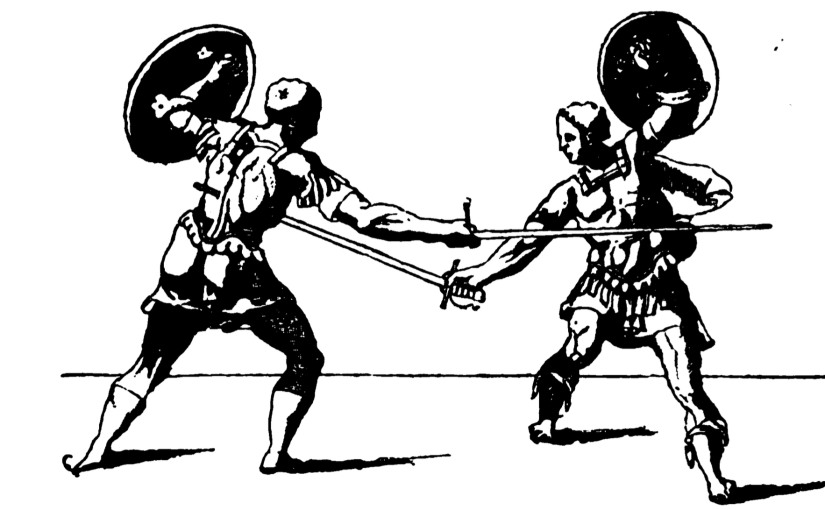
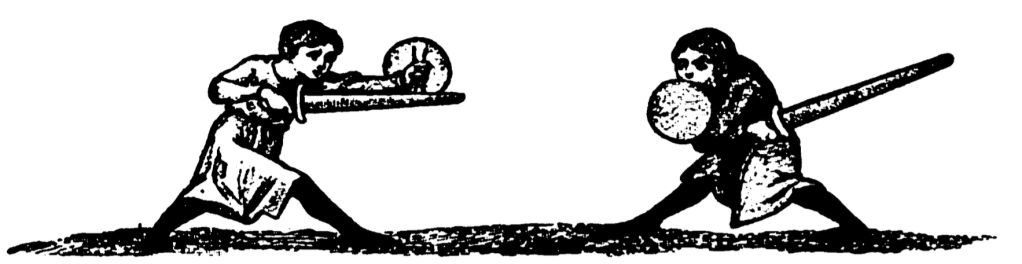
The origins of contemporary fencing must be found in Antiquity and medieval fighting methods. The swords used then were suitable as impact weapons and less so as stabbing weapons. The use of a shield to absorb the blow of a sword was widely accepted. Therefore, the warriors of the time were probably physically very strong. One cannot speak of true fencing.
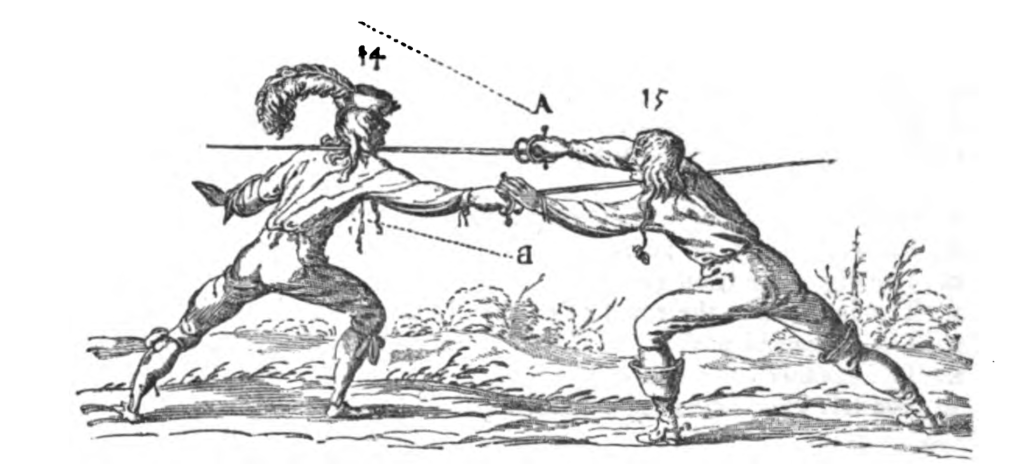
During the Renaissance, the use of stabbing weapons came more to the foreround. Probably because firearms made their appearance and heavy armour was replaced by lighter clothing. With the change in clothing, the way of body-to-body combat was also adapted. Impact weapons were replaced by stabbing weapons.

We do need to distinguish between civilian and military weaponry. The origins of modern fencing and the resulting stick fencing must be sought in civilian weaponry.
Civilian weaponry served 2 purposes:

  • Duel, an arranged engagement in combat between two people with matched weapons
  • Self-defense, about protecting yourself and your family against the hostile actions of criminals.

Dueling remained highly popular in European society, despite various attempts at banning the practice. From 1841 to 2000, Belgium had a criminal law on duelling.It offered reduced sentences for those who injured or killed someone during a duel.
The concept of ‘dueling’ can be found in numerous competitive martial arts styles.
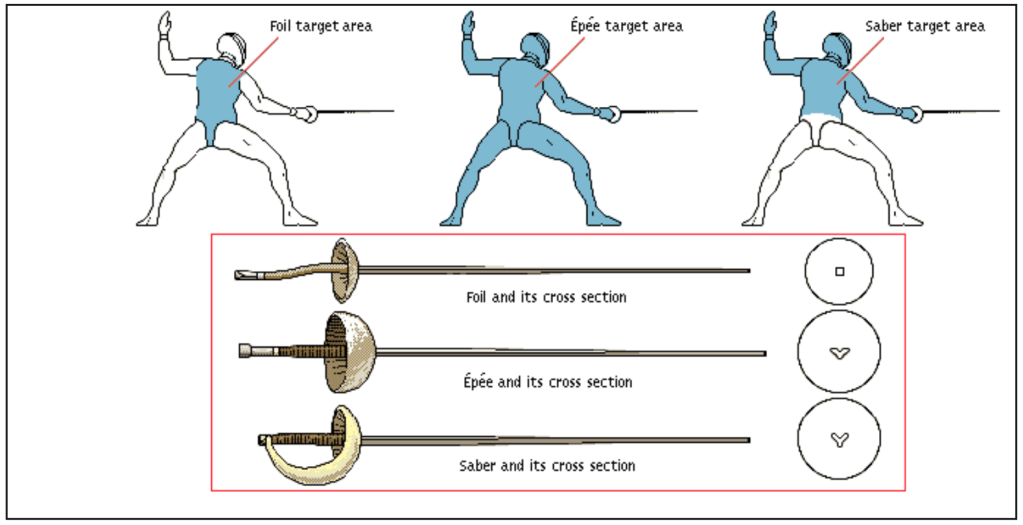
Today’s competitive fencing is largely based on a stabbing technique. Three types of weapons are promoted. Floret and epee are stabbing weapons, a sabre is a stabbing and impact weapon.


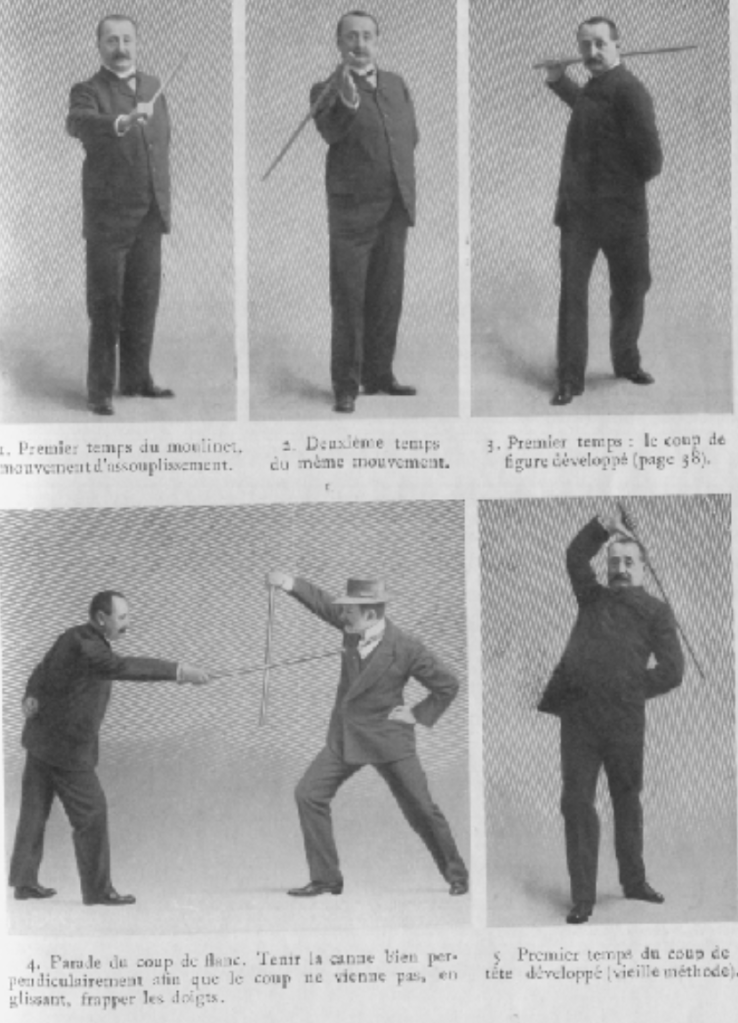
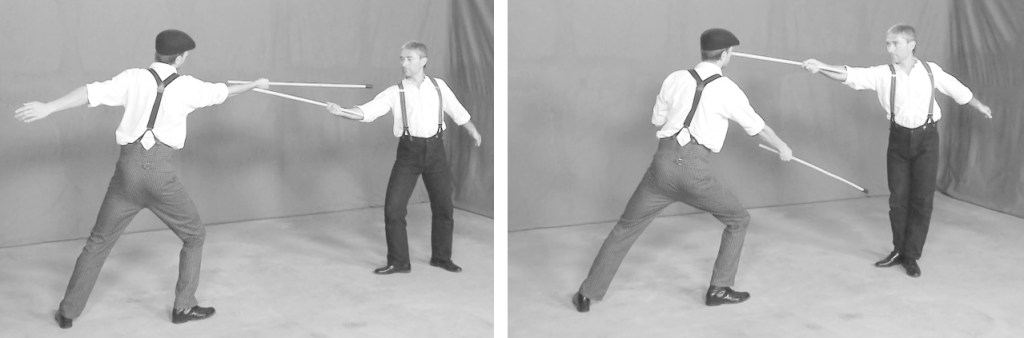
Stick fencing – La Canne

Stick fencing became popular in the 19th century as a result of the ban on carrying a sabre for civilians. Although a stick doesn’t have a sharp point or cutting edge, it still has the potential to kill or injure an adversary through its striking technique.

Stick fencing has several tendencies that can be derived from the different European fencing traditions. We distinguish between the German tradition, the Italian tradition, the Spanish tradition, and the French tradition. Despite regional distinctions, there have been many transfers between traditions in terms of technique and philosophy.
By the end of the 19th century, French traditions were the most prevalent methods. La Canne, as the French called their method, was part of a self-defence system that included French boxing. Outside the French language area, stick fencing can also be found.


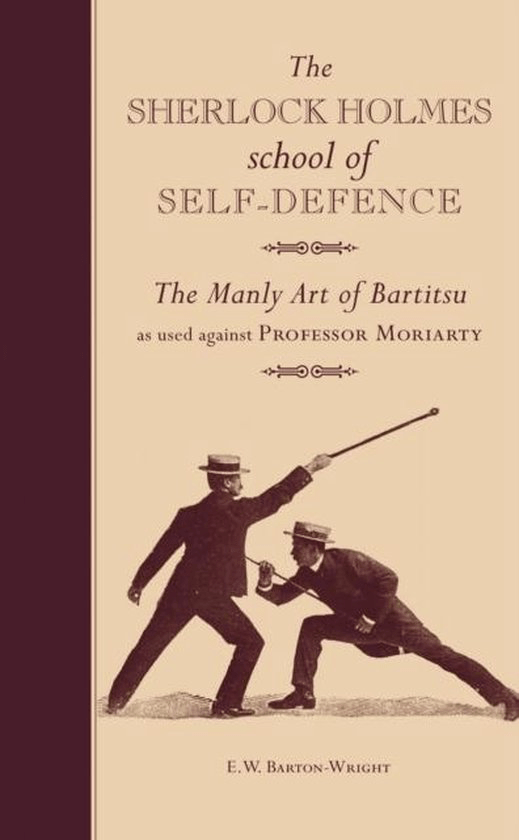
A popular version is the “Bartitsu stick fencing system”, an English method that gained fame thanks to Conan Doyle’s books featuring Sherlock Holmes as the main character. The stick fencing component has its origins in La Canne’s Vigny system, a method from the French-speaking region of Europe.

An upside-down world

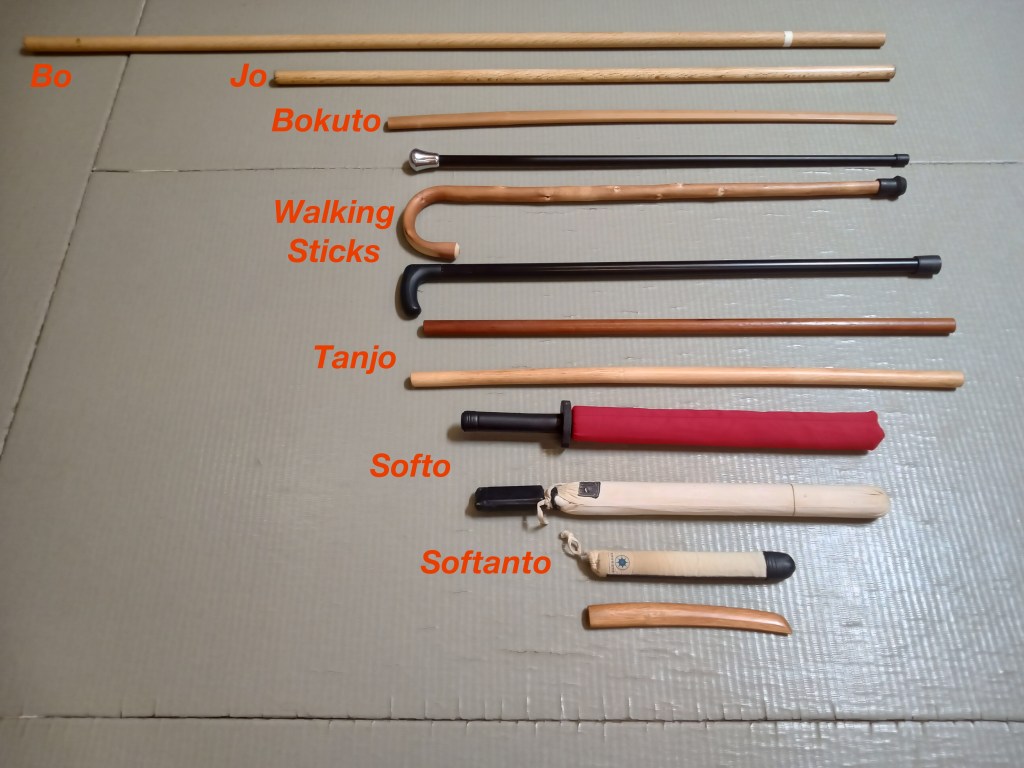
Of course, we cannot forget the Eastern traditions that found their way into the Western world of martial arts and martial arts in the 20th century. Despite the European influence in Tanjo Jutsu being denied by some Jojutsu practitioners, stances and striking technique share similarities.
One notable tradition is Japanese Shindo Muso Ryu Jo-jutsu. This tradition promotes a form of stick fighting using as its central weapon the Jo, a stick about 130 cm long. In this tradition one finds the Uchida-Ryu Tanjo Jutsu, a method based on European walking stick fencing from the 19th century.

The link with Aikido

hdr

Aikido was created by Morihei Ueshiba’s students after the war. In most modern aikido systems, weapons are used in training. A cane or a walking stick belongs not to the traditional weaponry in aikido.
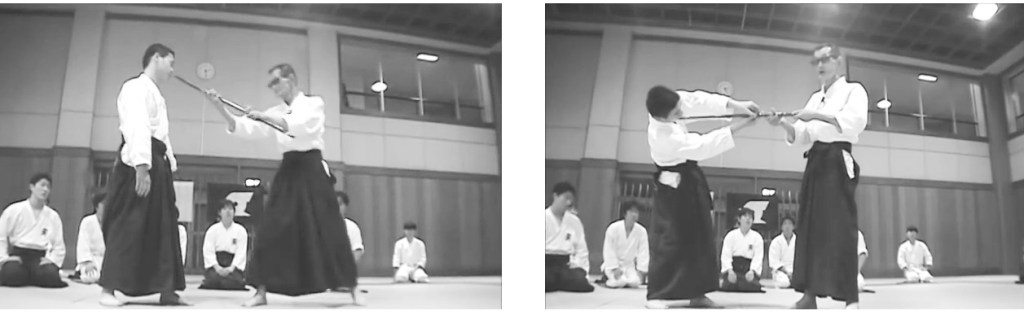
Nonetheless, a short stick was employed by a few of Ueshiba’s students in their training methods.

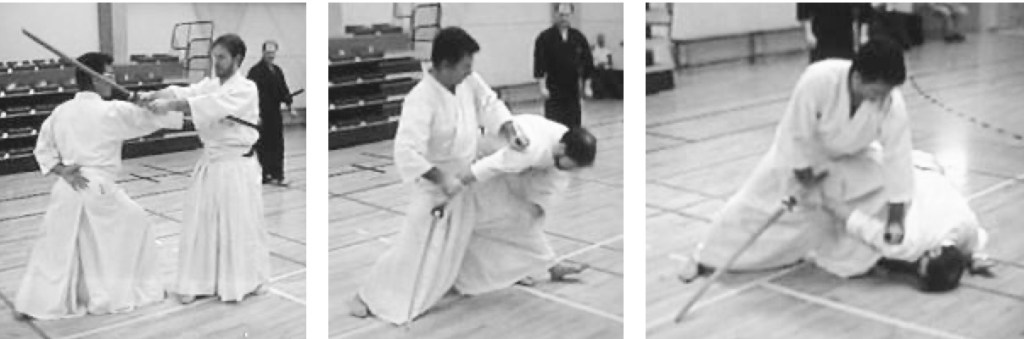
Kenji Tomiki, who created competitive aikido, also played a role in the creation of Goshi-jutsu no kata, which is a formal exercise in Kodokan Judo that has a self-defense section that involves the use of a short stick.

In the Tomiki Aikido training syllabus, a “Softo”, a short stick is used for example to practise “avoidance”.

Integrating a walking stick into your training requires a lot of study to determine which elements you would like to incorporate into your training. If your training is focusing on the sports side of Tomiki Aikido, practicing with a walking stick is a waste of time. As usual, there are no absolutes.
Le Combat de la Canne is a French competitive system with a stick that originated from the ‘La Canne’ methods for self-defense.

“La Canne” or the French Stick Fighting system

If the purpose of your training is to study practical elements for self-defense or aikido weapons training, practising with a walking stick can be very rewarding training supplement.
La Canne is build upon a more than 500 years experience of sword masters. Their knowledge is equal to that of the famous Japanese Swordmen.

Most of the La Canne methods have a similar syllabus that contains the following items.

  • Guards / Postures
  • Moulinets – Circling of the cane
  • Footwork
  • Striking, thrusting, ….
  • Parries
  • Combinations
  • Freeplay

A lot of attention is paid to:

  • Distance – 3 basic distances
  • Timing – 3 basic timings

The concepts of distance and timing are integral to Eastern martial arts. It can be said that they are the ‘essential concepts’ of all martial arts.


This concept can be practiced at different levels, with beginners generally moving slowly and not using powerful actions.

Are you intrigued?

The internet is a great place to find a lot of information. But fundamentally, practicing is the best solution.
For those who are interested, our group offers introductionary sessions.

Developing a solid grip

The use of excessive power is always a concern when practicing ‘randori’. Although we stress the importance of softness during practice, sometimes it is necessary to use all your human resources, including muscular strength.

Effective use of controlling techniques requires a solid grip. Your opponent will overpower you during randori practice if your grasping method lacks the strength to keep your grasp solid.
A grip that is strong must also have the ability to be flexible. Your techniques will become static and tension-filled if you lack movement skill.

The skill of ‘ju-and-go’ is to balance power and flexibility.

Basic Grip

Exercise to create a solid grip

To create a solid grip, we use a set of two sticks (tanjo, jo or bo).
A solid grip is necessary to keep the two sticks together. Without a strong grip, the two sticks will move freely and there won’t be any transfer to your training partner.
A solid grip and movement is based upon 2 basic methods:

  • Inside rotation of the arm
  • Outside rotation of the arm

The use of a solid grip

Developing a basic grasping method by using a solid grip. Different ways of grasping the wrist and hand to control the opponent’s arm.
Three fingers (middle, ring and little finger) are grasping the hand. Index and thumb are holding the wrist.

Solid grip and stretching or bending the arm

A basic grip on the wrist can be used for various applications. By understanding the fundamentals of a simple controlling technique, one can gain a better understanding of the complexity of the old Aikido techniques (Koryu no kata).

Timing – Hand-Body-Foot

Timing is crucial for controlling the distance between you and your opponent. Your actions can be more powerful and efficient by controlling the distance. To get a solid grip on your opponent, it’s crucial to have the correct distance. Your actions will become more effective if your distance control is more precise.
Your opponent will block or evade your hand action when you start with your foot. Before making any attempts with it, make sure to establish the distance before starting with the hand. At the appropriate distance, use offensive movements like thrusting, striking, or solid grasping techniques.
The best timing is when your hand touches the opponent and you don’t have to step. When you reach the target with your hand, utilize the body and power from your feet without taking a step.
When using your front foot to step towards the target, the time it takes to use your power will be much longer. This is a weakness in your strategy, but your actions can still be efficient.
Using both feet to step to touch the target takes a significant amount of time, and your opponent can exploit this weakness in your strategy. A clever strategy can still give you a chance to win the confrontation.

Power is always absent when touching the target with the hand. The only way to use power after touching the target is by standing correctly.

Accept your limitations

Martial arts marketing mainly emphasizes the idea of winning against a much stronger opponent. This idea is enforced by a clever training system that has rules and limitations for the attacker. A competing format tries to break out of those limitations. Unfortunately, the competitive format to become safe requires limitations and rules.
The study and training in a martial art occur in a specially equipped hall. For Japanese martial arts, the training hall is called a dojo.
Dojo training is not comparable to a hostile environment in the real world. Your belief that a competitive format will significantly improve your self-defense abilities is incorrect. A problem with many competitive martial arts is that they continuously assume the conditions of mutual combat. Before starting the fight, the opponents are identified and lined up at a comfortable distance.

It’s important to remember the physical and mental aspects of good health.
In order to survive in the arena, it’s important to be in good shape and have practiced the technical and tactical aspects of competitive fighting.

The reality on the street is totally different. Your attacker is not following the rules that govern the competition format. Your body and mind are conditioned by rules and limitations.
Self-defence courses emphasize the idea of running away from potential conflicts rather than engaging in physical combat. In the event that your condition is not good, what is the outcome? Can you run away? Are you fully prepared for the confrontation? Your limitations are highlighted by those questions.

Performance-oriented

Our society’s foundation is performance. If you cannot fulfill this concept, you will always be considered a member of the lower class.
Religions are also using this concept. Entering Paradise is possible if you adhere to the rules set by the religious leaders.

Martial arts are not excluded from this concept. In certain martial arts, their founders are treated as gods and their successors are treated similarly.
Certainly, some founders have the ability to excel in the field of martial arts. To become such a skilled martial practitioner, they lived a life based on training for both the mind and body.

Is it possible to become a skilled warrior in our society while maintaining a family relationship and performing well in your occupation for a living?
The chance to become a military or police officer is not available to everyone.

Your limitations

  • Physical and mental limitations
  • Social limitations
  • Educational limitations
  • Fat-belly syndrome
  • Other

Most of the limitations are interwoven and cannot be separated from each other. If you see the founder of your martial art as a godlike person, your way of thinking will be restricted by the dogmas outspoken by the founder and the successors. Dogmas can restrict your search to the truth in martial arts. Of course, if there is a truth in martial arts.

We cannot forget, most of the founders had a life as a professional martial art practitioner and their training was almost a full-time job.
Most of us have a responsibility to our family and social environment. These limitations, we have to accept, we cannot become at the same level as a professional martial art practitioner.

Physical and mental limitations are no excuses for not practising. Laziness are being often the origin of so-called physical limitations.
But each physical training program must be adapted to the real limitations of the practitioner. We cannot expect the same performance from a 80 yr old person compared to a 20 yr old practitioner.
Performing always at the maximum heartbeat is not healthy, especially for older practitioners.
Knowing your heartbeat is a key to excellent performing taking into account the limitations of your age and condition.

Using a smart watch or other device to measure your heartbeat can be helpful to find out something about your condition when performing for example solo-exercises with or without a weapon.

You can estimate your maximum heart rate based on your age. To estimate your maximum age-related heart rate, subtract your age from 220. For example, for a 50-year-old person, the estimated maximum age-related heart rate would be calculated as 220–50 years = 170 beats per minute (bpm). A 20-year-old person would be 220-20 years= 200 BPM.

When you know your max heart rate, you can calculate the BPM for efficient exercising.

Target heart rate zones are five ranges of heart rates that generally determine how much effort a person is putting forth in their exercise.

Heart rate zones vary from person to person—someone who is younger or more physically active will have different target zones than a person who is older or currently less physically active—so they’re described as percentages of maximum heart rate. 

  • Zone 1 – moderate to low intensity, at 50 to 60 percent of maximum heart rate 
  • Zone 2 – moderate intensity, at 60 to 70 percent of maximum heart rate 
  • Zone 3 – moderate to high intensity, at 70 to 80 percent of maximum heart rate 
  • Zone 4 – high intensity, at 80 to 90 percent of maximum heart rate 
  • Zone 5 – very high intensity, at 90 to 100 percent of maximum heart rate 

Educational limitations

Not every martial art has an extensive educational program, some of them are very limited and physical. Others are very wide organized and require a lot of mental energy.
Maybe, the martial art you practise has a very profound mental educational program. But you are very loyal to the group or teacher, but you like to practise more physical. This is your problem, not the system’s problem, and you have to solve it.
You can look around for a more physical method or you can use your creativity and a good conversation with the teacher to find a solution for your problem.

The fat-belly syndrome limitation

There was a time when I was accumulating too much fat in the belly. A fat-belly is of course a limitation in proper martial art training. Some people with this syndrome will tell you about developing a powerful hara. Of course, this is only an excuse for not participating in a physical training program adapted to the person in question.
After changing a bad habit of eating and drinking, my well developed hara disappeared and my training became more vigorous.

Knowing your limitations

We can detect a lot of more limitations, but deep in our heart we really know our limitations and we must adapt our training. Sometimes, you will find out remarks made by others about your performance. Those remarks can be very positive, but can have also a huge negative impact on your training. Especially social media is a well known source of negative influence.

Knowing your limitations is the path to “well-being”.

Dan ranking, a delusion

Dan ranks are mass produced these days and they no longer prove any real skill level or proficiency.

Around 1880, Jigoro Kano started transforming his Jujutsu method into what is now referred to as Judo. At the same time, a movement was underway to transform Kenjutsu into a competitive martial art called Kendo.
Kano gave some of his students their first rank “Shodan” in 1883.

To standardize and nationalize the martial arts, the Dai Nippon Butoku Kai (1895) was established. The Dai Nippon Butoku Kai awarded titles (Shogo) such as Renshi, Kyoshi, and Hanshi in Shogo. Later, the system of Dan-ranking was introduced.
The DAN-I (段位), a ranking system borrowed from GO or Japanese Chess was obviously heavily influenced by the system used in Judo that was instigated by Kano and used at Kodokan.
Shogo (称号) in Japanese translates simply as “title” or “rank,” and the word can be used in many areas, for example formal titles of nobility, military ranks, scholarly ranks, etc, and informally in the sporting world, between friends, etc.
Renshi was promoted to 4th-5th Dans, Kyoshi was promoted to 7th Dans, and Hanshi was promoted to 8th-9th Dans. The Shogo and Dan ranks were not automatically linked. Some were awarded Dan grades but not Shogo, while others were awarded Shogo but not Dan grades.

After the Dai Nippon Butoku Kai was dissolved as a result of defeat in WWII in 1946, the Dai Nippon Butoku Kai was reestablished again in 1953.
Even though the same name organization was established it is not related to the original Dai Nihon Butoku Kai though they probably wish to claim as such as the prewar organization received a lot of respect and honor as it was sponsored by the Japanese government. The current organization is no longer well known or large in membership as it is only a private organization without any sponsorship from the government.

Shodan, most important rank

初段 Shodan: The meaning of the first kanji “first time, beginning”, the second kanji “grade, steps, stairs”. Is it a mistake to translate “shodan” as “first dan – black belt”? Literally it is a mistake, but it is not a mistake because it is the first “dan” you can receive.

1917: Kenjutsu, starts using the Dan-i system similar to judo. At this point the system went only as far as godan, after that the titles of seirensho (renshi), kyoshi, and hanshi are awarded. In 1919, the Dai Nippon Butoku Kai changed the name Kenjutsu into Kendo.

The dan-i system was gradually adopted by other martial arts, including Aikido, which Morehei Ueshiba adopted around 1940. Some of Ueshiba’s senior students were quickly promoted to high dan grades, e.g. Kenji Tomiki 富木 謙治 was awarded the first ever 8th dan in the same year.

It is very difficult to find out level-explanation. Most of the dan-ranking requirements are just a list of techniques, kata and/or getting points by entering shiai.
Nevertheles, some Martial Arts can give you a glimpse of the differentiating in the dan-levels. For example Japanese Archery.
Someone who starts Kyudo has to shoot the arrow into the target. Someone of a high level has to shoot the arrow in the same target. Fundamentally there is no difference, both they shoot the arrow.

Kyudo – Japanese Archery

  • Shodan: The shooting form (Shakei) and the formal movement (Taihai) should be consistent with the standard form. There should not be disarray in the placing of the arrows (Yadokoro).
  • Nidan: Both the shooting form (Shakei) and formal movement (Taihai) should have good arrangement with evidence of spiritual energy (Kiryoku) in the application of the shooting technique (Shajitsu). There should be less uncertainty in the placing of the arrows (Yadokoro).
  • Sandan: The shooting form (Shakei) is better established and the formal movement (Taihai) is more stable. The breathing is ordered and the application of the shooting technique (Shajitsu) follows the principles of shooting (Shaho). The arrow should fly straight and there should be more consistency in hitting the Mato (Tekichu).
  • Yondan: The shooting form (Shakei) is better established and the formal movement (Taihai) is more stable. There should be correct breathing, the application of the shooting technique (Shajitsu) should be consistent with the principles of shooting (Shaho) and Hanare should be sharp. Consistency should be reached in hitting the Mato (Tekichu).
  • Godan: The shooting form (Shakei), the shooting technique (Shajitsu) and the formal movement (Taihai) should be consistent with the principles of shooting (Shaho) and refinement (Shahin) should be apparent. In particular, progress should be shown over the previous levels.
  • Rokudan: Shooting form (Shakei), shooting technique (Shajitsu), and formal movement (Taihai) have reached the stage of excellence. The shooting shows a high level of refinement (Shahin).
  • Nanadan: Shooting form (Shakei), shooting technique (Shajitsu), and formal movement (Taihai) are evident naturally in the body. The shooting has reached a high level of refinement (Shahin) and mastery.
  • Hachidan: There should be perfection in the technique, the highest level of refinement (Shahin) and embodiment of skill in the art of shooting.
  • Kyudan: The truth of Kyudo should be transparent.
  • Judan: 😉

Shodo – Non-Martial Arts Dan-Ranking

Shodo 書道, sometimes also called shuji 習字, is one of Japan’s oldest traditional art forms. It is the art of Japanese Calligraphy and can be translated into something like “the path of writing”.
It transforms kanji, the Japanese script based on Chinese punctuation marks, into true works of art. The point is to put the kanji on paper as beautifully as possible.
Each kanji consists of several “strokes” that must be placed in the correct order and in the correct manner. Pay attention to the length and width of your strokes, the way they extend, connect, and flow into each other.

In most of the Shodo schools, they use the concepts of “fundamentals”, “beginners model” and “advanced models”. Models are basically different kinds of scrips how to paint the kanji, hiragana and katakana, the 3 diiferent methods of Japanese writing.

To be graded to shodan, you must master the fundamentals of Shodo and make a painting based upon the beginners model.
From shodan students must start painting kaisho script using the advanced model, instead of the beginner’s model. From sandan students can start using the reisho and tensho styles. Also, from sandan students may submit works to the shoyuu gallery (書友ギャラリー), which is a relatively free form opportunity. The gallery model is only words in printed text: the submitting artist must decide which style to use.

As with Martial Arts, Shodo has several schools and styles and each of them are using different models in their dan-i system.
But every school is painting the kanji, the hiragana and the katakana. Fundamentally it is like Kyudo, everybody is shooting the arrow.

Aikido, a generic term

The definition of Aikido will be shaped by the question of who created it. There are those who claim that Aikido was created by Morihei Ueshiba, while others will talk about Sokaku Takeda. Some of the followers of those teachers created their own system. In most cases the name Aikido was used to identify their method.

The word “Aikido” must be regarded as a generic term for all “Yawara” based method. The list did not include Kodokan Judo, which was considered a unique martial art.
Of course, some methods are not using the term Aikido and prefer other terms like “Aiki (Ju) Jutsu”.
The name Aikido is adopted around 1940 by the Dai Nippon Butoku Kai. After WW2. In an interview with Minoru Hirai (Korido Ryu) and member of Ueshiba’s dojo the following is about choosing the name “Aikido”

(Stanley Pranin with Minoru Hirai).« “Aikido,” rather than being a specifically selected name, was the term used to refer to “Butokukai-Ryu” aiki budo within the Dai Nippon Butokukai. The headquarters of the Dai Nippon Butokukai was located in Kyoto and Butokuden centers were set up in all prefectures. Tatsuo Hisatomi from the Kodokan, and Shohei Fujinuma from kendo, were close friends of mine. The Butokukai was an independent, umbrella organization for the martial arts, and it also was in charge of martial arts in the police departments.
It was very difficult to create a new section in the Butokukai at that time. Mr. Hisatomi proposed the establishment of a new section including arts for actual fighting based on jujutsu techniques. The techniques of yawara (an alternate term for jujutsu) are comprehensive and also include the use of the ken and jo. I also made a number of suggestions and Mr. Fujinuma and Mr. Hisatomi understood my ideas. However, had I insisted on these things nothing would have been decided.
There was discussion within the Butokukai about the choice of a name for this new section. It was discussed many times in meetings of the Board of Directors, and particularly in the judo and kendo sections. We had to consider all of the different individual arts encompassed when we tried to come up with an all-inclusive name. It was decided to select an inoffensive name to avoid future friction among the different martial arts. »

1976 – Practising Korindo Ryu “Aikido” with Hakamatsu Shihan at his private dojo in Shizuoka. Hakamatsu Shihan was a disciple of Minoru Hirai.

Aikido is typically promoted as a martial art and can be utilized for self-defense reasons. On the other hand Aikido became also popular as a method to create “harmony”. Regrettably, the word ‘harmony’ is poorly defined and frequently interpreted as a ‘new age’ concept.

Another form of Aikido is the controversial “Sports Aikido” system. A method for competing that utilizes the technical foundations of Aikido, influenced by Kodokan Judo and Sports Kendo.

Fundamentals of Aikido

The Dan-I system is being used as a ranking method in Aikido, just like other martial arts.
To obtain the rank of Shodan, you must become proficient in the fundamentals of the art. The arts previously discussed, such as Shodo and Kyudo, also express this.

The fundamentals of Aikido must be based on how to use your mind and body under pressure in the environment. To perform at the best, your posture must be optimal and your mind must be focused on the task you are performing.

Tomiki’s Aikido Fundamentals

In Tomiki Aikido, the fundamentals are expressed through the concepts of:

  • Shizentai no ri – the concept of natural posture – a natural and unrestricted posture for attacking and defensive actions
  • Ju no ri – the concept of defensive power – do not oppose the offensive power of attacker
  • Kuzushi no ri – the concept of disturbing balance – creating an opportunity to attack with as little force as possible

The methods of kata and randori are employed to demonstrate these concepts.

An example of an early Tomiki Aikido Syllabus – Senta Yamada

The JAA syllabus

Shodan is built around the randori concept in Tomiki Aikido. The Principles (shizentai no ri, ju no ri and kuzushi no ri) are an integral part of the grading demonstration.
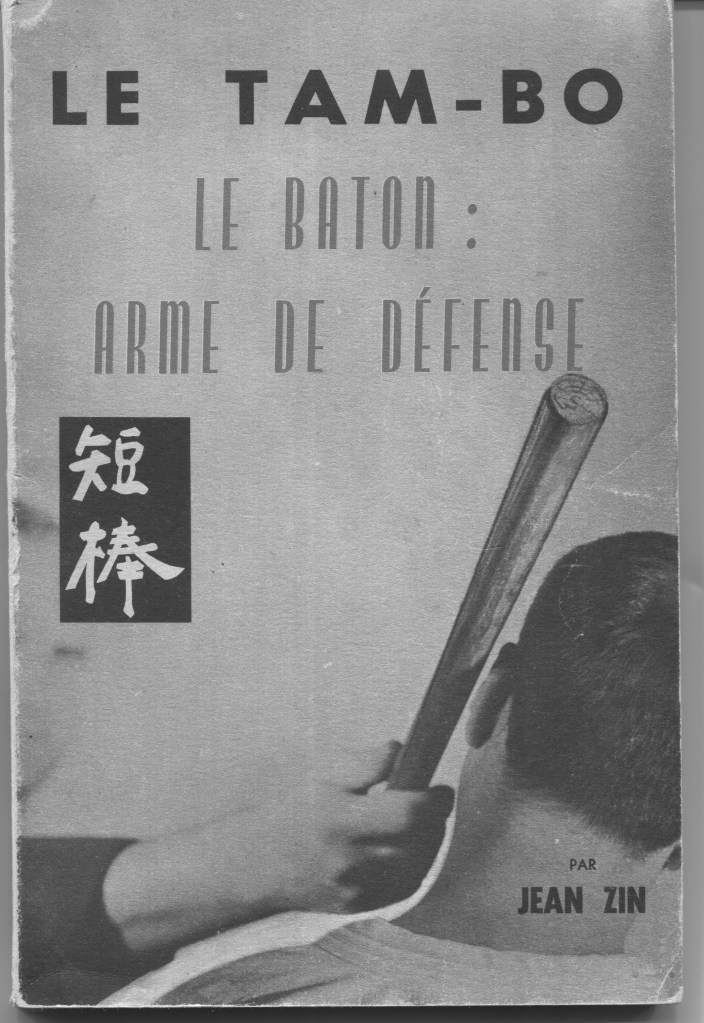
Nidan grading focuses on traditional pre-war techniques and a kata based on the concept of kuzushi. Demonstrating the randori concept requires the opponent to demonstrate a flexible resisting action.
Sandan’s grading demonstration is based on pre-war techniques. Weapons such as tanto, bokuto, and jo are demonstrated at a fundamental level. The randori concept is demonstrated with a flexible resistance action by the opponent, who can try to take over the actions of the defender.

The Fundamental Principles are the core of the grading demonstration. Without these fundamentals, the candidate will be failed by the panel or examiner.

If a candidate wins 1st place in a major tournament, they can climb up in the dan-I ranking without a formal grading demonstration.

Higher levels are a matter of technical proficiency demonstration or promotion for special services.

The Dark Side of the Dan Ranking

The Dan ranking system has a financial aspect. Promotion fees must be regarded as income for the organization.
The organization’s prestige has a significant impact. Being promoted by a well-known organization is what most people prefer. Regrettably, this is not always a proof of understanding and skills.
Nishioka Tsuneo’s book focuses on the compromised aspect of dan ranking.

A cure?

Finding a cure is not a problem. But accepting the cure is for most of the people the obstacle.

Do you have a passion for improving your skills? Your training is all about having enthusiasm. To enhance your skills, you need this secret ingredient. Even at a certain age, enthusiasm remains necessary.

A piece of paper can look beautiful on your wall, but it is not guaranteed that you have the necessary skills to demonstrate your art.

Using a “walking” stick in Aikido

Historically, the majority of bladed weapons were used for military or police interventions. Of course, those who like to walk on the wild side are also using bladed weapons.
While bladed weapons are not allowed to be carried by civilians in most countries, they can carry a walking stick and use it as a weapon if needed.

The Western walking stick or cane became a popular item in Japan at the beginning of the 20th century. Some martial art experts transferred the Western method of using the self-defence “Cane” into a Japanese style of martial art method called “sutekki-jutsu” or “tanjo-jutsu”. The length of a “cane” or “tanjo” is about 3 shaku and the diameter is about 10 bu.
Shaku, sun, and bu are traditional Japanese measures of length, with a shaku measuring approximately one foot. One shaku equals ten suns, and one sun equals ten bu. One bu is equivalent to 3.03022 mm. Today, the shaku-sun-bu unit system is almost exclusively used for old-fashioned measurements such as measuring the length of swords and other traditional weapons, such as the roku-shaku bo.

Shindo Muso Ryu Jo-jutsu, one of the Japanese traditional Jo or staff schools contains a kata or sequence with a walking stick length weapon: Uchida Ryu Tanjo Jutsu

The picture above clearly shows a technique commonly used in Aikido. Of course, the question arises whether we can incorporate the “Shindo Muso Ryu Tanjo-jutsu” kata into our Aikido training.
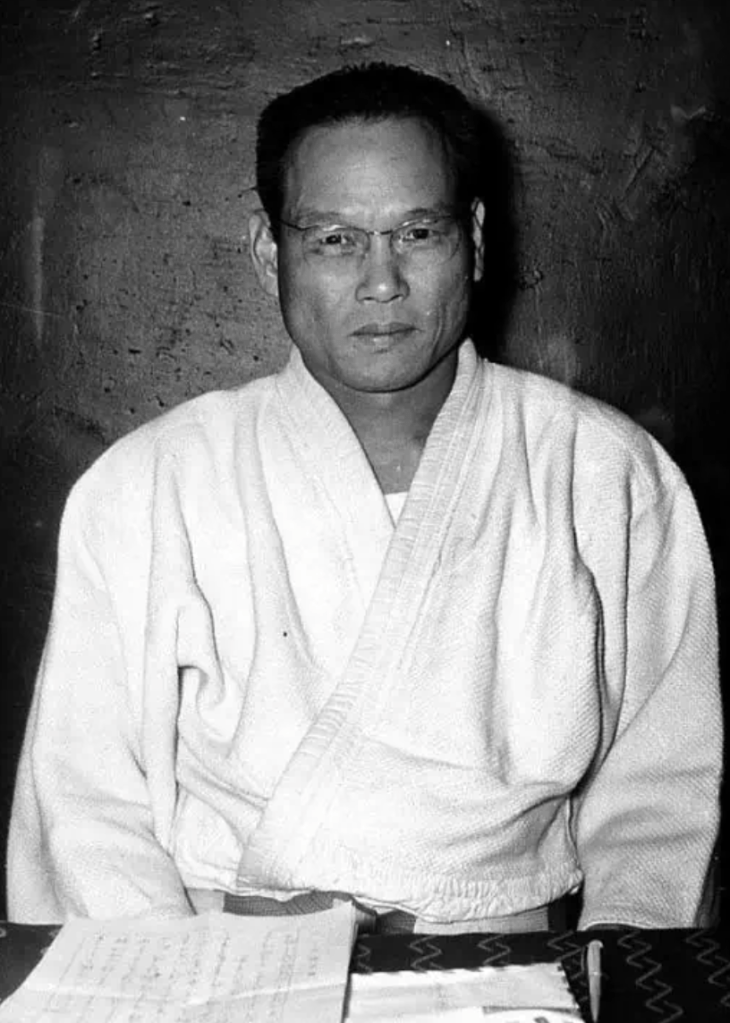
The Tanjo-jutsu kata is basically a formalized training sequence based on the use of the ‘Jo’, a 4-shaku, 2-sun (about 128cm) staff against a swordsman. Jodo is a specialized martial art that requires many years of training to become proficient in the use of the Jo and other weapons like the tanjo.
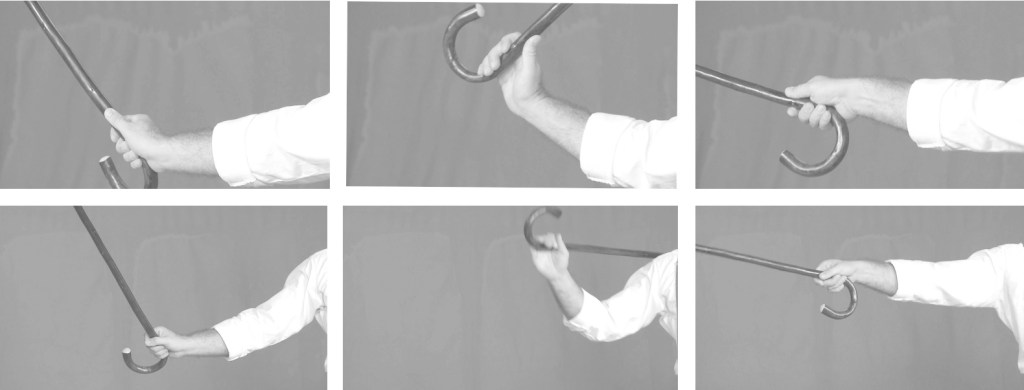
Introducing “suteki” into Aikido

There has been a few efforts to incorporate suteki, tanjo, or walking sticks into the practice of Aikido. One of the AikiKai teachers who uses a walking stick as a training tool is Kurowai Yoshio.
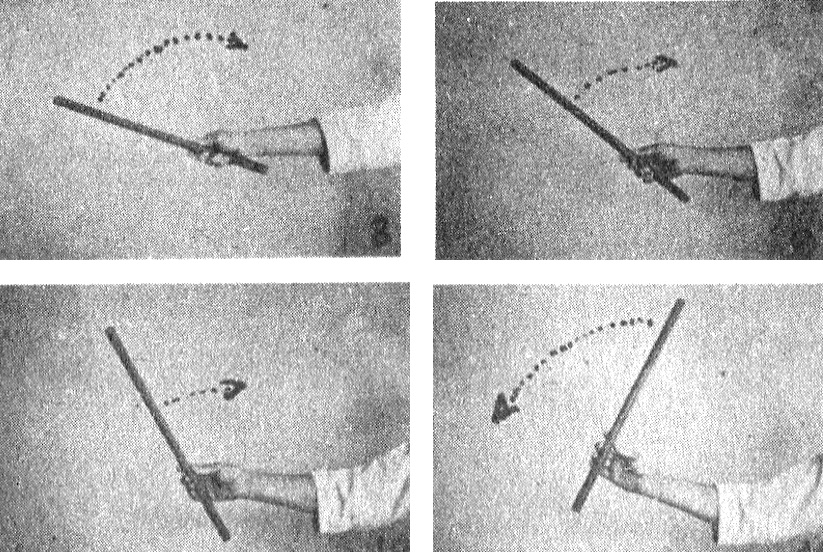
Kuroiwa Yoshio was a unique figure within the Aikikai. Although one of the senior postwar shihan, he refused rank past sixth dan. In fact, he simply refused rank all the way up the ladder until Ueshiba Kisshomaru (Nidai Doshu) personally requested that he accept a sixth dan, because dispatching him to teach in dojos without any rank was getting embarrassing. Kuroiwa was provocative, almost rebellious, but he remained within the organization — functioning at times like a grain of sand underneath an otherwise smooth mantle, but otherwise, largely ignored. He was technically original, with an utterly unique style of movement. Had he been a different man, and perhaps, if his health had been better, he could have started his own aikido group independently, like Shioda or Tomiki. Instead, he remained within the fold – but just barely.

In Memory of Kuroiwa Yoshio — 1932- 2010
by Ellis Amdur

The “stick” in Kuroiwa’s method has 2 main applications:

  • using the stick as an attacking tool in combination with “atemi” based upon boxing theory
  • using the stick to explain “basic techniques”, fundamentally the stick is used to visualise the traject of the movement.

Tambo or short stick

Another type of stick that can be used during Aikido training is the Tambo. The length of the ‘Tambo’ is 1 shaku 2 sun, approximately 37 cm, and is of course too short to use as a walking stick.

Jean Zin’s study with Tadashi Abe, known as a pioneer of Aikido in France, resulted in his writing two books about using a tambo.

Tadashi Abe

NameDimension (Jap)Dimension (Eur)Equivalent (bladed) weapon (Eur)
Hassaku-bo8 shaku±240cmSpear
Rokushaku-bo6 shaku±180cmHalberd (axe)
Jo4 shaku 2 sun±128cmSaber sword
Ham-bo/Tan-jo3 shaku±95cmSaber/Canne
Tam-bo/Tant-to1 shaku 2 sun or more±37cm/±45cmDagger

The wrist movement

Using a stick with wrist movements requires the correct grip. When the thumb is on top of the stick, it serves as a support for wrist movement. The wrist movement is more initiated by squeezing the 3 fingers (little finger, ring, and middle finger) when the thumb is folded. Usually, the thumb will be held in a folded position.

Manipulation of a tambo is almost the same as using a tanjo and a walking stick.

In order to impart the most kinetic energy into the target, you have to hit at a right angle (1). Anything else, the energy will dissipate in different directions.

As usual, every action has 2 sides. When you want to deflect an incoming force with your stick, you must change the angle, there will be a lesser impact (2). The kinetic energy of the attack can be used when you strike or stab the opponent.

Range of efficiency with “suteki”

The range of efficiency is similar to the kind of ranges used in traditional Japanese martial arts The efficiency range is comparable to those used in traditional Japanese martial arts, particularly sword fighting.
Generally speaking, there are three levels of fighting distance: toma, issoku-itto, chikama.

  • Toma is the far distance when one’s sword is not touching the opponent’s sword in any way.
  • Issoku-itto is the distance from which one can strike correctly with a single large step.
  • Chikama is the close distance when the swords are crossed near, but not at, the tsuba.

In reality there is a fourth distance. Tsubazeriai is the extreme close distance when the tsubas are pressed together. You can compare it with clinching in boxing.

Offensive and defensive footwork

Footwork is an important element in training to optimize the efficiency of techniques.
Offensive footwork is mostly done when stepping forward towards the opponent and using an offensive technique, such as striking or stabbing with a stick.
To avoid an incoming attack, defensive footwork is usually done by stepping back with one or both feet. Defensive footwork can be used to practice different types of blocking with a stick. But certainly, defensive footwork can be used to us offensive striking or stabbing.
These are just some basic formats, of course. Various formats can be explored during the training.

The footwork can be practiced using an isolated method. Tomiki’s basic footwork pattern demonstrates both offensive and defensive footwork.

Striking and stabbing

A stick can be used to perform basic arm and hand movements. Tomiki’s Tegatana Dosa is a training method that can be applied with a stick or other weapon.

  • Shomen uchi – vertical striking with the weapon
  • Shomen tsuki – stabbing with the weapon
  • Uchi mawashi – circular inside striking
  • Soto mawashi – circular outside striking
  • Uchi gaeshi – circular inside blocking
  • Soto gaeshi – circular outside blocking

These movements can be practiced in a variety of formats. Here is a sample.

Partner training

This type of training can be done after someone has sufficient skill in manipulating a stick. Different types of training can be used depending on the goal you want to achieve with such training.

Using a ‘chambara’ stick is an ideal method for practicing without the danger of inflicting an injury on the opponent.