Translating Tomiki’s Budōron

Translating Kenji Tomiki’s “Budōron” (武道論): Critical Concepts Requiring Clarification

The translation of Kenji Tomiki’s “Budōron” (武道論 – “Theory of Martial Arts” or “Discourse on the Martial Way”) presents unique challenges due to its rich philosophical content and historical context. Several critical concepts in this seminal work require careful clarification to preserve their full meaning and significance.

The ultimate goal in translating Budōron should be to make Tomiki’s innovative martial philosophy accessible to non-Japanese readers while preserving the depth and subtlety of his thought. This requires not just translation in the narrow sense but genuine cross-cultural interpretation that builds bridges between Eastern and Western philosophical traditions.

The Significance of “Budōron” as a Text

The title itself—”Budoron” (武道論)—merits examination:

  • (Bu): More than just “martial,” this character encompasses military matters, combat, and the control of violence
  • (Dō): Beyond “way” or “path,” this indicates a life discipline and philosophical approach
  • (Ron): Signifying “theory,” “discourse,” or “treatise,” this indicates a systematic philosophical exploration

This work represents Tomiki’s comprehensive philosophical framework for understanding martial arts in the modern world, bridging traditional practice with contemporary educational values.

Critical Concepts Requiring Clarification

1. Technical-Philosophical Terms with No Direct English Equivalents

Terms like “waza” (技) and “kokoro” (心) appear frequently in Budoron but resist simple translation. “Waza” encompasses technical skill, practical application, and artistic expression simultaneously. “Kokoro” represents the unified heart-mind-spirit complex that Western languages typically separate.

2. Historical Transitional Concepts

Tomiki writes during a pivotal period in Japanese martial arts history. His discussion of the transition from “jutsu” (術) to “dō” (道) marks not merely a terminological shift but a profound reconceptualization of martial practice from battlefield techniques to paths of personal development.

3. Complex Educational Philosophy

Tomiki’s contrast between “tanren-shugi” (鍛錬主義 – discipline-oriented principle) and “goraku-shugi” (娯楽主義 – recreation-oriented principle) requires careful explanation. These aren’t merely opposing approaches to physical education but represent different philosophical orientations toward human development itself.

4. Religious and Ethical Dimensions

The text contains numerous references to Buddhist concepts (無心 – mushin, 不動心 – fudōshin), Confucian ethical principles, and Shinto perspectives. These require contextualization within Japanese religious traditions to be fully understood.

5. Evolution of Technical Systems

Tomiki describes the systematization and differentiation of martial techniques using terms that carry nuanced meanings in martial contexts. His discussion of the standardization of “kata” (型) and development of “randori” (乱取り) reflects not just technical evolution but philosophical adaptation.

6. Socio-Political Context

Written in the post-war period, Budoron engages with the transformation of martial arts from militaristic training to democratic education. Terms like “minshū kyōiku” (民主教育 – democratic education) carry specific historical connotations related to Japan’s post-war reforms.

7. Metaphysical Concepts

Tomiki frequently references East Asian philosophical concepts like “ki” (気 – vital energy or spirit), “wa” (和 – harmony), and the principles of yin-yang and the five elements. These require explanation of their traditional metaphysical foundations.

Translation Approach Needed

Translating Budoron effectively requires more than linguistic conversion—it demands:

  1. Contextual notes: Providing historical, cultural, and philosophical background
  2. Conceptual mapping: Explaining how Japanese concepts relate to Western philosophical frameworks
  3. Terminological consistency: Maintaining consistent translations while acknowledging the limitations of English equivalents
  4. Explanatory expansions: Sometimes expanding one Japanese term into several English phrases to capture its full meaning
  5. Preservation of ambiguity: Where Tomiki intentionally employs terms with multiple meanings, preserving this richness rather than narrowing to one interpretation

The Book: Budōron

The book appears to be organized into three main chapters plus an introduction, conclusion, and commentary sections:

Major Structural Components

  • Introduction: “What is Budō?” (6 subsections)
  • Chapter I: “The Modernization of Budō…Harmony of Tradition and Modernity” (7 major sections)
  • Chapter II: “What is Judo?…From “Waza” to “Michi”” (6 major sections)
  • Chapter III: “Modernization of Aikido…Creation of Competitive Aikido” (4 major sections)
  • Conclusion: “Educational Love and Physical Education” (4 sections)
  • Commentary section

Essay Count Estimate

Counting each major numbered section as a distinct essay (as they appear to be standalone pieces compiled into this volume):

  1. Introduction: Contains 1 comprehensive essay with 6 subsections
  2. Chapter I: Contains 7 distinct essays
  3. Chapter II: Contains 6 distinct essays
  4. Chapter III: Contains 4 distinct essays
  5. Conclusion: Contains 4 distinct essays

Total estimated essays: Approximately 22 separate essays or articles

This estimate is based on the structure visible in the table of contents. The book appears to be a compilation of Tomiki’s writings on martial arts philosophy, likely published over several years and brought together in this volume. Each numbered section has its own title and appears to be a complete piece that could stand alone, suggesting these were originally separate essays or articles that have been organized thematically into chapters.

The comprehensive nature of the collection, spanning from fundamental questions about the nature of budō to specific discussions of judo and aikido techniques, indicates this is a substantial compilation of Tomiki’s philosophical and technical writings on martial arts.
Aikidō: A Matrix Budō

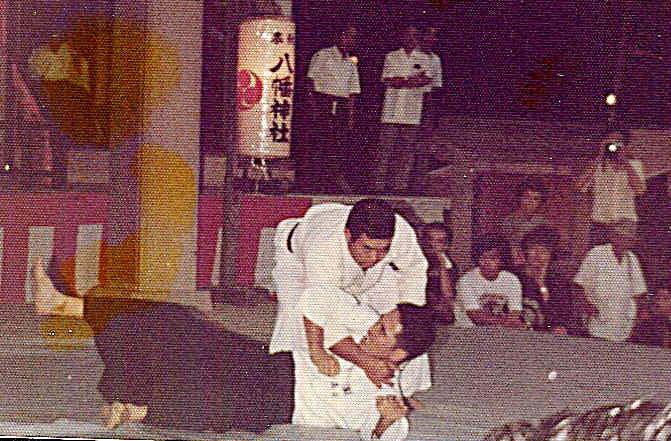
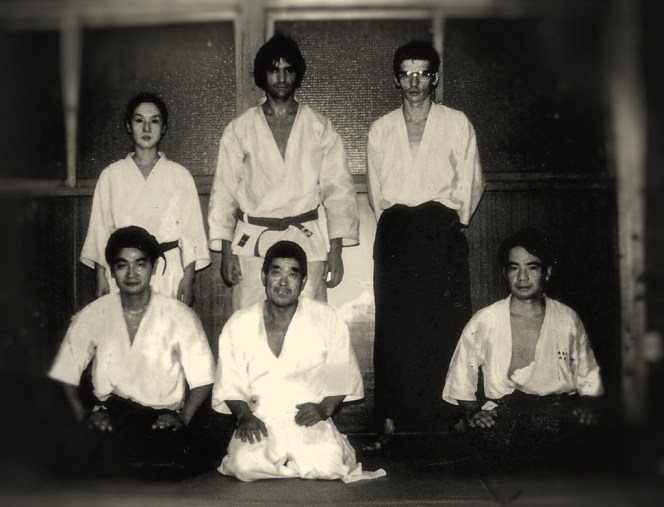
In 1976, I stayed for several weeks in Shizuoka Japan and practised mostly Korindo Ryu Aikido with Hakamatsu sensei, a Shihan of Minoru Hirai Korindo Ryu. I didn’t really understood very well the principles and concepts of this martial art. But I made a lot of notes in my martial art diary. From time to time I am re-reading my notes and I discovered some secrets which I didn’t understood very well in that time.

The ideas and concepts taught to me in 1976 by Hakamatsu sensei are not opposing the ideas and concepts of Kenji Tomiki sensei and Hideo Ohba sensei. I was thaught by Hideo Ohba in Okubo Tokyo a few years later and I didn’t realize the similarities at that time.

It was a shocking idea to discover the concept of “Matrix* Budō “. One of the most important principles is to apply a single set of basic forms of exercise, which contains all vital movement elements, to all types of combat. These forms are contained in the developed taisabaki (tandoku undo). This taisabaki is the basis of all forms of movement, from which all techniques arise. A botai-budō or matrix-budō.

This concept was in the mind of Kenji Tomiki, when he was rationalizing Ueshiba’s Aikido. He formulated unsoku-ho and tandoku undo, containing the basic information for further development of the practitioner. Together with some other fundamental principles, a unique system is created which included kata and randori.

*Matrix = Botai (母体) = whomb, uterus

Don’t become fixed on techniques. Create your own waza.

Matrix

Matrix: an environment or material in which something develops; a surrounding medium or structure.

Matrix Budō

Minoru Hirai was the founder of Kōrindō Aikidō, a martial art based upon older forms of Jujutsu, Kenjutsu and other Japanese martial arts. He was also during World War II a director of Kobukan, Morihei Ueshiba organisation. Minoru Hirai introduced the word aikido as a generic term for Japanese martial arts not associated with Judo or Kendo. Basically it can be said, aikido is a term to define martial arts auround the “aiki” principle. (see also Minoru Hirai Korindo Aikido). As usual, the information on Wikipedia is based sometimes upon the view of one person or group and can be controversial for other persons.

Hirai’s martial art developed over time into what he calls Matrix Budō “, which is not based on a multitude of different techniques, but is based on a single principle practised during taisabaki movements:

The harmoniously round circle (enten) and ball rotation (kyūten) expressed by koshi-mawari in a number of forms of movement called taisabaki.

Koshi-mawari taisabaki serve as the basis in order to acquire efficient natural movement.

From koshi-mawari taisabaki, you develop a natural, rotating-flowing movement mode. Out of this, techniques are created unintentionally and adapted to the constantly changing situation, with which the attacker can be controlled and thrown because one does not oppose the attacking force. In order to acquire the movement of koshi-mawari taisabaki the following forms of exercise are practiced in training:

  • 7 or 8 forms of movement (taisabaki), which are initially trained individually, then in combination, and finally with a partner;
  • Partner forms to deepen the correct posture and the approach of every movement;
  • Randori means free attack and free movements in order to spontaneously realize the principle of koshi-mawari.

Enten

円転 Smooth circular motion; spherical; rolling smoothly; (with) smooth circular motion

The principle of giving movements a circular, flowing, non-okori course. The circular movements can be thought of as horizontal and vertical rotations.

Okori: The approach or initial impetus that usually initiates a movement. As a result, an attack usually reveals itself at the moment it arises. This happens often when attacker lauch a strike by stamping his back leg into the ground to create momentum or using a stamping front leg to give more power in the (tanto)strike. This can be avoided by using ashi no korobi or rolling feet or using a short tsugi-ashi after adjusting ma-ai.

Kyūten

球転 Ball rolling, ball rotation

In Chinese martial arts, the concept of Dantian and Chan Si Gong (silk reeling exercises) is related to kyūten and tenshi & tenshikei (discussed earlier).

from: Narita Shinjūrō – Kōrindō Aikidō

The ball rotation is perfectly round at all times. It has no corners or edges. Thanks to the rotations of the ball with this form of movement, continuous changes in direction are always possible. One could also describe the rotations as the sum of all angles of a circle. In Budo, the angles at which the two opponents meet play a critical role for victory or defeat, since each of the opponents tries to avoid the attack of his opponent in some way in order to get to the target with his blow. How to design the relationship of the angles to an attack line for your own advantage is therefore one of the decisive questions in every style.

Hirai came to the conclusion that it was not necessary to deliberately choose an angle of attack or defense against an opponent, but it was enough if one acted on his rotational movements from the angular fullness of the rotations of a 360 degree circle. Because when you implement the circular principle in your actions, you move completely freely and unhindered, because every movement always includes all contact points as they lie on a 360-degree circle. The sum of the angles of a circle remains the same, regardless of its size, although the smaller the circular movements, the more favorable it is for our purposes. In the thousands of possibilities, any one of the opponents will always be captured.

Since a circle encompasses a total of 360 degrees, any other shape, no matter how polygonal, would be less favorable in any case, since it must inevitably always have blind spots. As a result, gaps arise in defense, where one is inevitably defeated. Without this principle as a matrix, there can hardly be any effective taijutsu, kenjutsu or jojutsu. If it is possible to acquire koshi-mawashi, everything else will follow naturally.

To illustrate the effect of the koshi-mawashi principle, one can imagine the following: hold a sword horizontally sideways and turn from the center, i.e. koshi. Each angular point of the circle will be full of energy.

This effect can also be shown by a partner exercise from 7hon no kuzushi

This is something that every human being is able to accomplish. Every student has the opportunity to learn aikido with sufficient effort, since everyone is naturally capable of these circular or spherical movements with their 360 degrees.

With this form of movement, you have an unlimited number of hit points on the 360 degree circle, at least one of which inevitably contains the opponent’s hit point location. With the circular or spherical movements (Kyūten), you reliably reach the crucial point. Everything depends on the skill of moving the body with a circular or spherical pattern and able to to generate power to the opponent from each point of circle created by koshi-mawari taisabaki.

An opponent who fixes his attack on only one point only has this one chance. On the other hand, if you trust in the infinite number of angular possibilities, you are definitely in an advantage, because you can generate power from any point of your circle to an opponent’s vulnerable point.

Beyond that, no further considerations or techniques are required. Because of the fact that, in contrast to the opponent attacking with only one possibility, you have this unlimited number of angles, and you are able to master it completely, you can overcome it. Since this can hardly be achieved with rehearsed, fixed and therefore rigid techniques (katachi), it is better to work with the kyūten principle. This in turn is inextricably linked to the term yawara (suppleness).

Kyūten can be considered as a yōso or fundamental principle and is used under different names.

Basic Tomiki Aikido Kata (Basic15 or 17…) can only be considered as an effecient method, when taking in consideration fundamental principles (yōso) and the evolution from katachi to kata. The different waza cannot be considered as techniques, but as an expression of fundamental principles of Budō. By using randori, waza becomes alive. As Tomiki sensei mentioned: we need randori to paint in the eye of the dragon.

Achieving smooth movements must be regarded as one of the most important prerequisites for successful Budō. Jerky, forcefully applied techniques have the disadvantage that each new movement starts from a standstill. The absence of circular or spherical movements needs a forcefully start of a linear movement, which is easily detected by an opponent. Remember, kyūten is a skill for instant power generation and movement. This type of movement cannot be learned solely through the appropriately determined handles and tricks

These rotational and smooth movements are inseparable linked to the concept of yawara (suppleness). Rather, this idea of yawara* (JU in JU-do or JU-jutsu) is the physical expression of an inner attitude, which is often expressed in terms of harmony. Internal tension and aggressiveness would prevent the development of suppleness. As it is free from tension, it represents the most natural of all forms of movement and finds its equivalent in the concept of enten-mukyu**, the endlessly flowing and spherical twists.

*The kanji for yawara and ju in jujutsu is the same (柔). For Tomiki sensei “ju or yawara” is the principle of gentleness and it is similar to “aiki”, which is an explanation of the principle from within. Remember it was Minoru Hirai who introduced the word “Aikido” to make a separate division in Dai Nippon Butokukai. The word “aiki” was used by different Ryuha and it was difficult to bring them under the banner of Kodokan Judo.

**Endless circular movements. Can be considered as a Buddhist concept of Karma. After Buddhism was introduced to Japan, people easily accepted the notion of karmic retribution but not the literal belief of rebirth as animals or lower life forms. Transmigration of the soul focused more on the practical path to liberation.

Koshi-mawari

Koshi

Physiologically the pelvic area of the human body. It is also related to the lower back and sometimes it is referring to the waist. It is often translated by “hips” and referring to the hip joints although this is not completely correct. See “Koshi or other blog post and do a search with “koshi”.

Koshi-mawari or koshi-mawashi

The difference between the two terms koshi-mawari and koshi-mawashi is a grammatical one and consists in the fact that this is a question of a transitive and an intransitive verb form.

In practical use, the transitive form “koshi mawashi” means that the rotations are deliberately started, while koshi-mawari points to automatic, naturally occurring rotations by koshi.

Taisabaki

Some practitioners believe taisabaki is just avoiding an attack. This is only a small part of taisabaki. Basically it means a moving body.

Taisabaki has 3 elements;

  • Ashi-sabaki – concerning the feet and legs
  • Te-sabaki – concerning the hands and arms
  • Koshi-sabaki – concerning the central body, especially the lower part

How to……?

In fact, your training is not about winning or losing a match or a combat. It is about your attitude towards an unknown territory named Budō. In Budō-land are no rules or descriptions how to do a technique. There are only Yōso or fundamental principles. If you cannot see them and understand, you will not be a real Budō-ka (a martial art practitioner). You will rely on brute force and driven by primitive desire to win.

In these blog-posts, there are many indications how to master fundamental principles. If you can integrate them into your martial art practise, I believe you are on the right path of Budō.

Anyway you can have more ideas here