Ma-ai, a question of space

Budo movement can be understood as communication between two persons mediated by the body, that is usually considered two separate and independent bodies but rather should be considered integrated as one body communication system.
The point where two bodies (in Budo) becomes one body communication system depends upon the condition of the interface between the two bodies or persons. (from: Movement of Budo by : Yosuke YANASE )

A communication system is a moving construction and when communication stops there will be no movement anymore.
During a moving process, the feeling of safety is very important and is expressed by the skill of “rikakutaisei, fighting from a distance”.
Distancing or using the appropriate distance during a confrontation is a skill often used in martial arts but also in other fields of human behaviour.

Ma-ai, a dynamic concept

In Japanese terminology, distancing is ma-ai (ma, spatiotemporal interval 􏰀 ai, harmony). Ma-ai integrates space, time, and rhythm and is the ideal situation to control a confrontation.
Controlling the situation or in other words “controlling the actions of the opponent” is depending on Hyoshi.
Ma-ai is not a fixed distance, it is dynamic. Depending on the situation, distance will change.

Safe and unsafe distance

In another post, ring of power, the concept of a close distance was used to practise posture and power through a grip on opponent. Before we have a proper grip on opponent, we need some skills to gap the distance between you and opponent.
These skills incorporate the concept of safety by using “rikakutaisei” or fighting from a distance.

Basically we can distinguish 3 kinds of distance during a confrontation.

  • When there is no physical contact it is called To-ma.
  • Making physical contact but still safe in your own environment it is called Uchi-ma.
  • Chika-ma is the distance for using power. Without controlling opponent actions it is very unsafe.

Don’t confuse distancing or ma-ai with the 3 kind of distance. In each distance, the skill of ma-ai can be used.

Rikakutaisei, fighting from a distance

Rikakutaisei is a word to describe the expression “fighting from a distance”. In general this is explained as a distance when using “tegatana awase” distance. Of course to attack we have to come closer. The attacking distance is depending on the use of ma-ai or distancing.

We know space is expressed by the word “Ma” and it is not fixed distance. Controlling the actions of opponent can give an opportunity to attack. The example here is from “uchi-ma” entering into “chika-ma” to apply power or in other words “a technique or waza”.
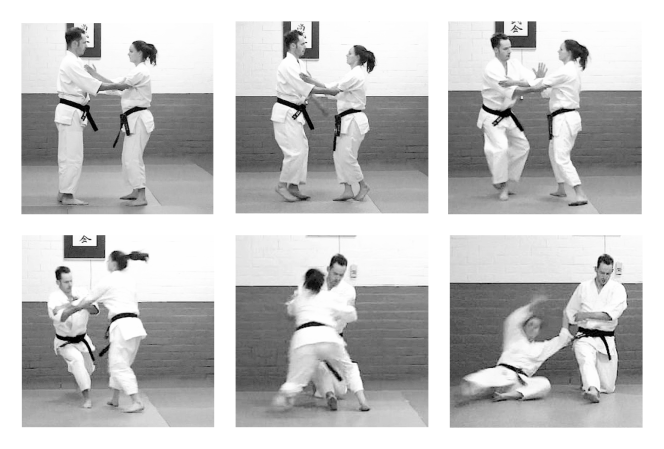
Closing the gap between you and opponent

As with everything in martial art, there are many solutions for 1 problem. It depends on the level of the practitioner which skill is used.
To create such skills, basic training is used to ingrain basic movements into the subconscious mind.

Stepping skills
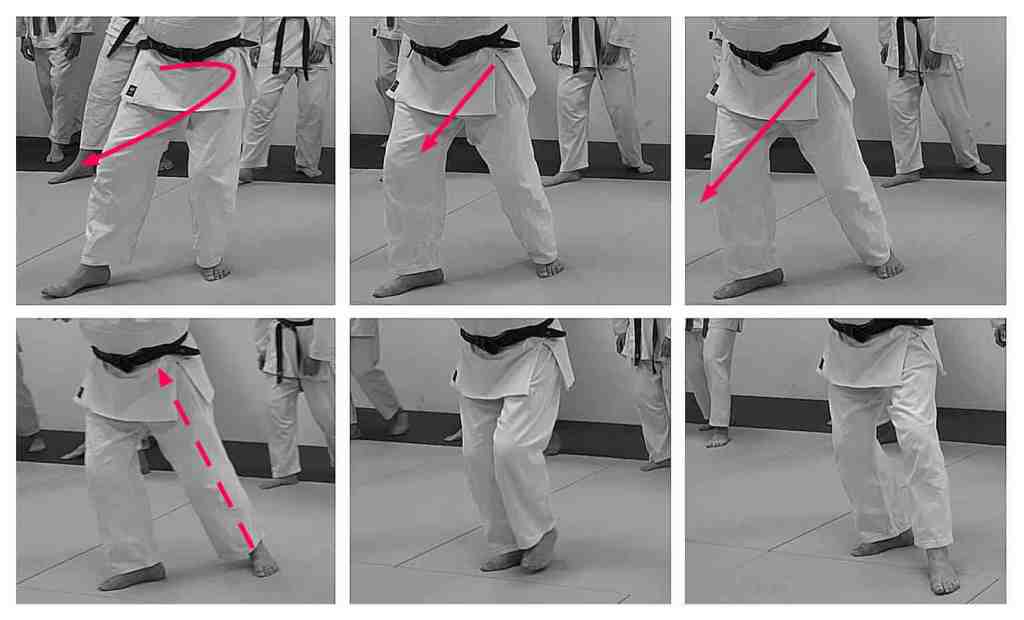
During unsoku-ho, basic patterns are used to practised stepping skills. In this exercise the skill of tsugi-ashi is practised.
Bridging a long distance uses mainly a ayumi-ashi stepping method and will be practised separately.
Controlling skills
If we only use stepping skills it is possible we can control an opponent without touching. But at a certain point in a confrontation we have to take a decision and use our hand(s) and arm(s) to create a definite solution.
There are many armskills to control an opponent. In the various kata, examples are used to have training in the control of aggression.
To understand the principles of aikido, we use our body as a communication tool.
The example below shows a kind of body turning, an important bodyskill. Uke is grasping the arm, Tori is not changing the interface of the grip. Tori uses the turning of the body and at the end of the turning the power of the turning is entering into the body of Uke. The distancing performed by Tori is necessary to perform the bodyturn and to use “tenshikei”.

Internal and external distancing

Distancing or ma-ai is not only depending on stepping methods, but can also performed when we cannot do stepping skills.
As in the previous example, the body can turn without changing the interface of the grip by Uke.
How is this possible?
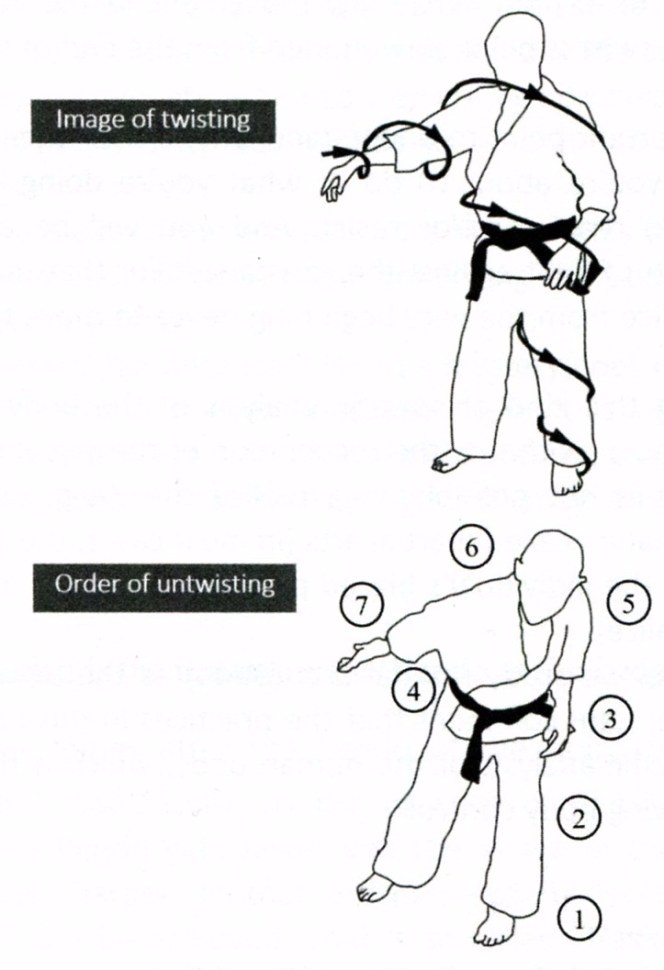
If some is twisting your arm, your muscles are wrapping around your skeleton. The power of the twist is stored in your muscles but also in your tendons. Tendons have a great capacity to store energy. This energy can be released. This action is a clever way to use distancing internally.

Some clarification

Most of the material discussed in the blog articles is my interpretation of the various teachings learned and practised during seminars, workshops and long-term training periods with interesting people.
Sometimes I am using material to explain some topics with images found in articles and books. Mostly I provide the source of the images, but sometimes I fail to mention the source. I apologise…..
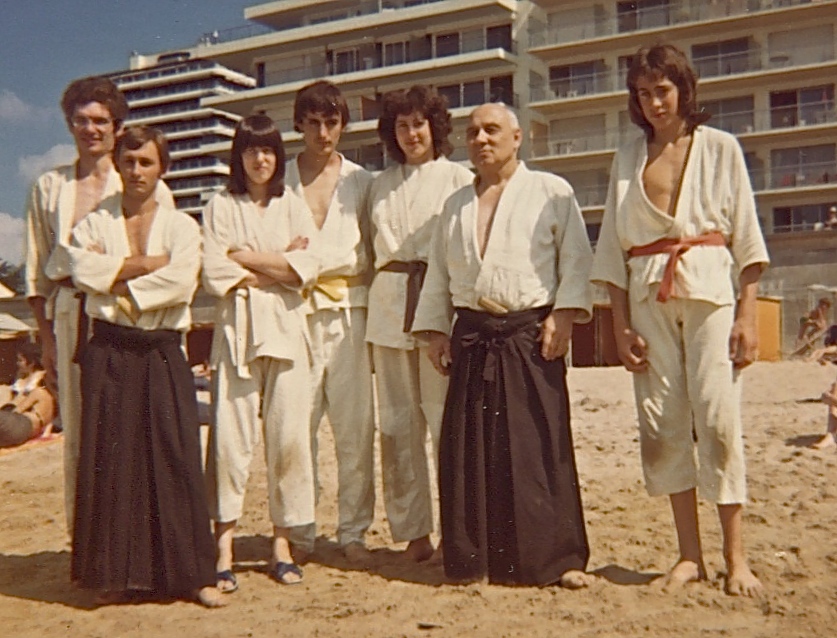
2-weeks seminar with Andre Nocquet – La Baule/France 1972

Fibonacci, tenshikei, meguri

Practising for health purposes is an assumption often made by marketeers for a martial art like aikido, based upon a balance between soft and hard. Movements are created following a spiral pattern. It gives a perception of harmony which is another assumption.
When aikido is promoted as a competitive sport, other factors become also important. Fitness, stamina and muscle power come to the foreground.
Although it is said “sport is healthy”, we cannot deny the many injuries of competitors. These injuries come mostly from abusing the body with the purpose to win a game.
On the other side, self-defense is also built upon using our body as a weapon against an opponent. It takes time to internalize aikido patterns in the brain. Fitness, stamina and muscle power are a solution to work around the long term vision of aikido training. Of course fitness and stamina are necessary in order to carry on the training of aikido.
Harmony during movements is a sign of aikido skills and it takes time to become skillful.

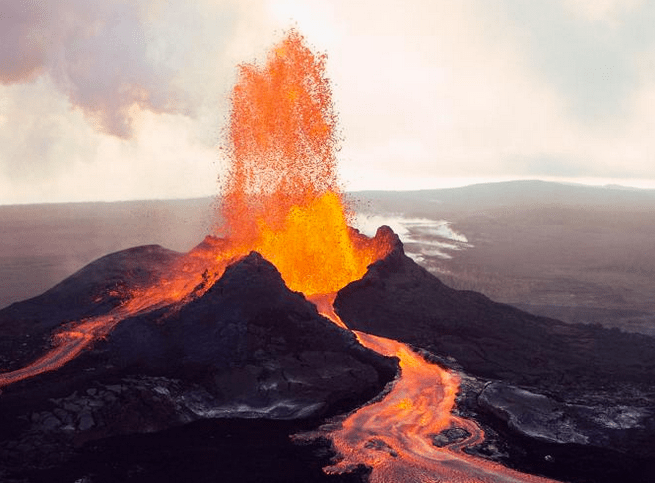
If we look around in nature, harmony can be seen in everything where human kind is not involved. Even the eruption of a volcano has harmony in the movements of the lava.
Is there a secret formula in nature for harmony?

Fibonacci sequence or spiral

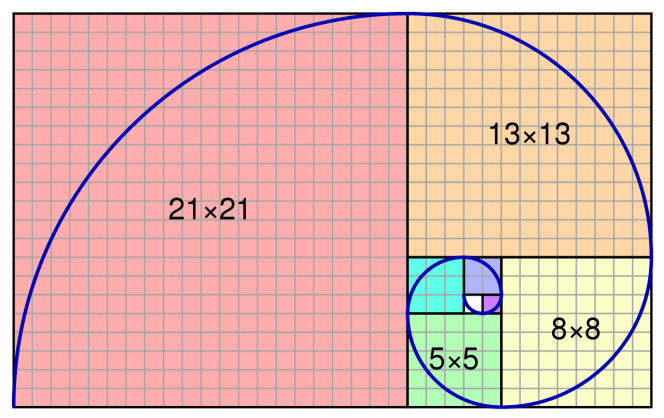
The Fibonacci spiral based upon the sequence is already mentioned in another blog post, namely The Switch.
But as your read more about these magic numbers more confusion will come into your mind.

The Fibonacci sequence is one of the most famous formulas in mathematics.
Each number in the sequence is the sum of the two numbers that precede it. So, the sequence goes: 0, 1, 1, 2, 3, 5, 8, 13, 21, 34, and so on.
It’s true that the Fibonacci sequence is tightly connected to what’s now known as the golden ratio. Simply put, the ratio of the numbers in the sequence, as the sequence goes to infinity, approaches the golden ratio, which is 1.6180339887498948482… From there, mathematicians can calculate what’s called the golden spiral, or a logarithmic spiral whose growth factor equals the golden ratio.
more Fibonacci

1-1-2-3-5-8-13-21-…..

The Fibonacci sequence and human movement

Can we use mathematics to create a better movement? Some consider that there is a relation between our movements and the Fibonacci sequence.
Unfortunately there has not been much research on this matter.
In the field of dance and performance art Fibonacci sequence is utilized to make an image of harmony for the spectator.

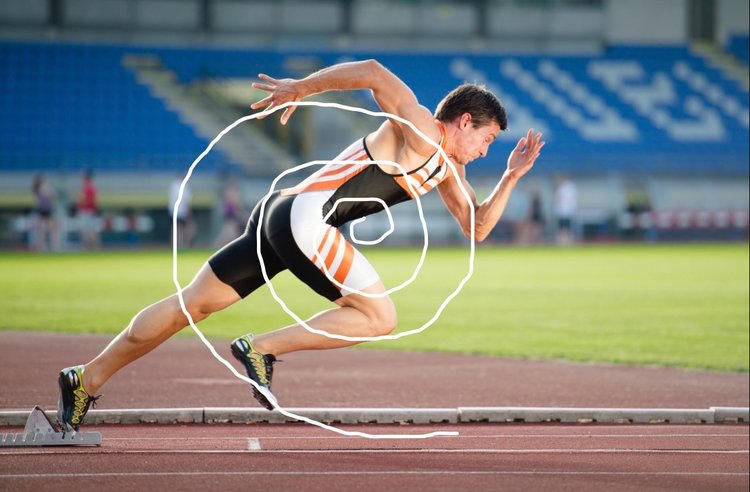
Some research is done in the field of athletic sprint.

And Martial Arts?

In karate tsuki ( straight punch), some practitioners are alluding to the Fibonacci ratio. The fist is turning at the end of the trajectory following the Fibonacci ratio.
And what about Aikido, especially Tomiki’s method.
There is no real research in Tomiki Aikido to explain some movements according to the Fibonacci sequence.
Why should we use of Fibonacci formula?

How to transport “force”

The source of power under the best conditions is the ground, the body with all the elements – skeleton,muscles,tendons,fascia,….) are the tools to transport the force to the target.
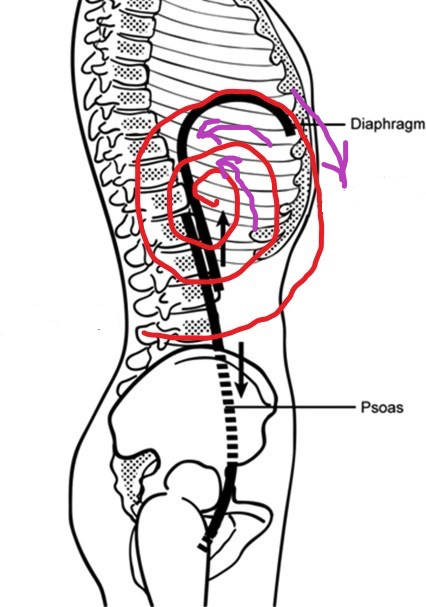
Internal constructions are spiral force pathways and can be used to change the direction of the force. As we see above in the runner picture, there is a possibility to add a Fibonacci spiral. The picture at left is from the article “athletic sprint” mentioned earlier.
Eventually we can use kyokotsu to trigger a kind of internal Fibonacci spiral like the runners spiral.

The power at the target

The power at the target can be optimized with the Fibonacci formula. Think about “meguri” or spiral action when applying a technique. Or what about tenshikei or rotational power. Spiral power will be generated most efficiently when our structure is optimized. The Fibonacci spiral is not powered by itself, but is a tool to increase the acceleration during the transport of the force from the ground.

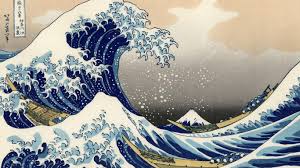
The power at the target can be compared to the power of the waves at the sea

An example how to adjust with a Fibonacce spiral

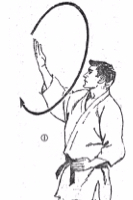
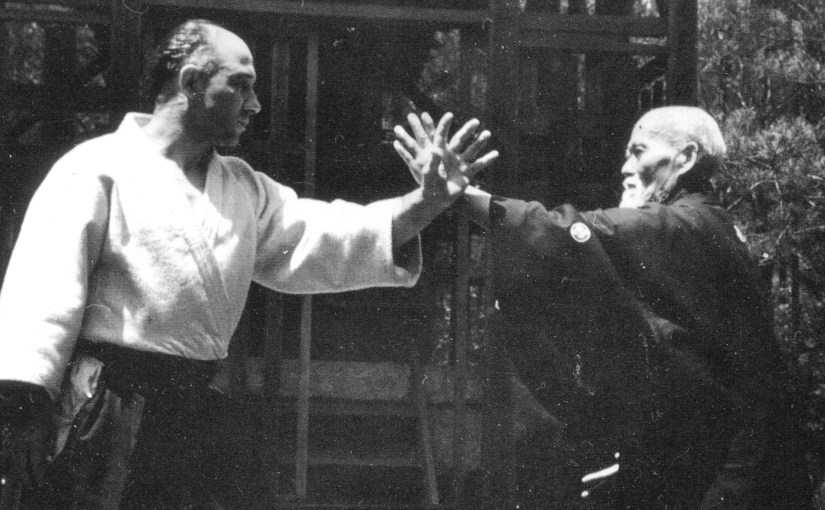
The picture above at the left gives shows a Fibonacci spiral in “uchi mawashi” movement. The picture at the right is from an old Tomiki book “Goshin Jutsu” and the Fibonacci sequence cannot be seen in this drawing.

Tenshikei and Fibonacci

Using the concept of tenshikei and the Fibonacci sequence will increase the power of acceleration due the longer distance. See further about Tenshikei.
Uchi mawashi will become more efficient together with the appropriate displacement of the feet. See “Tsugi Ashi“.

Tenshikei or the rotational power is generated by rotation of the body internally and is expressed by the movement of the arms or legs.
Using the spiral construction of the body, the length of the transport from the floor to the hand can be compared with the bullet in the barrel of a rifle. The construction of the riffle’s barrel creates a spiral action on the bullet and increases the acceleration of the bullet.

Leg spirals can also make the force at the target more powerful.

Final solution?

There is no final answer for the problems we encounter during martial arts training. Our body is a very complicated construction and many movements facets will influence our way of moving around. Also the mind has an influence on the body movements.

The Fibonacci sequence can be used as a proportion rule in our movements. Sometimes we start with a small circular movement which grows to a big one. In another situation we go from big to small. A perfect movement can happen but we cannot copy because the circumstances are always different.
By keeping to the principles, our body will react with the best solution at the right moment if we don’t interfere with the conscious mind, let the unconscious mind do the job. Nature will do it’s job.