Hachi Danken (Kiko/Qigong)

Qigong, known as Chinese Breathing Exercise, is a holistic system of coordinated body postures and movements, breathing and meditation used for health, spirituality and martial arts training.
Kiko is the Japanese word for Qigong. Hachi Danken is Badua Jin’s expression from Japan.
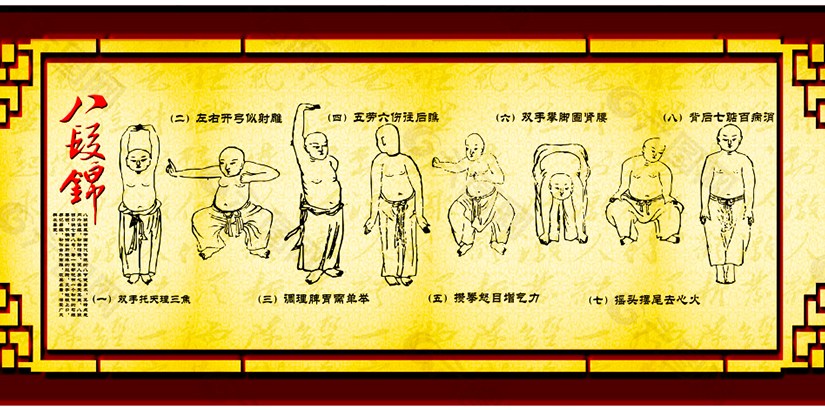
The Baduanjin qigong (八段錦) is one of the most common forms of Chinese qigong used as exercise. It was primarily designed to be a form of medical Qigong, to repair injuries and enhance global health. It is also used as part of the training regimen in certain martial arts.
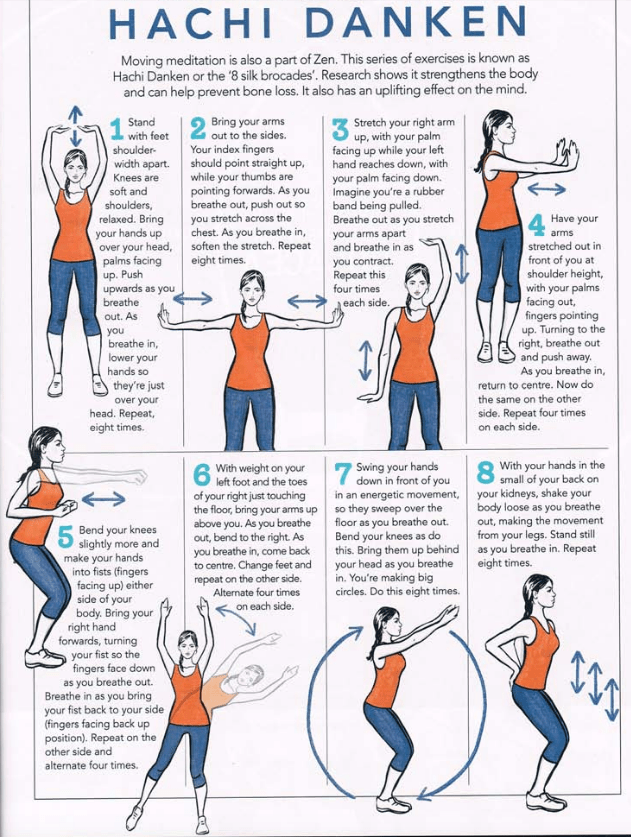
Hachi Danken

The Japanese version of BaduaJin, exercises aimed at enhancing the flow of energy in the body.
Like with Aikido and other martial arts, there are many versions of these millennial exercises. Although most versions taught today are from recent times.
The Chinese government has made great efforts to streamline the old ways of moving the body for martial or health purposes.

Standing

Every session start with a moment of standing.
In martial arts terminology we speak about “shizentai” or natural posture.

Diaphragm and pelvic floor muscles

When learning the exercises, you must be conscious of your diaphragm. When you can localize your diaphragm you can push down it after breathing in, you can relax and breath out. Don’t force the breathing. It must be smooth and no sounds. Try to avoid breathing in with the mouth.
A very difficult part of the exercises is the control of the pelvic floor muscles.
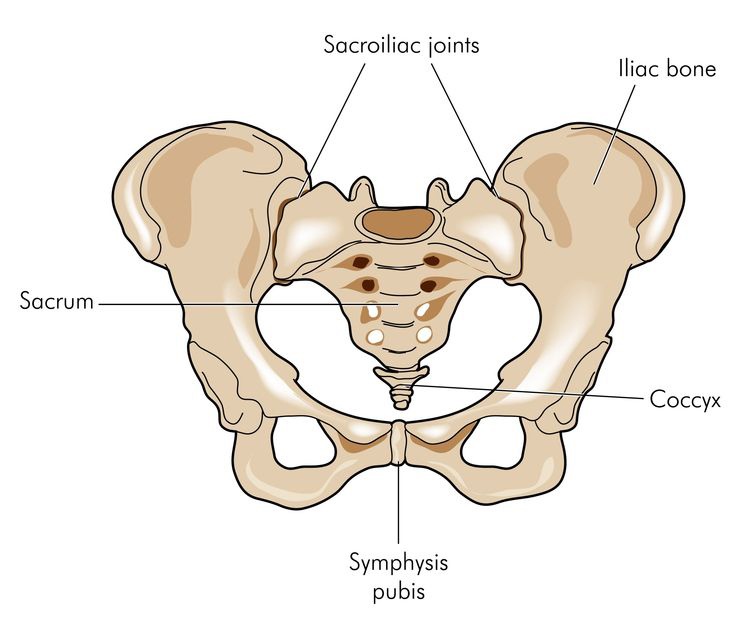
The pelvic floor is a muscular sheet that closes the pelvic cavity and the pelvic organs from below and is curved upward at the edges.
The muscles of the pelvic floor relax during bowel movements and while urinating. This also happens in women during sexual intercourse and when giving birth. The perineum is part of the pelvic floor too. It is located between the scrotum and the anus in men, and between the vagina and the anus in women.

Pelvic muscle control is important for keeping hara-tanden-koshi at the centre of your movements during martial arts training.

Breathing method

The synchronisation of the breathing and the movements will increase the effectiveness of the exercises. Nevertheless the breathing cannot be forced because this is unnatural. Breathing is a basically an unconscious process.

There are 2 fundamental methods of breathing.

  • Abdominal breathing: It involves taking slow, deep breaths in through your nose. The goal is to breathe deep enough to fill your belly with air. This increases how much oxygen you take in, and may help slow down your breathing and heart rate.
  • Reverse breathing: If you take a breath in and your stomach draws in, you’re reverse breathing. Usually, this goes along with a lifted chest and/or shoulders on the inhale. With the exhale, you’ll notice get the opposite: the chest/shoulders sink down and the stomach expands out. This breathing technique relaxes you. It also enables you to become aware of your emotions and increase your meditative focus which is necessary during martial arts training.

Reverse breathing is used for exercises 1 to 6.
Exercise 7 and 8 natural breathing.
Exercise 1 – Shin-kokyu

Taking a low posture

Exercise 2 -Shooting an arrow

Exercise 3 – Heaven and Earth

Exercise 4 – Gazing Backward

Exercise 5 – Bending to the side

Exercise 6 – Touching the Toes – Butterfly

Punching

Body shaking

Rendo -The art of linking

A “martial art body” is determined by the word “Jukozo” or flexible structure.
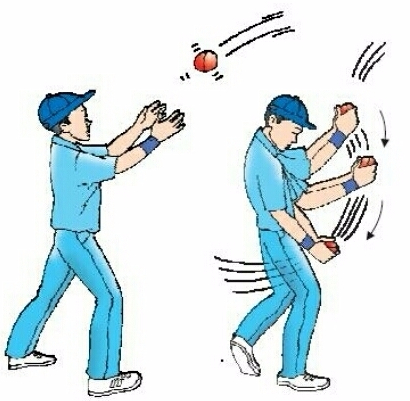
When we see how someone is catching a ball, we can get an idea how the body works during a whole body movement.

The synchronisation of the body with the ball is the main concept. Catching with a stiff body will not be very successful in catching the ball.

Developing a flexible structure – Jukozo

This has nothing to do with stretching exercises per se; rather, it has to do with learning to maintain a certain suppleness and adjustability in the body.
By controlling different parts of the body, we can create linked movement segments. The power of Rendo is going further than the power of an isolated movement of the arm.

We can move the arm or we can move the arm as a whole body movement.

Isolated movement = Movement segment

From a scientific point of view, a movement segment is “a functional unit made up of two adjacent articulating surfaces and the connecting tissues binding them together. “

This is for most of us too difficult to understand, we need a more simple and practiacal explanation.

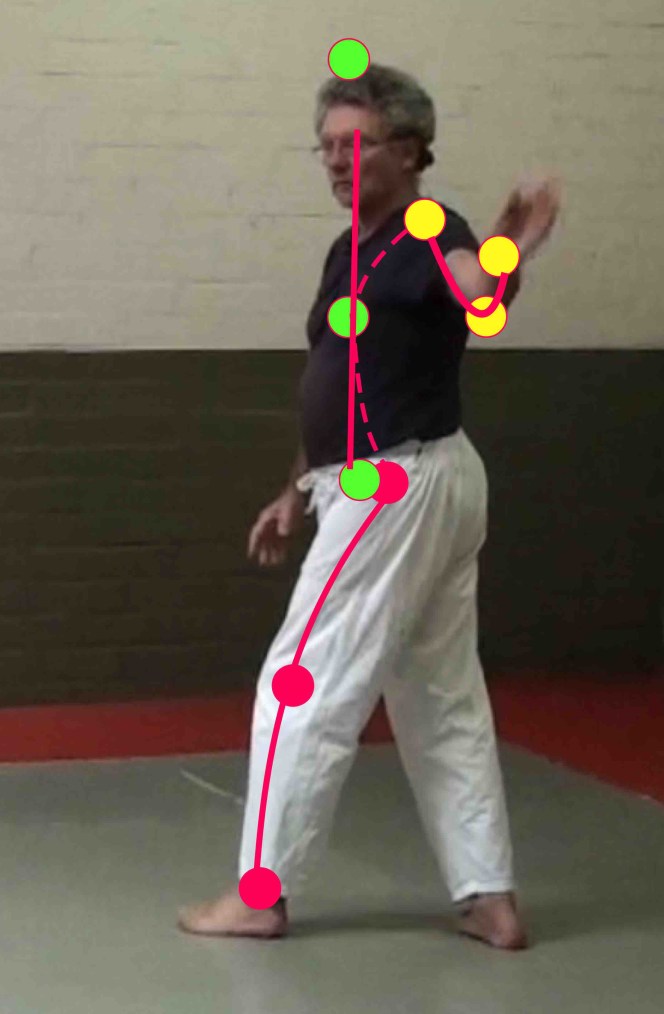
The green dots are 3 centres to create a stable posture.

The yellow dots show the movement segment of the arm.

The red dots show the movement segment of the leg.

Of course, this is very simplified, but it has some practical use for our training.

Whole body movement

Whole body movement is made by linking movement and postural segments and it is called “rendo”. It is not only a physical action, the brain (and its functions) plays also an important role.

Postural Segment

Once again, simplicity is key to success in an entire body movement. Too many details create a malfunction in our brain. Also, understand that there are more than 3 points required to move an arm (or other segment) efficiently. Maybe one time you will feel so many dots that it becomes a flow. Each point during the movement can be handled by your mind… the game of “ki” begins.

Of course, it is not easy to control the linking process. Controlling the mind using “zanshin” or focusing the mind may be the first step of the control process. Zanshin is a skill how to use the mind to control our body and movements. Many martial traditions mention this skill and use the art of standing – Ritsuzen – (ZhanZuang in Chinese arts) to perfect the focusing skill. Ritsuzen is a simplistic method to create Jukozo. Ritsuzen uses three main areas of his body:

  • The Mind residing in the head
  • Sternum
  • Pelvic region

In our research on martial arts training, most methods mention vertical posture as the most favourable to apply a punch or strike to the opponent. Even when working at the office, the upright posture is the healthiest.

Let us examine these centres and begin with the centre of the basin, the pelvic area or hara.

Hara, the pelvic region

The word “hara” is often used to describe the use of power in martial arts training.

Hara can be described either as the physical centre of a human being or as the metaphysical centre.

As part of our training, the hara may be considered the physical centre and it contains the centre of gravity. This is true in most cases, because it is possible that the centre of gravity is somewhere outside our body. The centre of gravity is not fixed in any particular place.

If you’re doing an Internet search, there’s a lot of information out there. And some of this info can be helpful during our training.

  • The balancing, equilibrium, or pivoting point of the body. 
  • It is the point where the sum of all the forces and force  movements acting on the body is zero. 
  • It is the point at which all the weight of the body may be  considered to be concentrated and about which all the  parts exactly balance.

A physical view

When standing, the centre of gravity in the human body is located in the front of the sacrum at the height of the sacral vertebras.

A metaphysical view on hara

In our western culture, the pelvic region has still a kind of taboo. The association with our sex organs makes it difficult to talk about this region. From a metaphysical point of view, the pelvic region is a source of energy. When you have an interest in this matter, I suggest you to look into the many articles on the internet on Traditional Eastern Medicine and Healthy Living.

So, please put aside your taboo thinking and see our pelvic region as an important part of whole body movement.

Kyokotsu, the sternum centre

Like the hara, kyokotsu is a small part of the body which cannot be regarded as a hinge. Basically, it cannot move by itself. Nevertheless, with the help of the surrounding muscles, it is mobile and will affect the spinal column and the attached muscles. Since the spinal cord is involved, it will also influence the use of the hara or pelvic region.

Movements of the arm is not only by using local arm muscles, but it is a process of a whole body movement. By controlling kyokotsu, we can use the muscles of the pelvic region and the attached legs.

Connection between hand and kyokotsu is by determining the “dots” between root, segment and tip.

The Mind

The function of ‘The Mind” is briefly described in another post: “The science of training”.

Previously I mentioned Zanshin or controlling the mind to perfect the skill of focusing the mind. It takes a lot of training time to become skilful and maybe this goes beyond too much the motivation to do a martial art. If you go this path, you cannot ignore the metaphysical part of training.

Many martial sport champions acknowledge the importance of this part of the training. Controlling the mind is a basic skill to create high competence in your art. And this applies also for all sports or professional activities.

On the other hand, if your martial art activity is some kind of social gathering with friends, this is not a mistake but don’t expect a high level performance. Martial arts have different faces, and you can make a choice.

Tenshikei – rotational body movement

Tenshikei

spiral line012Tenshikei is the Japanese term for chan shi jin or silk reeling, a skill in Internal Chinese martial arts. The name derives from the twisting and spiralling movements of the silkworm as it wraps itself in its cocoon and the pulling off the silk from the coccoon. The body is imitating this by winding and unwinding movements.
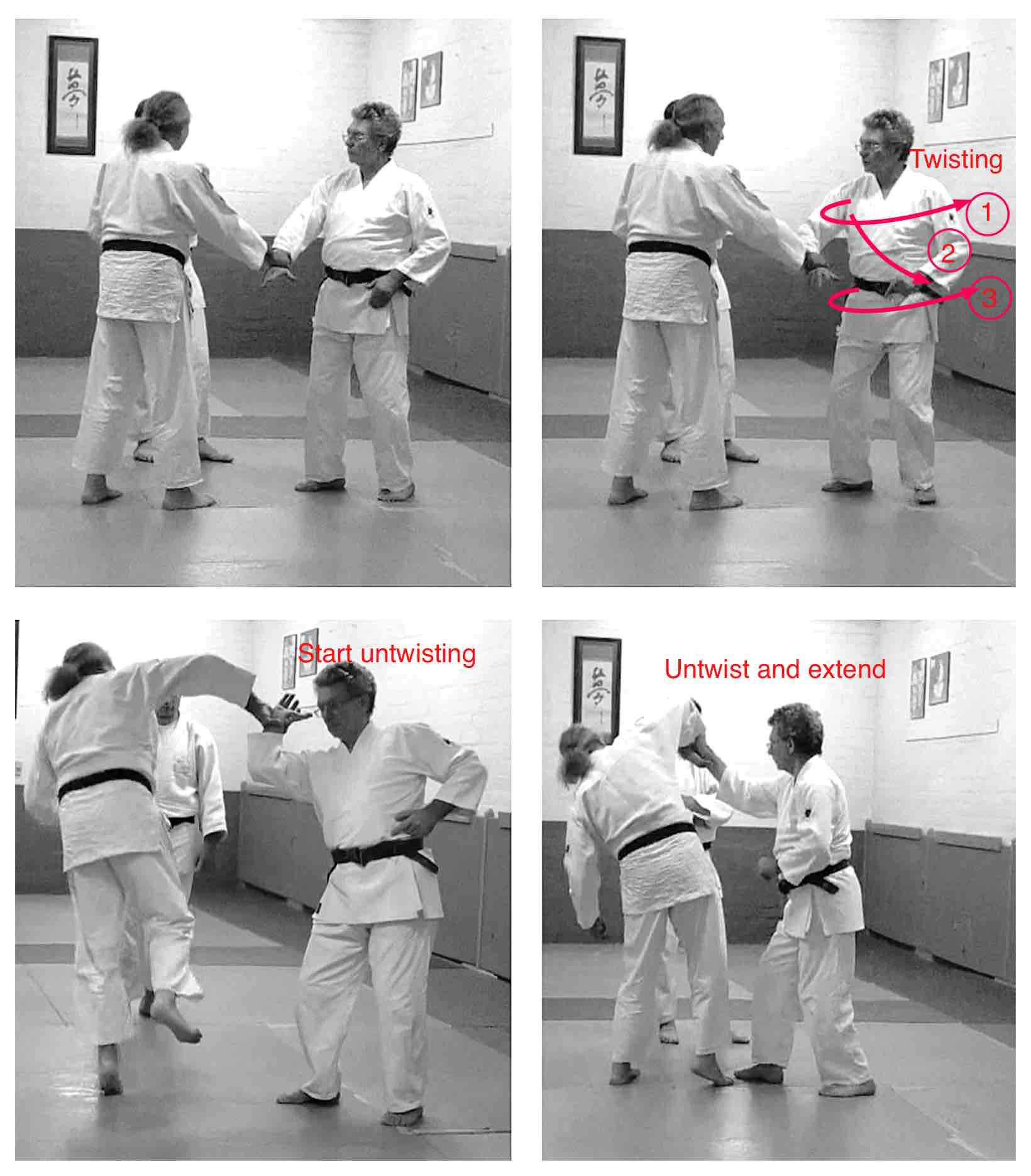
Tenshikei uses the diagonal tension and releasing of the muscles and tendons in the central body. Tension and releasing are controlled by the kyokotsu.
Kyokotsu as a control centre of the movement, uses the tanden,koshi and yōbu as the stability platform.

Hara – Tanden, Koshi & Yōbu

Basically Hara is the lower part of the central body. Mostly it is translated as “belly” or “abdomen”.

  • Koshi means the area of the hips. It also includes the lower back.
  • Tanden is a point below the navel, loosely translated as the energy centre (Chinese medicine and martial arts). It is the focus point for internal techniques and exercises.
  • Yōbu is the waist area. The Chinese word is Yao. The waist is the part of the abdomen between the rib cage and hips.

In our study, Hara will be used in many exercises, especially during Tenshikei.
When the body moves, the Tanden is the centre and is the place of a relative no-movement.
The muscles associated with koshi and yōbu will be used to start movements. There are other methods to start movement like using gravity, but this is discussed elsewhere in this study.

Morita Monjuro (1889-1978)
Famous Japanese swordman wrote some interesting notes on the relationship between tanden and koshi in hitting with a sword.

The striking at a single pace: the tanden and koshi by which all kind of strikes are possible

Tanden and the musculature of the koshi form a unity, but their roles are not the same. The tanden controls the koshi. The training of koshi is synonymous with the training of the tanden, center of the body, and thus it becomes a training of body and mind … We can say the training of each technique strengthen the muscles of the koshi and the tanden. Which has almost the same effect as to strengthen the tanden practicing zazen. If the practice remains at a mere technical manipulation, the effect can not be the same. By producing the art of the koshi and tanden, we can strengthen our mind and body.
To hit properly from the tanden and koshi, we must use a perfect structured body and a perfect handling of the sword. This is a gesture that is produced in accordance with the two forces that go diagonally right leg left arm, left leg and right arm.
The perfect handling of the sword is produced by the integration of three elements:

1. the rotation of koshi
2. diagonal tension produced by this rotation
3. displacement of the body

Twisting and untwisting

In a basic format the twisting of the upper body will follow a certain sequence.

  1. Turn the shoulder line. Keep gankyo bappai **
  2. Turn the body along the diagonal line.
  3. Turn the pelvis line.***

Feel the spiral movement in the body. Avoid muscular tension by pulling the muscles, the tension you feel is the result of the twisting

Untwisting follows the reverse sequence.

** Gankyōbappai (含胸抜背).
This is a phrase used to describe the postural adjustment at the chest level (Empty the chest & Pull out the back ). Keep the concave shape of the chest and stretch the spine to widen the back. Important is not to tense the muscles.

***Turning the pelvis line is only possible when the “mata” or “kwa” is flexible and not tensed up. If you cannot make the groin soft, you will not make the full twisting movement.

Tenshikei solo exercise – twisting and untwisting

rolling tanden01

Using a modified kyokotsu exercise – see earlier.
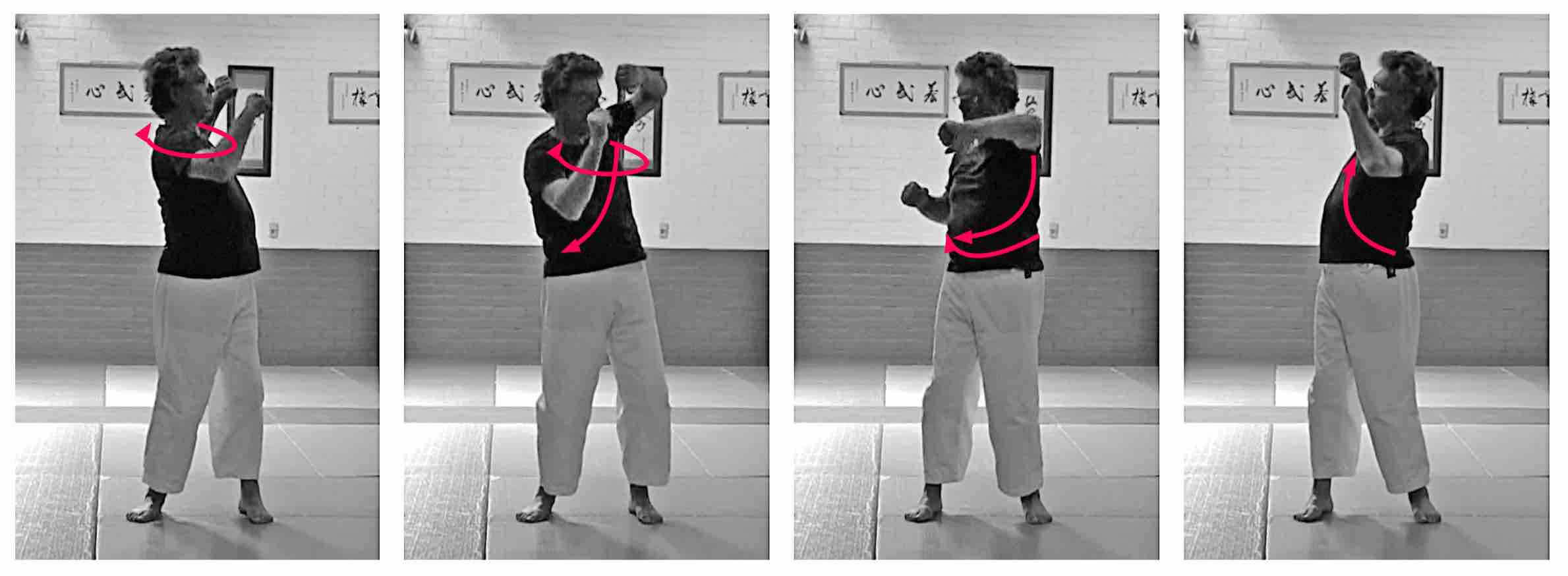
The arrows show the direction of the movements.
Don’t tense the muscles, just release the tension when turning to the other side.
The exercise is “one” continuous movement.

Tenshikei and force

Twisting and untwisting creates force, this force can be transmitted into the opponent.

Tenshikei lines

Partner exercises are an example for applying twisting and untwisting.
In the example the force of twisting and untwisting will be transmitted by extending the arm and creates the opportunity to apply “oshi taoshi” or pushing down.
Extending the arm and putting the weight into the opponent will create “hakkei” or sudden power.

Tenshikei from the lower body

tenshikei lower body

The body is a system which includes also legs, feet…. To create a full-body tenshikei, we must take out the tension of the knee.

The lower part of the central body will become involved in a full-body tenshikei.

See example : Bring the bodyweight on the the right foot, take out the tension of the right knee. Make a full tenshikei by moving the shoulder line, the diagonal lines and the pelvis line.

Both shoulders should be moved as 1 unit.

Ido-ryoku

Ido-ryoku can be  translated as ‘locomotive power”. When we grasp the arm of the opponent we can move our body a certain distance, this creates some power called momentum.

In Newtonian mechanics, linear momentum, translational momentum, or simply momentum is the product of the mass and velocity of an object. It is a three-dimensional vector quantity, possessing a magnitude and a direction. (Wikipedia)

Another meaning, although related to the previous one, ido has the idea of “shift”. It is not always necessary to move the feet. Body weight shifting (taijū no idō) is a method to produce power without the use of the feet.


Ido-ryoku is the effectiveness of “physical movement” that works even without a locomotive power in a mutual relation between two practitioners. (Prof. Shishida – Aikido Lecture & Seminar at the 11th TAIN International Festival / 2015 Aikido World Championships On Thursday October 22, 2015.)

Kyokotsu – sternum control

Kyokotsu – 胸骨 = sternum
胸 mune = chest
骨 hone = bone

Hino’s Budo Theory opened my eyes to improve my movements, especially the basics in Tomiki Aikido (unsoku-ho, tandoku undo tegatana dosa, sotai dosa……….)

It is a misunderstanding to label Tomiki Aikido as only competition. There is more…..

rolling tanden01

Kyokotsu – Control Centre of the human spine

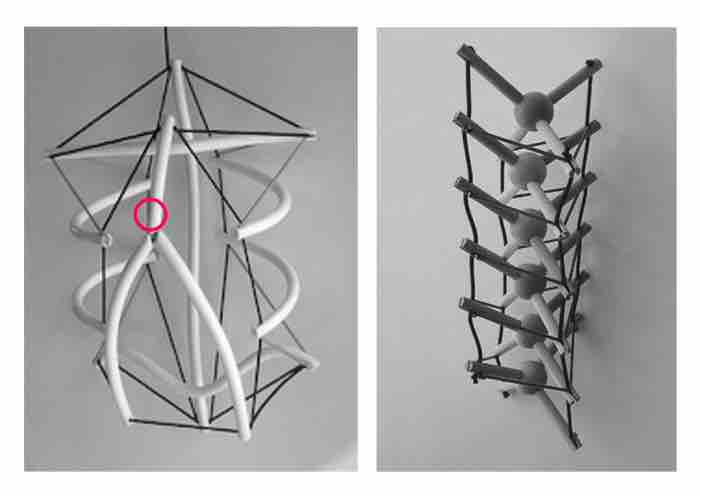
tensegrity modelThe spine plays an extremely important role in our body as it supports the upper body’s weight, provides posture while allowing for movement and flexibility, and protects the spinal cord.
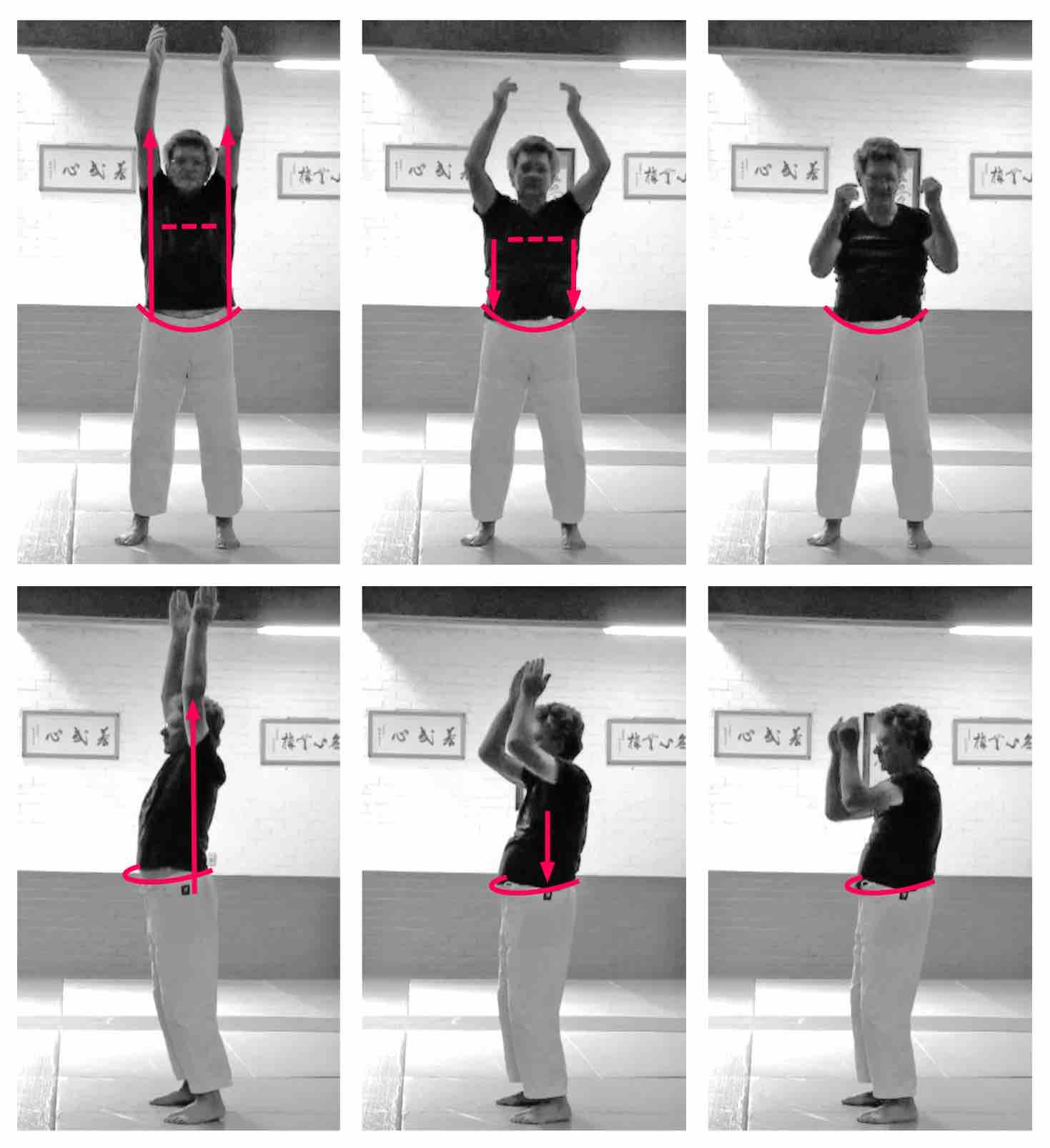
The muscles attached to the spine are very strong and are used to generate efficient body movement with the help of the arms and/or legs.
Controlling the muscles attached to the spine is not an easy task.

“Use the spine but don’t think about the spine.”

In our bodywork we are using “kyokotsu” as a control centre of the spine. If our attention is to the spine, the spine muscles becomes tensed and our body will act rigid.

Relationship between elbow and kyokotsu

The freedom of the arm is in direct proportion to the use of the elbow. The elbow is controlled by the kyokotsu.
When the kyokotsu moves backwards, the arms will move forward due the activation of the back and shoulder muscles.
The elbow will give direction to the hand when the back and shoulder muscles are activated. To create an efficient movement guided by the elbow a “pattern” must be created in the mind which can be used by the unconscious mind.
Putting the mind on the “specific point” of the elbow will greatly improve the efficiency of using the arm and hand.

Our skeleton is build in 3 sections, one of them is the upper axial skeleton. Some info you can find under “power management”.

Why is it important to put your mind on the elbow?
The movement of the kyokotsu is connected to the elbow due the movement of the back and shoulder muscles. When turning the shoulder line, in normal cases the elbow will follow the shoulder line rotation. By putting the mind on the specific point of the elbow we can direct the elbow in a straight line to the target.

In Atemi* Waza the elbow is often used to give direction to reach the target.
On the other hand the target is not always the face or the stomach, but it is also possible targeting by gripping the opponent’s wrist , shoulder or other joint.

* Atemi is a general term in martial arts or Budo/Bujutsu to describe the techniques for punching, thrusting, striking, kicking,…aimed at critical areas of the body.

Kyokotsu exercises

When working with kyokotsu and koshi, it is advised not to focus on koshi but focusing on kyokotsu.
Why? When you focus on koshi you will have tension on the muscles of the koshi area. This will disturb the concept of yukozo and the result is a lesser mobility and flexibility.

There are 3 kind of kyokotsu movements to practise

1. front and back
2. up and down
3. figure 8

kyokotsu in-out

Forward and back

Push the kyokotsu forward without changing the position of the shoulders. Thereafter move the kyokotsu backwards.
Be careful not to use the shoulders.
Pulling in the kyokotsu is not done by pulling in the stomach muscles!

Keep the abdomen in a relaxed way.
When doing the exercise correctly, the pelvis will start to move, but don’t put too much attention to it, the pelvis movement is the result of the kyokotsu movement.

Up and down
Push the line between the nipples up. This will stretch the sides of the body. You will feel this on waist level. Lower the sides of the torso.
During the up and down movement, the elbows are moving up and down by the movement of the central body. The pelvis is not moving up, it serves as an anchor from which the upward stretch is done. Visualize your are pulling up and pushing up the kyokotsu.

up & down kyokotsu 01

Figure 8

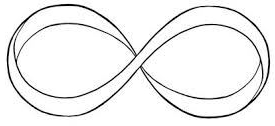
The movement of both elbows are simultaneous and rotate on the central body axis, like a figure 8 around the kyokotsu.

3d figure 8
When turning the shoulder-line, stretch the body up, turn back and pull in the kyokotsu, stretch the body up……….

tenshikei solo exercise