written and/or compiled by Eddy Wolput °1948 – 7th dan Aikido (JAA-Tokyo/Japan) – 5th dan Iaido – 5th dan Jodo. Part of the material in this article is not directly linked to the Japan Aikido Association (NPO) program or Shodokan approach. Other concepts are incorporated into the study of the subject presented.
Qigong, known as Chinese Breathing Exercise, is a holistic system of coordinated body postures and movements, breathing and meditation used for health, spirituality and martial arts training. Kiko is the Japanese word for Qigong. Hachi Danken is Badua Jin’s expression from Japan. The Baduanjin qigong (八段錦) is one of the most common forms of Chinese qigong used as exercise. It was primarily designed to be a form of medical Qigong, to repair injuries and enhance global health. It is also used as part of the training regimen in certain martial arts.
Hachi Danken
The Japanese version of BaduaJin, exercises aimed at enhancing the flow of energy in the body. Like with Aikido and other martial arts, there are many versions of these millennial exercises. Although most versions taught today are from recent times. The Chinese government has made great efforts to streamline the old ways of moving the body for martial or health purposes.
Standing
Every session start with a moment of standing. In martial arts terminology we speak about “shizentai” or natural posture.
Diaphragm and pelvic floor muscles
When learning the exercises, you must be conscious of your diaphragm. When you can localize your diaphragm you can push down it after breathing in, you can relax and breath out. Don’t force the breathing. It must be smooth and no sounds. Try to avoid breathing in with the mouth. A very difficult part of the exercises is the control of the pelvic floor muscles. The pelvic floor is a muscular sheet that closes the pelvic cavity and the pelvic organs from below and is curved upward at the edges. The muscles of the pelvic floor relax during bowel movements and while urinating. This also happens in women during sexual intercourse and when giving birth. The perineum is part of the pelvic floor too. It is located between the scrotum and the anus in men, and between the vagina and the anus in women.
Pelvic muscle control is important for keeping hara-tanden-koshi at the centre of your movements during martial arts training.
Breathing method
The synchronisation of the breathing and the movements will increase the effectiveness of the exercises. Nevertheless the breathing cannot be forced because this is unnatural. Breathing is a basically an unconscious process.
There are 2 fundamental methods of breathing.
Abdominal breathing: It involves taking slow, deep breaths in through your nose. The goal is to breathe deep enough to fill your belly with air. This increases how much oxygen you take in, and may help slow down your breathing and heart rate.
Reverse breathing: If you take a breath in and your stomach draws in, you’re reverse breathing. Usually, this goes along with a lifted chest and/or shoulders on the inhale. With the exhale, you’ll notice get the opposite: the chest/shoulders sink down and the stomach expands out. This breathing technique relaxes you. It also enables you to become aware of your emotions and increase your meditative focus which is necessary during martial arts training.
Reverse breathing is used for exercises 1 to 6. Exercise 7 and 8 natural breathing.
Years ago, my children made the remark: “What is the purpose of doing tandoku undo (unsoku and tegatana dosa) always in the same way for years and years like a robot?”
Gitte and Tim were both World-Champion Tanto Randori in 2005. At the center is prof. Fumiaki Shishida.
This question caused me to reflect on the advantages of practicing the “tandoku undo”. It was always said, by doing tandoku undo my Aikido will improve. So, I did some research in the field of martial arts solo-training. I got some experiences of my time doing karate. Several years later, I was exposed to Korindo-Ryu’s solo exercises. Tandoku-renshu or solo practice is also part of Jodo and certainly a main part of Iaido. I learned from one of my Jodo and Iaido’s teachers about the importance of “understanding”.
To return to the initial question about Tandoku-undo from my children, the answer came as a shock.
If we do the exercises with belief by doing it often and many rehearsals, it is an illusion that we will progress.
By practicing the exercises with an understanding of the mental and physical level, progress will come stage by stage. Sometimes the progress will be large as an explosion, but most of the time it will be minor and will occur only after practicing regularly with understanding.
Human behavior (mental and physical) can only progress in a positive direction when we get out of the box full of dogmas. Dogmas are created to keep people foolish and ignorant about evolution.
The concept: Tandoku Undo
Teruo Fujiwara on Tandoku Undo or Yawara Taiso (Judo exercises). The time when I studied under Tomiki-shihan in 1956-1958 is called ‘the age of Judo Exercise’ (Yawara Taiso). The main ways of moving the body and hands were picked from Aiki skills, then simplified and abstracted and organized as exercise forms, called ‘Judo Exercise’ (Yawara Taiso). The plan of making ‘Judo Exercise’ (Yawara Taiso) was that by doing them repeatedly, we can learn Aiki as if we learned hundreds of thousands of skills which can benefit our bodies in a positive fashion. . ‘Judo Exercise’ (Yawara Taiso) is the valuable legacy of Tomiki-sensei.
Simplified and abstracted
The significance of “simplified and abstract” can be described as a method of exercises which can be used in different situations. We should be able to detach a fixed application derived from performing a tandoku undo exercise. The implementation of tandoku undo in our training must create the gate of “creativity”. By using “creativity” we are able to deal with a different situation.
Movement memory – 2 phases
According to Science, learning a body skill is a two-step process. Mostly, the term Muscle Memory is used, we cannot assume that this search is only built around “Muscles”. The whole movement system is integrated into the research. We can talk about muscles, tendons, ligaments, fascia, neurons………. and our brain.
Muscle memory encoding
Muscle memory consolidation
The coding of information in the brain in Phase 1 is well documented by Science. The coded information has to be transferred to another part of the brain during Phase 2. The transfer of coded information has also been investigated by Science, but Science still does not know where the information is stored. How the transfer occurs is also a source of speculation among the various interpretations.
Bridge between Science and practical use of Martial Art Exercises
Movement Memory is a real thing and is not a fantasy used by people to earn some money by promising unrealistic skills. The bridge between science and the practical use of martial arts exercises (randori & Goshin-ho) resides in how we organize our training. The purpose of the training is to activate the movement memory in an efficient way.
Tandoku-renshu (solo-training) and sotai-renshu (paired training) include both the same body movement skills. Those skills are centered around:
Body structure (shizentai)
Methods of using gravity as the power source
Body weight shift (taiju no dendo)
Body weight displacement (taiju no ido)
Coiling movement (tenshikei)
Tandoku renshu and Koryu no Kata
“The main ways of moving the body and hands were picked from Aiki skills, then simplified and abstracted and organized as exercise forms, called ‘Judo Exercise’ (1954 – Yawara Taiso).“
This is a remark on Judo Taiso (Tandoku Undo and Sotai Renshu) by Teruo Fujiwara, an early Tomiki student. In those days, Koryu no kata did not exist as a formal exercise. Students practised most basic waza and exercises. Some classical waza have been used to demonstrate the capabilities of Aikido as an art of self-defense (martial art). It was also during this period that Kododokan Goshin Jitsu was introduced. Kenji Tomiki was the first public demonstrator of this kata. You will find his demo on YouTube.
Creation of Koryu no kata
In about 1958, we practiced mainly the unsoku, tandoku undo, yonhon no kuzushi (the original version of the present nanahon no kuzushi) as well as the jugohon no kata (fifteen technique kata). In around 1960, the junanahon no kata (17 technique basic kata) and the roppon no kuzushi were created and then the dai-san no kata was devised as a kata of classical techniques. During the mid-60 Ohba Sensei and others worked on the creation of the kata forms of the dai-ichi (first) to dai-roku (sixth), which we presently practice as the koryu no kata, in order to work on techniques for demonstrations and for purposes other than randori. What Ohba Sensei particularly stressed in formulating these kata was the organization of different techniques in such a way that students could learn connections between techniques easily and naturally. After he had organized the techniques to some extent, Ohba Sensei reported to Tomiki Sensei and demonstrated what he had done for him. He received some advice from Tomiki Sensei and then added corrections to the kata. (“Bujin Hideo Ohba,” Kyogi Aikido Soseiki no Ayumi; Ohba Hideo Sensei o Shinobu, p. 67)
A tangle of movements
The source of Koryu no kata is mainly on the art of Morihei Ueshiba, especially the pre-war training methods. In the original Tandoku Undo, there are more body moves to explore than in the modern version of the Japan Aikido Association and the Nariyama Shodokan Method (Osaka). Unfortunately, when researching older versions of Tandoku Undo, the first challenge is the myriad of different movements. The use of all these Aiki-skills in a logical order without loss of effectiveness is the next difficulty. There are a number of successful and unsuccessful attempts in the history of Tomiki Aikido.
According to Teruo Fujiwara the original Tandoku Undo can be described as follows:
Tegatana soho in Yawara Taiso Tegatana sosaho or handcontrol exercises
Tegatana soho 1 : Kihon no kamae – Fundamental posture, power is concentrated in tegatana Tegatana soho 2 : Uchi mawashi – Inside sweep Tegatana soho 3 : Soto mawashi – outside sweep Tegatana soho 4 : Uchi gaeshi – soto gaeshi – Inside turn and outside turn Tegatana soho 5 : Uchi mawashi tentai – Inside sweep with forward turning (demawari) Tegatana soho 6 : Soto mawashi tentai – Outside sweep with backward turning (hikimawari) Tegatana soho 7 : Ko mawashi – Compact method of tegatana soho 2 and 3 Tegatana soho 8 : O mawashi – Big turning forward and backward
A young Senta Yamada demo of Tandoku Undo Tegatana Dosa
Kihon no kamae Uchi mawashi Soto mawashi Uchi gaeshi/soto gaeshi Uchi mawashi tentai Soto mawashi tentai Ko mawashi O mawashi
In the next videoclip, Kenji Tomiki is performing an early version of “Tandoku Undo Uchi gaeshi/Soto gaeshi”. It is not very clear if Tomiki is performing an arm twist (inside and outside), or is he just swinging his arm forward and sideways. In the Yamada clip, there is an impression of a more clearer arm twist.
From the Early Tomiki Movie around 1950
Uchi gaeshi & Soto gaeshi
Back to the future
Can we recognize “the main ways of moving the body and hands” in koryu no kata, as the simplified and abstracted movements found in Tandoku Undo?
There are some videoclips of Kenji Tomiki performing old style aikido (koryu). Unfortunately, his movements are not very clear and give no clues how to move the body in a more efficient way. The performance of Senta Yamada demonstrating old style aikido gives a better impression. His movements are much closer to the movements of Hideo Ohba.
Ohba’s movements gives the impression of a loss of body structure. Tomiki and Yamada are showing a much better control of the body structure. But, on the other hand , Ohba’s seems to use more taiju-no-ido skill, using momentum to control uke’s body. Circular movements are frequently used in koryu-no-kata.
An example by Kenji Tomiki – Kote Mawashi
It seems Tomiki uses taiju-no-dendo of bodyweight transfer to control Uke. Koshi movement is a part of this body control.
An example by Senta Yamada – Kote Mawashi
Senta Yamada use his structure to control Uke. There is no unneccesary movement.
An example by Hideo Ohba – Kote mawashi
Hideo Ohba gives the impression to use shoulder power to control his Uke.
Another example by Hideo Ohba
Taiju-no-dendo or bodyweight shift is a part of controlling Uke
The key to success lies in your creativity.
I learned about Tomiki Aikido at the end of the seventies of the last century. I was taught unsoku and tandoku undo by Dr Lee ah Loi. Most of the time, this was the modern version of JAA, but there was an influence of Senta Yamada. Whereas the JAA version is a fairly straight version, the influence of Senta Yamada is circular.
Another important person for my footsteps on the way to Tomiki Aikido is Itsuo Haba. He taught me some basics for randori, but also something about the effectiveness of gentleness in body movements.
After more than 40 years of Tomiki Aikido, it is a natural evolution, my Tandoku Undo, Kihon Waza and Koryu no kata are “not” the same as of Tomiki or Ohba. Of course you will find influences of many instructors, wellknown or not, but at the end it is my Tandoku undo. Maybe it looks like Tomiki Aikido…..maybe……
Both in static posture or dynamic posture we use the feet to take power from Earth and transfer it to the arms and hands.
Gravity
Gravity is the force through which a planet or other body attracts objects toward its centre.
What else does gravity do?
Why are you landing on the ground when you’re jumping rather than floating in space? Why does everything fall when you throw it away or let it fall? The answer is gravity: an invisible force that attracts objects together. Earth’s gravity is what keeps you on the ground and what makes things come down.
Anything that has mass also has gravity. Objects with more mass have more gravity.
The gravity of the Earth comes from its entire mass. Its entire mass creates a combined gravity attraction over the entire mass of your body. That’s what gives you weight.
Gravity and martial art
Gravity is necessary to create the equilibrium of your posture. If you fail to act on the concept of balance, gravity becomes your worst enemy and you will fall.
What is balance?
Balance is a situation in which your body has stability. It does not take much effort to keep your position. All forces that apply to your body are canceled out. When you are in balance, it is very hard to throw you or move you. This is true standing.
Gravity applies to everything in the body. If you combine the effect of all gravity forces, you can summarize it as a force applied at a single point, the centre of gravity. Put another way, “Hara” is the centre of your physical being. If you can put your mind in “Hara”, you are a balanced person, physical and mental.
Exercises used in training should consider the concept of gravity. Without a good body structure, you will not be able to use the power of the earth and you rely only on the local muscle power. And even if you use local muscle power, earth mass and gravity are needed. Sadly, it is not the most effective way to move the body and use power.
Practical exercises
There are many practical exercises to train in martial arts. Some have a direct advantage in martial art applications, others have an impact on body structure and power generation. Some exercises are directed towards improving health.
Since you don’t always have a partner to practice, solo training may be an option. Most practitioners are familiar with the basic solo exercises of their Aikido method. Tomiki Aikido isn’t the exception.
The objective of this article is to explain certain exercises with a “creative touch”.
All the exercises has 1 important concept: we have to use the power of the earth.
Gravity is the greatest source of power by touching the opponent. During solo training, the adversary may be in your mind, but maybe you can use a boxing bag. It is also possible to use various weapons as a tool to enhance your body movements including the use of gravity.
The moving body
A moving body has 3 main methods to generate force:
Taïjū no idō – using footwork
Taïjū no dendō – using body weight
Tenshikei – diagonal tension
Local muscle power is not used during the 3 metods. The use of gravity is an important source as well as the solidity of the Earth. Without control of the body centers, local muscle power will replace the flexible and elastic power organised by koshi and kyokotsu.
Moving koshi forward and back
Push with the hand (backside) on the sacrum forward. Let the body return and start over the pushing.
After some practise, you will notice the movement of “koshi”. This is an important step forward in the concept of using “koshi” or hip-power.
Oshi taoshi exercise
Move the arms up with the dynamics of lifting kyokotsu. Dropping kyokotsu into koshi and feet.
While we say “use kyokotsu”, this is not the power source. Kyokotsu is the controller which sends the power to the arms. When kyokotsu returns to the original position, it controls the downward power to the legs via Koshi.
Rowing exercise
Body moves forward before the arms. This is controlled by kyokotsu.
Tenshikei, diagonal/coiling power
Sometimes a comparison is made between tenshikei and wringing a towel. Of course, if you don’t know about “tenshikei”, this conversation is ridiculous.
Tenshikei is the rotational power generated with a body skill using gravity. If there is no gravity, you will have probably a difficulty to generate tenshikei or diagonal power.
Role of the knees during tenshikei exercises
Think about a ball between the knees. There is a certain tension (opposing forces) between the 2 knees.
The example shows a ball when adopting “shizentai – mugamae”. The same feeling must be experienced during a forward posture or a 2x shoulderwide posture (kiba-dachi or jigotai)
A simple example of Tenshikei movement
Between the knees, an image of a ball can be used when performing uchi-mawashi and uchi-gaeshi/soto-gaeshi.
Using waist and hips during tenshikei skill
This topic is a difficult one. In martial art the waist is a part of the koshi. Koshi is mostly translated as hips, but this is partly wrong. The hips are a part of koshi.
Our waist usually turns only from five degrees to thirty degrees. Occasionally, it turns forty- five or ninety degrees. Many practitioners use their hips instead of their waist without realizing it. This is because it is much easier to use our hips than our waist. The waist gives power for the push and also functions as a rotational tool. This action is basically “tenshikei” skill.
The hip joint is used to push down into the leg.
When moving forward or back, the ball of the front foot is used as the rebound tool or as a shock absorber. The heel of the front foot is slightly lifted. Using power for moving forward comes from the back foot. When moving back, the front foot is the driving foot.
Taïjū no idō – Taïjū no dendō
Taijū no dendō or body weight transmission (body weight conduction) is a skill to transfer power into the opponent by using body weight and gravity.
Taijū no idō or body weight shift creates “power transfer” in the body of opponent by displacement of the body.
Both methods are basically dependent on the use of gravity with or without footwork.
There are many kinds of footwork. Most of them are based upon using losing balance and regaining balance. Using gravity is the main source for this kind of footwork. An example is “rolling foot movement during pushing”.
Not all the foot movements have “losing balance – gravity” as the main source of movement power. The driving power of the leg can be used to move forward or back.
Driving leg – receiving leg
Moving around is a matter of using koshi, knees and ankles. The pressure between the feet and the earth has also to be taken into account.
There is always a leg which is doing the action – the driving leg. There is also the receiving leg with an absorbing function, but also a rebound action.
Where is the pressure in the foot?
Both in static posture or dynamic posture we use the feet to take power from Earth and transfer it to the arms and hands.
Mostly, the pressure will be on the ball of the foot. Triangle formed by 1-2-3
But it can also move more in the direction of the heel without losing the pressure on the ball. Triangle 1-2-4.
Point 1 will act as a kind of pump to transfer Earth’s power up. During breathing exercises, the mind can use the “pump” image to bring Earth”s power to the koshi and further to the arms when inhaling. When breathing out, point 4 will receive the down power.
The mechanism of pump and switching from point 1 to point 4 is very useful during Taijū no dendō or bodyweight shift.
Although we speak about points, we have to consider the image of the triangles. Using triangles makes a better use of the feet soles surface without forgetting the different points marked in the picture.
An important point of attention is the stability of the knee. Keep an imaginary ball between the knees.
A simple exercise to introduce the foot pressure skill. When moving up, use the ball (point 1 – pump) to take the Earth’s power up by breathing in. At the end of inhaling, push the breath down end let it sink into the heel (point 4). After a while you will feel the action of the pump.
Grabbing the floor with the toes
Sometimes you can read this advice. And this advice is not only for martial arts, but also other sport are involved like weightliftting and sports with a squating action. Grabbing with the toes has to be viewed as grabbing with the plantar fascia. Find here a nice animation:
When you start using the triangles in the foot, the plantar fascia is the driving element in the use of the Earth’s power along the body structures. If the plantar fascia is not correct working, the rest of the body will act accordingly mostly with a faulty structure. The result is a damaged knee or hip joint. Even the neck will have a negative impact.
The importance of the plantar fascia
Plantar fascia – the longest ligament of the foot. The ligament, which runs along the sole of the foot, from the heel to the toes, forms the arch. By stretching and contracting, the plantar fascia helps us balance and gives the foot strength for walking.
Regularly shift weight from one foot and leg to the other stretches the tight muscles of the feet. Thight muscles often contribute to plantar fasciitis pain, also called heel spurs. One basic move simply puts your body weight from heel to toe with a rocking motion. This promotes balance along with foot strength. (pendulum exercise)(rolling feet movement) This will also actually massage the foot by applying different pressure in a graduated fashion along the foot. Another move allows for a rocking motion from the outside of the foot to the inside of the foot. This will strengthen the lateral muscles and medial muscles of the leg. Your weight will shift from the arch to the outside of the foot.
As a westerner, am I to understand “Shu Ha RI”? If we simply read the words “keep, break and leave”, it gives a sense of “no respect” to your teacher. Of course, in the history of martial arts, there are numerous examples of the breakup of the founder after an argument, mostly a “money” argument.
However, there are many examples of leaving the teacher after he has given permission to leave. The teacher understood very well that the disciple needed a certain freedom to grow as a person practising martial arts. The teacher trusts the disciple, and the teacher knows that the legacy is safe in the hands of the latter.
When Kenji Tomiki became an 8th Dan by Morihei Ueshiba, this was a sign of confidence and also an indication of liberty permission. Of course, there are also signs of political motives as far as relations between Tomiki and Ueshiba are concerned. This topic is not central to this article and will not be expanded.
The idea of leaving is a mutual decision between the master and the disciple, and depends entirely on the understanding of the concept of “keeping and breaking”.
Keep and break
As a matter of fact, the concepts of “keep and break” are very simple. On the other hand very difficult to understand by a western person. There is a famous quotation by Morihei Ueshiba and for him the Westerners are “yes, but people”. If he really made that quote, I don’t know, but it’s going around in martial arts circles.
During the “Keep” relationship with our teacher, we learn from the teacher’s experience and we may ask questions about something we do not understand. Of course, we never criticize the teacher. We learn the basic elements of our martial art.
Depending on the time we practice and study, our understanding goes in the direction of “Break”, and this can lead to a very difficult situation. This is a period of your formation where you can see that truth has different aspects. You always learn from your teacher, but you can add personal insights into your training. Your teacher acknowledges this and sometimes will give you some advice.
The two, teacher and disciple, are still interacting positively during the breaking period. Otherwise, the outer world will see disagreements and this can have a negative effect on the functioning of the martial art school.
Randori, 3 types of practising
The relationship between the 3 kinds of randori and Shu Ha Ri may not be obvious. But they certainly have something in common.
Kakari geiko – Shu
Hikitate geiko – Ha
Randori geiko – Ri
In kakari geiko, the roles of attacking and defending are determined. We can talk about teachers/attackers and students/defendants. Sure, there is some freedom in timing and distance.
During hikitate geiko, the attacker has the freedom to interact during the actions of the defendant. There is still the role of teachers/attackers and students/defendants.
Randori geiko is not a shiai, not to win medals. Randori geiko is a process for the physical discussion of the art of fighting. Both practitioners recognize the equality of the two.
The Shiai Paradigm
Shiai should reflect the power and beauty of martial art during a public performance. Spectators must be attracted by the skills of the competitors and not by their brutal and aggressive nature.
It is true that in the shiai there is a certain rivalry, but also the respect of the adversary. When we figure that out, winning a medal is no longer important. The most outstanding performance you can offer is your reward. Whatever you know may be used depending on the circumstances. When you become obsessed with earning medals, your approach will be inflexible from a living human perspective. Respect for other people’s lives and ideas is more precious than winning medals.
The role of the teacher and student is an important factor when approaching the competition. In particular the role of the teacher is significant in the education of the martial art career of the student. The teacher’s respect and attitude toward the student without a medal should be positive.
How to improve someone’s skills comes in the first place.
The Kata & Randori Dilemma
“A kata is not fixed or immoveable. Like water, it’s ever changing and fits itself to the shape of the vessel containing it. However, kata are not some kind of beautiful competitive dance, but a grand martial art of self-defence – which determines life and death”….Kenwa Mabuni….Okinawa
Some martial arts instructors believe that they execute “kata or formal exercises” in the same way as the founder of their system. If you understand something about “Shu Ha Ri”, then you know that’s a little beside the truth.
The development in kata is already discussed in another blog post on katachi and kata. Kata and randori are 2 sides of a coin, but there is a 3rd part of a coin: kata and randori and….
In martial arts, we see the evolution of basic body movements to katachi and further to kata. Again, the term “Shu Ha RI” is like that.
Once you find the freedom of Kata, the application will go smoothly to randori. There will be no difference between kata and randori.
Of course, if you stick too much to Shu Ha RI without understanding the real meaning, you will be locked up into fixed forms without flexibility of mind and body. You will never find the liberty of Kata and Randori, which is the true dilemma of martial arts.
Tomiki Aikido: Past and Future
In her book “Past and Future”, she attempts to explain the real values of Aikido as a martial art with a message. There are no techniques explained, but the value of the book is at a much higher level: How to practice Aikido!
Fast movements can conceal flaws and mistakes can slip by. One does not do the movements slowly for the sake of doing them slowly, and it is most certainly untrue that the slower it is done, the better. There has to be a purpose for doing them slowly; there has to be “substantially” to those movements or progress will not come. It is about “Ishiki”
Ishiki 意識
Ishiki has 2 kanji, 意 = I, and 識 = shiki. “Shiki” means identification, it is the act of recognizing someone or something. “I” means intent, it is the determination to do something.
Why slow movements?
Posture and Health
Slow movements help you with the help of intentional thinking (Ishiki= 意識) to raise awareness of your posture. This will allow your posture to be adjusted to make the body function better and improve energy efficiency.
Slow movements with the whole body will affect and help the micro-circulation in the capillaries. It goes much deeper than fast movements.
Mindfulness training
Martial arts in Japan refer to a variety of physical and mental practices developed based on historical combat techniques. Nowadays, martial arts are considered not only as sports and/or fighting methods, but also as activities aimed at obtaining a unity between mind and body.
Aikido is a Japanese martial art that includes multiple components, such as musculoskeletal training and improvement of both interoceptive and exteroceptive consciousness.
Aikido and related styles include practices (randori – sparring) that are considered elements similar to those of sport, although these practices (randori – sparring) are not aimed at winning the competitions as typical sports do.
Aikido essentially emphasizes the importance of paying attention to one’s own breath and body, and the awareness of both internal and external environments.
“If you wish to see the truth then hold no opinions for or against anything. To set up what you like against what you dislike is the disease of the mind. Do not search for the truth; only cease to cherish opinions.
When the mind exists undisturbed in the Way, nothing in the world can offend, and when a thing can no longer offend, it ceases to exist in the old way.”
~Seng Tsan, Third Patriarch of Zen Hsin Hsin Ming 信心銘 – Verses of Faith in Mind
There is certainly something positive about lockdown during the Corona-COVID-19 pandemic. Our life has changed completely, especially our time schedule is different. If you are a martial art instructor, during lock down the dojo is closed and the contact with the students or practitioners is reduced to online meetings or occasional meetup outside the dojo. As an instructor, you get more time for yourself and study concepts beyond basic and advanced training.
There are several stories of people who have been isolated for quite a while. They developed a method to practice their martial art. For instance, Kenji Tomiki was imprisoned after the war for a few years and created solo exercises from his experiences with several martial arts experts. These solo exercises formed the nucleus of an Aikido method focused on basic movements and techniques applicable in randori.
The result of investing time in personal training
If you do “personal training” as an instructor without students due Corona problems, the result of investing time can be very different from the thoughts you had when you embarked on your martial art journey. Your mind and body are not the same as a few years ago when you were a beginner.
One must accept that “change” is an all-pervasive concept in one’s life. Cultivating “curiosity” cannot be neglected in your training. Looking beyond all you have learned is a skill that should be cherished to the fullest.
Beyond existing methods
From a scientific standpoint, the research process basically follows a certain pattern.
The research process consists of eight steps: choosing a topic, studying the literature, developing theoretical and conceptual frameworks, formulating the research question, research design, data collection, data analysis and drawing conclusions.
In martial art, the process of research as part of our training follows also a certain pattern. But we are in a situation (pandemic) comparable to that of Tomiki during his time of imprisonment. Of course, we have more options because we can search the digital world for information, but the situation of not having training opportunities is the same. Some of us don’t even have a training partner.
Topic of research
Two topics may serve as an example to other research.
Physical and fitness training
Martial art movements
The question is whether to choose scientifically proven methods or methods based on mystic beliefs without any scientific proof. In this blog about martial arts training, some methods are discussed with respect to physical training, but also to a more metaphysical type of exercises primarily based on Japanese and Chinese methods with backgrounds in Taoism, Zen-Buddhism and similar philosophical ways of thinking.
The following methods are up-to-date, scientifically studied and the effects of these exercises may be repeated in a scientifically approved situation. The research process serves to formulate a conclusion, with physical and mental exercises resulting from the research.
Especially competitive martial sport is extensively researched for better performance. Scientifically tools are used to increase efficiency power and or speed. The Kodokan Judo Institute has published since 1958 a scientific report on Kodokan Judo on a regular base. The 1969 report has an item written by Kenji Tomiki.
An extract of 1969 report
Zhangzuang or Ritsuzen ( standing exercises) are a kind of exercises researched in hospitals with qualified personnel.
Some of the health-exercises like Qigong or Kiko can be executed on different levels from a pure physical point of view to a more metaphysical or a combination of physical and metaphysical. You can find many scientific studies on the internet. These studies are executed under scientifically rules and the results are published in academic magazines for professional metal health and physical body workers.
There is also a crossover concept using martial art movements useful as physical and fitness training. Plenty of examples can be found in modern fitness methods linked with popular music.
The “traditional” dilemma
When you enter the world of martial arts, you will see mane different views on how martial art has to be practised. As martial arts have always a flavour of conservatism and some of the practitioners are trapped into a “traditional” dilemma.
The question is about understanding the traditional elements in a martial art. Most martial arts have some traditional culture as a part of their training. Some “traditional” elements have no meaning in our Western way of thinking and are practised just as a kind of mannerism, doing something without knowing the origin and meaning of the action or movement. Trying to understand the traditional elements with an open mind is not easy, and sometimes there is a tendency to dogmatism in your martial art.
Removing traditional elements of a martial art need a deep understanding of the traditional culture. On the other hand, some instructors are adding cultural elements with or without understanding the content. Removing and adding elements with understanding sometimes creates a “new” martial art or sport with of without cultural value. The choice is up to you.
Understanding the technical syllabus
As a high level instructor we can choose to research the existing methods of our founders with the tools based upon scientifically proven methods. Of course, there are metaphysical or psychological elements which are difficult to measure with our tools. Take for example the concept of “sen” or “hyoshi“, as explained by Miyamoto Musashi.
The barrier between science and pseudoscience is not clearly defined and can create problems when we seek for the Truth.
The “Truth” dilemma
This post started with a quote by Seng Tsan, Third Patriarch of Zen (Hsin Hsin Ming 信心銘 – Verses of Faith in Mind).
I believe most practitioners are not looking for the “Truth”, but they found a method for practising a martial art. If they never have a confrontation, mentally or physically, there is no need to find the “Truth”, because they found the truth in their method. Unfortunately, some of the practitioners became “True Believers” and are not open for the “Truth”. During a confrontation, maybe they will win, maybe they will lose.
“The True Believers” – The critically acclaimed true story about the human cost of hero worship in martial arts. The term “True Believers” is inspired by a book by Eric Hoffer.
Eric Hoffer (July 15, 1902 – May 21, 1983) was an American moral and social philosopher. He was the author of ten books and was awarded the Presidential Medal of Freedom in February 1983. His first book, The True Believer (1951), was widely recognized as a classic, receiving critical acclaim from both scholars and laymen. (Wikipedia)
Finding your Way
Again, finding the “Truth” is letting go all pro- and contra- opinions. Martial Art is not a cult, but it is a tool to become aware of the world around you and inside you. Dogmatism will disturb your progression, on the other side, if you are happy………
A “martial art body” is determined by the word “Jukozo” or flexible structure. When we see how someone is catching a ball, we can get an idea how the body works during a whole body movement.
The synchronisation of the body with the ball is the main concept. Catching with a stiff body will not be very successful in catching the ball.
Developing a flexible structure – Jukozo
This has nothing to do with stretching exercises per se; rather, it has to do with learning to maintain a certain suppleness and adjustability in the body. By controlling different parts of the body, we can create linked movement segments. The power of Rendo is going further than the power of an isolated movement of the arm.
We can move the arm or we can move the arm as a whole body movement.
Isolated movement = Movement segment
From a scientific point of view, a movement segment is “a functional unit made up of two adjacent articulating surfaces and the connecting tissues binding them together. “
This is for most of us too difficult to understand, we need a more simple and practiacal explanation.
The green dots are 3 centres to create a stable posture.
The yellow dots show the movement segment of the arm.
The red dots show the movement segment of the leg.
Of course, this is very simplified, but it has some practical use for our training.
Whole body movement
Whole body movement is made by linking movement and postural segments and it is called “rendo”. It is not only a physical action, the brain (and its functions) plays also an important role.
Postural Segment
Once again, simplicity is key to success in an entire body movement. Too many details create a malfunction in our brain. Also, understand that there are more than 3 points required to move an arm (or other segment) efficiently. Maybe one time you will feel so many dots that it becomes a flow. Each point during the movement can be handled by your mind… the game of “ki” begins.
Of course, it is not easy to control the linking process. Controlling the mind using “zanshin” or focusing the mind may be the first step of the control process. Zanshin is a skill how to use the mind to control our body and movements. Many martial traditions mention this skill and use the art of standing – Ritsuzen – (ZhanZuang in Chinese arts) to perfect the focusing skill. Ritsuzen is a simplistic method to create Jukozo. Ritsuzen uses three main areas of his body:
The Mind residing in the head
Sternum
Pelvic region
In our research on martial arts training, most methods mention vertical posture as the most favourable to apply a punch or strike to the opponent. Even when working at the office, the upright posture is the healthiest.
Let us examine these centres and begin with the centre of the basin, the pelvic area or hara.
Hara, the pelvic region
The word “hara” is often used to describe the use of power in martial arts training.
Hara can be described either as the physical centre of a human being or as the metaphysical centre.
As part of our training, the hara may be considered the physical centre and it contains the centre of gravity. This is true in most cases, because it is possible that the centre of gravity is somewhere outside our body. The centre of gravity is not fixed in any particular place.
If you’re doing an Internet search, there’s a lot of information out there. And some of this info can be helpful during our training.
The balancing, equilibrium, or pivoting point of the body.
It is the point where the sum of all the forces and force movements acting on the body is zero.
It is the point at which all the weight of the body may be considered to be concentrated and about which all the parts exactly balance.
A physical view
When standing, the centre of gravity in the human body is located in the front of the sacrum at the height of the sacral vertebras.
A metaphysical view on hara
In our western culture, the pelvic region has still a kind of taboo. The association with our sex organs makes it difficult to talk about this region. From a metaphysical point of view, the pelvic region is a source of energy. When you have an interest in this matter, I suggest you to look into the many articles on the internet on Traditional Eastern Medicine and Healthy Living.
So, please put aside your taboo thinking and see our pelvic region as an important part of whole body movement.
Kyokotsu, the sternum centre
Like the hara, kyokotsu is a small part of the body which cannot be regarded as a hinge. Basically, it cannot move by itself. Nevertheless, with the help of the surrounding muscles, it is mobile and will affect the spinal column and the attached muscles. Since the spinal cord is involved, it will also influence the use of the hara or pelvic region.
Movements of the arm is not only by using local arm muscles, but it is a process of a whole body movement. By controlling kyokotsu, we can use the muscles of the pelvic region and the attached legs.
Connection between hand and kyokotsu is by determining the “dots” between root, segment and tip.
Previously I mentioned Zanshin or controlling the mind to perfect the skill of focusing the mind. It takes a lot of training time to become skilful and maybe this goes beyond too much the motivation to do a martial art. If you go this path, you cannot ignore the metaphysical part of training.
Many martial sport champions acknowledge the importance of this part of the training. Controlling the mind is a basic skill to create high competence in your art. And this applies also for all sports or professional activities.
On the other hand, if your martial art activity is some kind of social gathering with friends, this is not a mistake but don’t expect a high level performance. Martial arts have different faces, and you can make a choice.
If we look at humanity’s slow rise from prehistory, there have been three waves ofevolutionary acceleration. The first was the transition from hunting-gathering to the development of the agricultural age. This happened roughly a few thousand years ago. The second was the industrial revolution, propelled by the invention of automation and standardization. This happened a few hundred years ago. And the third is the “digital” revolution and this started a few decades ago.
One of the dificulties in the process of Evolution is the concept of Conservatisme. This is not always to be bad, but to keep going on and to improve your way of life we need the concept of Evolutionary Innovation.
Evolutionary innovation focuses on orientation TOWARDS today’s way of life and improving it.. To use this concept we have to accept the idea that we sometimes have to leave the “fixed” path of our predecessors.
“Revolutionary ideas rely on evolution to survive”
It is a fact, most people cannot surpass the concept of a fixed or so -called standard form. Although we need a fixed form to pass on the concepts and techniques of a martial art, it is important at a certain moment in our training to forget the fixed form and start your own method based upon movements stored in your subconscious mind. This is already discussed in blog posts concerning “katachi” and “kata”. Also the post about “Matrix Aikido” can give you some insight.
Using equipment from other disciplines
When we don’t have a partner to practise our waza, we can use a tool to mimic a body-part of the opponent. The tool in my mind has to mimic the fore-arm of an opponent and the idea is to practise arm and wrist techniques. This is not a new idea because other Aikidō sensei are also using such a tool. For example a “Neribō”.
Neribō (neri:to knead & bō:wooden stick)
The Neribō stick was introduced in Aikidō by Hiroshi Tada (Aiki-Kai)
The neribô is a tool that can be used in the practice of aikido solo; it is a wooden cylinder with a variable diameter and a length of around half a meter, with rounded edges to avoid hassle in operating it. Simulates the uke’s forearm , so you can train with neribô to perfect mainly the basic or gokyo techniques ( ikkyo , nikyo , sankyo , yonkyo , gokyo), to keep the level of execution unchanged, or simply when you have the pleasure. Its use is useful especially when you consider training time on the tatami insufficient to achieve your goals , but also when you want to intensify the study of a technique, nikyo for example, which is unthinkable to replicate for dozens or even hundreds of times on an unfortunate human uke .
Because the arm of an opponent is not so stiff as the wooden Neribō, an alternative can be found in the use of a TheraBand FlexBar Resistance Bar.
TheraBand FlexBar® to improves grip strength in the arm, hand and shoulder. The resistance level are: yellow (6lbs. of force), red (10 lbs. of force), green (15 lbs. of force), or blue (25 lbs. of force).
As you can see, the FlexBar is a flexible tool with a resistance degree depending on the kind of FlexBar. You can bend the FlexBar, but you also can twist the tool. The moment when you loose the bending or twisting power, the FlexBar returns to the original shape.
Of course it has not the same feeling as the arm of the opponent, but playing with the bending or twisting power will improve your grip on the arm of an eventually opponent. The control of you power is increasing when practising often with the FlexBar.
Tomiki-Aikidō waza with FlexBar
These are some examples how to use FlexBar with Tomiki Aikido waza. Use your imagination to develop other methods to use FlexBar. Have fun…
In 1976, I stayed for several weeks in Shizuoka Japan and practised mostly Korindo Ryu Aikido with Hakamatsu sensei, a Shihan of Minoru Hirai Korindo Ryu. I didn’t really understood very well the principles and concepts of this martial art. But I made a lot of notes in my martial art diary. From time to time I am re-reading my notes and I discovered some secrets which I didn’t understood very well in that time.
The ideas and concepts taught to me in 1976 by Hakamatsu sensei are not opposing the ideas and concepts of Kenji Tomiki sensei and Hideo Ohba sensei. I was thaught by Hideo Ohba in Okubo Tokyo a few years later and I didn’t realize the similarities at that time.
It was a shocking idea to discover the concept of “Matrix* Budō “. One of the most important principles is to apply a single set of basic forms of exercise, which contains all vital movement elements, to all types of combat. These forms are contained in the developed taisabaki (tandoku undo). This taisabaki is the basis of all forms of movement, from which all techniques arise. A botai-budō or matrix-budō.
This concept was in the mind of Kenji Tomiki, when he was rationalizing Ueshiba’s Aikido. He formulated unsoku-ho and tandoku undo, containing the basic information for further development of the practitioner. Together with some other fundamental principles, a unique system is created which included kata and randori.
*Matrix = Botai (母体) = whomb, uterus
Don’t become fixed on techniques. Create your own waza.
Matrix
Matrix: an environment or material in which something develops; a surrounding medium or structure.
Matrix Budō
Minoru Hirai was the founder of Kōrindō Aikidō, a martial art based upon older forms of Jujutsu, Kenjutsu and other Japanese martial arts. He was also during World War II a director of Kobukan, Morihei Ueshiba organisation. Minoru Hirai introduced the word aikido as a generic term for Japanese martial arts not associated with Judo or Kendo. Basically it can be said, aikido is a term to define martial arts auround the “aiki” principle. (see also Minoru Hirai Korindo Aikido). As usual, the information on Wikipedia is based sometimes upon the view of one person or group and can be controversial for other persons.
Hirai’s martial art developed over time into what he calls “Matrix Budō “, which is not based on a multitude of different techniques, but is based on a single principle practised during taisabaki movements:
The harmoniously round circle (enten) and ball rotation (kyūten) expressed by koshi-mawari in a number of forms of movement called taisabaki.
Koshi-mawari taisabaki serve as the basis in order to acquire efficient natural movement.
From koshi-mawaritaisabaki, you develop a natural, rotating-flowing movement mode. Out of this, techniques are created unintentionally and adapted to the constantly changing situation, with which the attacker can be controlled and thrown because one does not oppose the attacking force. In order to acquire the movement of koshi-mawaritaisabaki the following forms of exercise are practiced in training:
7 or 8 forms of movement (taisabaki), which are initially trained individually, then in combination, and finally with a partner;
Partner forms to deepen the correct posture and the approach of every movement;
Randori means free attack and free movements in order to spontaneously realize the principle of koshi-mawari.
The principle of giving movements a circular, flowing, non-okori course. The circular movements can be thought of as horizontal and vertical rotations.
Okori: The approach or initial impetus that usually initiates a movement. As a result, an attack usually reveals itself at the moment it arises. This happens often when attacker lauch a strike by stamping his back leg into the ground to create momentum or using a stamping front leg to give more power in the (tanto)strike. This can be avoided by using ashi no korobi or rolling feet or using a short tsugi-ashi after adjusting ma-ai.
Kyūten
球転 Ball rolling, ball rotation
In Chinese martial arts, the concept of Dantian and Chan Si Gong (silk reeling exercises) is related to kyūten and tenshi & tenshikei (discussed earlier).
from: Narita Shinjūrō – Kōrindō Aikidō
The ball rotation is perfectly round at all times. It has no corners or edges. Thanks to the rotations of the ball with this form of movement, continuous changes in direction are always possible. One could also describe the rotations as the sum of all angles of a circle. In Budo, the angles at which the two opponents meet play a critical role for victory or defeat, since each of the opponents tries to avoid the attack of his opponent in some way in order to get to the target with his blow. How to design the relationship of the angles to an attack line for your own advantage is therefore one of the decisive questions in every style.
Hirai came to the conclusion that it was not necessary to deliberately choose an angle of attack or defense against an opponent, but it was enough if one acted on his rotational movements from the angular fullness of the rotations of a 360 degree circle. Because when you implement the circular principle in your actions, you move completely freely and unhindered, because every movement always includes all contact points as they lie on a 360-degree circle. The sum of the angles of a circle remains the same, regardless of its size, although the smaller the circular movements, the more favorable it is for our purposes. In the thousands of possibilities, any one of the opponents will always be captured.
Since a circle encompasses a total of 360 degrees, any other shape, no matter how polygonal, would be less favorable in any case, since it must inevitably always have blind spots. As a result, gaps arise in defense, where one is inevitably defeated. Without this principle as a matrix, there can hardly be any effective taijutsu, kenjutsu or jojutsu. If it is possible to acquire koshi-mawashi, everything else will follow naturally.
To illustrate the effect of the koshi-mawashi principle, one can imagine the following: hold a sword horizontally sideways and turn from the center, i.e. koshi. Each angular point of the circle will be full of energy.
This effect can also be shown by a partner exercise from 7hon no kuzushi
This is something that every human being is able to accomplish. Every student has the opportunity to learn aikido with sufficient effort, since everyone is naturally capable of these circular or spherical movements with their 360 degrees.
With this form of movement, you have an unlimited number of hit points on the 360 degree circle, at least one of which inevitably contains the opponent’s hit point location. With the circular or spherical movements (Kyūten), you reliably reach the crucial point. Everything depends on the skill of moving the body with a circular or spherical pattern and able to to generate power to the opponent from each point of circle created by koshi-mawaritaisabaki.
An opponent who fixes his attack on only one point only has this one chance. On the other hand, if you trust in the infinite number of angular possibilities, you are definitely in an advantage, because you can generate power from any point of your circle to an opponent’s vulnerable point.
Beyond that, no further considerations or techniques are required. Because of the fact that, in contrast to the opponent attacking with only one possibility, you have this unlimited number of angles, and you are able to master it completely, you can overcome it. Since this can hardly be achieved with rehearsed, fixed and therefore rigid techniques (katachi), it is better to work with the kyūten principle. This in turn is inextricably linked to the term yawara (suppleness).
Kyūten can be considered as a yōso or fundamental principle and is used under different names.
Basic Tomiki Aikido Kata (Basic15 or 17…) can only be considered as an effecient method, when taking in consideration fundamental principles (yōso) and the evolution from katachi to kata. The different waza cannot be considered as techniques, but as an expression of fundamental principles of Budō. By using randori, waza becomes alive. As Tomiki sensei mentioned: we need randori to paint in the eye of the dragon.
Achieving smooth movements must be regarded as one of the most important prerequisites for successful Budō. Jerky, forcefully applied techniques have the disadvantage that each new movement starts from a standstill. The absence of circular or spherical movements needs a forcefully start of a linear movement, which is easily detected by an opponent. Remember, kyūten is a skill for instant power generation and movement. This type of movement cannot be learned solely through the appropriately determined handles and tricks
These rotational and smooth movements are inseparable linked to the concept of yawara (suppleness). Rather, this idea of yawara* (JU in JU-do or JU-jutsu) is the physical expression of an inner attitude, which is often expressed in terms of harmony. Internal tension and aggressiveness would prevent the development of suppleness. As it is free from tension, it represents the most natural of all forms of movement and finds its equivalent in the concept of enten-mukyu**, the endlessly flowing and spherical twists.
*The kanji for yawara and ju in jujutsu is the same (柔). For Tomiki sensei “ju or yawara” is the principle of gentleness and it is similar to “aiki”, which is an explanation of the principle from within.Remember it was Minoru Hirai who introduced the word “Aikido” to make a separate division in Dai Nippon Butokukai. The word “aiki” was used by different Ryuha and it was difficult to bring them under the banner of Kodokan Judo.
**Endless circular movements. Can be considered as a Buddhist concept of Karma. After Buddhism was introduced to Japan, people easily accepted the notion of karmic retribution but not the literal belief of rebirth as animals or lower life forms. Transmigration of the soul focused more on the practical path to liberation.
Koshi-mawari
Koshi
Physiologically the pelvic area of the human body. It is also related to the lower back and sometimes it is referring to the waist. It is often translated by “hips” and referring to the hip joints although this is not completely correct. See “Koshi or other blog post and do a search with “koshi”.
Koshi-mawari or koshi-mawashi
The difference between the two terms koshi-mawari and koshi-mawashi is a grammatical one and consists in the fact that this is a question of a transitive and an intransitive verb form.
In practical use, the transitive form “koshi mawashi” means that the rotations are deliberately started, while koshi-mawari points to automatic, naturally occurring rotations by koshi.
Taisabaki
Some practitioners believe taisabaki is just avoiding an attack. This is only a small part of taisabaki. Basically it means a moving body.
Taisabaki has 3 elements;
Ashi-sabaki – concerning the feet and legs
Te-sabaki – concerning the hands and arms
Koshi-sabaki – concerning the central body, especially the lower part
How to……?
In fact, your training is not about winning or losing a match or a combat. It is about your attitude towards an unknown territory named Budō. In Budō-land are no rules or descriptions how to do a technique. There are only Yōso or fundamental principles. If you cannot see them and understand, you will not be a real Budō-ka (a martial art practitioner). You will rely on brute force and driven by primitive desire to win.
In these blog-posts, there are many indications how to master fundamental principles. If you can integrate them into your martial art practise, I believe you are on the right path of Budō.
The discussion about truth or nonsense is non-productive as we try to find a Western answer on the question if Ki exist. Martial art with the Ki-concept as Aikido, is based around the existence of Ki (Qi in Chinese). When we cannot accept the existence of the ki-concept we cannot define our art as Aikido. Studying Aikido is related to the study of Ki. The practice of the art of Ki starts in most cases with preliminary exercises to develop better ki-flow. My exposure to Hachi Danken (Ba Duan Jin or 8 Brocade exercises) was my early training in AikiKai Aikido (1970-1978) with teachers like Tamura-sensei and others. Kanetsuka-sensei taught me Makko-Ho, which resembles the many JAA warming-up exercises. There was influence from Macrobiotic teachers and Oki Yoga instructors. Later Hachi Danken and Makko-ho went to the background, but never was forgotten. The JAA-exercises became just a physical method for warming-up and flexibility. It came back to the foreground when my interest in competition faded away and was succeeded by concepts focusing on self-development and health. There is a vast difference between a sole physical method and a method which included physical and mental involvement.
Different versions 8 Brocade
As with Aikido or other martial art, there are numerous versions of these millenium old exercises. Although most of the versions taught nowadays are of recent date. The Chinese government made big efforts to rationalize the old methods of moving the body for martial or health purposes.
Makko Ho – Meridian Stretch Exercises
As with the 8 brocade exercises, there are multiple versions of Makko-ho. The main purpose of these exercises is to create a better Ki-flow in the body. When Ki or Qi can reach every part of the body in a optimal way, the result will be a better well-being, more flexebility and certainly a better focus for martial training. The brain receives more blood with the associated advantages of it.
The characteristics of these exercises are the absence of strong contraction or strong stretching of the muscles. The objective is to open the ki-meridians of the body.
Ki flow
So what is “Ki flow”?
In the body, Ki flow means proper operation of systems and organs.
In the mind, Ki flow implies coming and going of thoughts and feelings.
Ki flow being interrupted means Ki blockage, or mental and/or physical illness.
The concept of Ki is for many people controversial and for most of them Ki doesn’t exist.
But if we consider Ki as a concept to understand how the body works as a holistic whole, we can explain why we prefer soft exercises and not the hard muscular workout.
In Western psychology, there is the concept of “the flow” also known colloquially as being in the zone.
Ki flow and martial arts
As mentioned earlier, the concept of ki flow has 2 components.
a physical ki flow
a mental ki flow
Feeling Ki-flow is a matter of using the mind to create body movements. The mind stimulates the ki-flow in a relaxed body with muscle tone ready for action. Only when the body and mind are working as one unit, ki-flow can be optimized for perfect martial techniques, called waza. Hachi-danken and makko-ho are basically physical exercises to stimulate ki-flow in the body. Exercises to use the mind to stimulate ki-flow can be found in methods which promote ritsuzen (zhan-zuang) or posture training.
Academic studies on the benefits of postural exercises gives indications on a certain flow of energy and power in the body using the fascia system. Find here an excract of such an academic study:
A SCIENTIFIC INVESTIGATION INTO POSTURE TRAINING IN THE CHINESE INTERNAL MARTIAL ARTS: A MASTER’S THESIS ANTOINE CAMILLERI B.Ch. D. 1992 Mgarr, MALTA JULY, 2018
Power generation A powerlifter can lift 250kg but spinal muscles alone can support 50kg. This is explained by the coordinated utilization of the fascia (Gracovetsky, 2008). It has been shown that when the pelvis tilts so as to straighten the lumbar lordosis (curvature), forces in the pelvis and back become borne mainly by the lumbodorsal/thoracolumbar fascia rather than by the erector muscles (Gracovetsky, 2008). In the upright posture and during walking, the power from the legs to the upper body is ideally transferred via the lumbodorsal fascia so as to minimize stresses on the intervertebral joints of the spine (Gracovetsky, 2014). The lumbodorsal or thoracolumbar fascia has been described as the connecting system that joins the pelvis and lower back regions to the upper and lower limbs (Cortell-Tormo et al., 2017). These findings support the requirement of the internal arts to keep the ‘lowest vertebrae plumb erect’ via the pelvic tilt, so that the power from the feet and legs can flow upwards unimpeded as efficiently as possible along the myofascial trains. Wilke et al. found that fascia is thinner in the arms than in the legs, and thicker in the posterior regions than at the front (2018). This suggests that myofascial force transmission is largest posteriorly i.e. along the back and through the legs (Wilke et al., 2018). This is aligned to the internal martial arts’ teaching that power is generated from the feet and legs and transferred up the pelvis and back to be released in the hands.
The benefits of power training
Do I dislike power training? No, because we need exercises to develop and/or keep the optimal tone of the muscles. The heart need also training, mostly called cardio. Only when power training is out of proportion, the benefits of the short term will have a long term effect which is not always beneficial for body and mind.
The benefits of aikido training
Aikido is a martial art where we use an optimal mind and body connection. Before we can perform such an aiki-skill we have to prepare our body and mind.
So, the benefits are not in the skills of winning from an opponent, but in the development of our being by practising “taiso” and “waza”.
Self-development is not only for attaining mastership in martial art, but also to become a stronger person in body and mind than yesterday.
The Essence of things?Everybody has his style but the essence is common. There is not one fixed method, and there is no method which would not be included. The basis is no fixed method, even if there is some method, it should be empty too. (Wang Xiang Zhai – Yiquan)
Words can express very beautiful an idea, a concept. But a concept is always only an approximation of reality. By becoming an observer of our moving body, maybe we can experience a glimpse of reality. Martial arts are techniques to become aware of the movements of our body and mind. The movement of the body is a result of the “mushin” mind. The understanding of this body/mind experience depends on the translation from one culture into another because each culture has a different thruth of the “empty” mind (mushin). It is also very obvious there are many thruths for a wellknown word: Budō. We can make a whole list of words describing the essence of things.
Tomiki Aikido in this case is not an exception, it has concepts with beautiful words. Take for example:
From: The statute of general incorporated association, International Tomiki Aikido Federation [ITAF]. The philosophy of incorporation An abstract Master Kenji TOMIKI has devised an Aiki-randori method, (a kind of free sparring method in Aikido, which was later turned into an Aikido competition). The nature of his methods lie in total practicality, which is acquired by integrating technical principles of budo (Japanese martial arts)……….. …….The methods of our character building are found in a long time training of Aikido techniques in kata and randori. A competition itself is not Aikido practitioners’ primary goal but merely a way to measure how much one has achieved one’s aims of training. We respect Olympism, and aim at creating an Olympic sport event, in which the educational nature is inherent, as mentioned above. We aim at keeping the current traditions of budo culture…………
What is the meaning of “technical principles of budo” and “ the current traditions of budo culture“? If we can find an answer to these questions, we can find the essence of the words in the ITAF text.
Martial Art & Budo
Budo in general is translated as “martial art” and the system is in general defined as a physical, mental and/or spiritual training method, practised in a Japanese socio/cultural environment.
On the other hand there are martial arts without the concept of Budo. Boxing, The Art of Manliness is a Western concept of a combat method. Another one is classical fencing. Sword fighting schools can be found in European historical records dating back to the 12th century. Some fencing schools claim:
As with any true martial art, our goal is not just to defeat the opponents or become the first place champion in a particular discipline but rather to be better than we were five minutes ago.
Budo in the West
Western society is inclined to classify everything and martial arts are no exception. How to classify and describe martial method in words which accomodate the essence of your art from the point of view as a practitioner in the West? Because we try to describe a method from the point of view as a Western educated person, our classification cannot be based upon the concept of Japanese Budo or other Eastern concepts mostly inspired by Bhudism, Taoism, Confucianism or other philosophical system. Nevertheless many Asian martial arts are practised in the Western society. Once a Japanese teacher told me about understanding Western people, you just have to study the Bible. Maybe there is some truth in this. The motivation to practise Budo by most of the Western people is based upon some imported ideas which are missing in our contemporary Western culture. In the past there was some time to “meditate” in the church during the services. There was also a certain “code” of our functioning in society. To be clear, I don’t want to go back to the good old time. For some of us, Budo is a replacement for our “Christian” involvement. But do we understand the essence of the words behind the Budo concept with our heart? Let’s go back to classification.
Classification of martial arts
Martial Arts scholars have tried to define Asian martial arts, and some of these approaches are in some way practical to use. As with most so called solutions there are “pros” and “contras”.
Three different approaches to Asian martial arts practice in the West have been described by Theeboom, De Knop, & Wylleman, 1995: (a) traditional, (b) efficiency, and (c) sporting.
Traditional Approach In this approach, participants strive for unity and coordination between internal (e.g., spiritual and mental) and external (e.g., physical) elements. According to this view, physical excellence in martial arts will not go without spiritual or mental cultivation (Kleinman, 1986). This approach can also be described as “holistic”. Back and Kim (1984) described four criteria that need to be fulfilled to keep the status of a traditional Asian martial art: (a) recognition of national or cultural origin, (b) development of fighting skills, (c) presence of artistic aspects, and (d) spiritual development.
Efficiency Approach The efficiency approach emphasizes effectiveness and application of the techniques in a fight. Martial arts in this approach are mainly practised for self-defense reasons. Although one might argue that this approach actually goes back to the origin of the martial arts, that is, to know how to protect oneself, in Asia this function has lost a great deal of its importance, as other functions became more important (e.g., aestheticism, health and fitness). For example, distinct changes in form, content and function have characterized the development of the Chinese martial arts (Theeboom & De Knop, 1997). In the West however, the efficiency approach is very popular. According to van Bottenburg (1994), this is the result of a growing commercialization among martial arts schools. Often, the value of these schools is measured by the degree to which fighting skills are used efficiently by their students. As a result, many martial arts schools are constantly looking for harder and more efficient fighting techniques to offer. van Bottenburg (1994) has described this evolution as the “hardening” of martial arts.
Sporting Approach The sporting approach does not focus primarily on the acquisition of fighting competence, but rather regards martial arts as sports with positive effects on the physical, mental and social state of its participants. Unlike the efficiency approach where “anything goes”, in this third view the variety of fighting skills is restricted to what is allowed according to specific competition rules. Although it is important to mention that recent evolutions in martial arts competitions, such as the introduction of so-called “ultimate or cage fighting” where only a very limited set of rules is used, raise doubts about whether these activities can still be referred to as sport. Consequently, some have described this trend as a “desportification” of the martial arts (van Bottenburg & Heilbron, 1996), as these extreme fighting systems have a very limited set of rules and consequently show more resemblance to real combat than to sport. One can refer here to the definition of sport as described by Steenbergen and Tamboer (1998), who defined sports as “physical games” in which players are confronted with movement problems (e.g., running faster or jumping higher than others). These problems can only be solved by overcoming a number of “unnecessary obstacles” (limitations or rules). With hardly any of these obstacles (forbidden techniques), most of these extreme fighting forms cannot be regarded as sports. Förster (1986) even described this trend as the “brutalization” of the Asian martial arts.
Warior and civilian
The difficulty in this classification, there is not any difference between a warrior method and a civilian method.
A warrior is a professional fighter (soldier, police….), while a civilian practitioner has a profession mostly not related to martial arts.
Although some traditional schools are referring their method to combat on the battlefield, most of the Asian Martial Arts can be categorized as a civilian method, a tool to stop people assaulting you.
Also interesting is the reference to the socio/cultural context or in some cases the absence of it. Though various civilian combat systems are referring to a socio/cultural context, this reference in the non-Asian groups has only a kind of a superficial socio/cultural layer in comparison with most Asian groups.
Take for example the ITAF group, a Tomiki Aikido group with Eastern and Western participants. The text is mainly written by people of Japanese origin. Reference to Budo culture is for most non-Japanese people an alien concept. In the ITAF text reference is made to the current traditions of budo culture.
The maze called Budo
The ultimate goal in the ITAF text :
We aim at keeping the current traditions of budo culture.
What is the meaning of “budo culture”?
Budo is literally translated as the “Martial Way”, and may be thought of as the “Way of War”.
Further, in this context, it is also necessary to distinguish budō from the Westernized martial arts.
Studies have shown that Westerners encounter difficulties to fully understand the underlying principles of a traditional approach due to distinct cultural differences. Anyway there are attempts to use Budo in a more globalization context.
Budo was featured in the Summer Olympic Games demonstration programme in 1964. Budo is used as generic term for (Japanese) martial art like kendo, jujutsu, aikido, judo, karate,…….
Question arises”Is Budo a functional method outside the Japanese cultural and social life?” or “Can we keep Budo culture in an Olympic Sport?”
There are many martial methods and each method has a different view on the meaning of Budo. In fact the expression “keeping Budo culture” is only beneficial for people living in Japanese society because the ideas behind Budo are similar to the ideas behind the way of living in a Japanese cultural environment. Budo has an origin in the cultural heritage of the Japanese people. Any attempt to promote Budo in the Western society creates conflicts with the way of living in Western society.
The evolution of Olympic Judo gives an impression about the many difficulties to merge a traditional Japanese concept into a universal method.
Of course there are attempts to create a martial art which can be used in the context of globalisation method. The word Budo is used in a different context than the traditional Japanese.
Recreational combat system
Most of us are involved in aikido as a ‘recreational” practitioner and Most of us are involved in aikido as a ‘recreational” practitioner and although there is some interest in Japanese society and philosophy. We are not becoming a Japanese person. Kenji Tomiki recognised this dilemma and created a method accessible for Western people. He just wanted to create a martial art with the purpose to build character based upon Samurai traditions. These traditions are the origin of the so-called current Budo culture without the risk of dying or gravely injuring during training. By eliminating dangerous actions, the training method became a physical education system which can be used by everyone.There is not any restriction on age or gender. That is the theory.
The clash between East and West
The application of the theory became different when Western ideas influenced the training method, especially the competition side.
The modifications of skill sets and physical fitness attributes, achieved by focusing on power and speed training of the body are the main functions in this training method. A healthy and fit fighter who is less skilled in the strategy of aiki-randori may still hold an advantage against a fighter not physically strong with better strategy skills.
The elimination of lethal tactics, if they exist, during randori (free play) works in favour of power and speed.
Power and speed training replaces the skills of the professional warrior which is moving beyond the training of power and speed. A skilled warrior needs an intensive daily training. It is his job!
The training method of the average practitioner became a recreational combat system eventually with a philosophical background.
Of course there are professionals in the field of recreational combat systems, but most of them are teaching a recreational method and are not really practising like a warrior
Most of martial art training fall into a category of gymnastics or physical education. Concepts and their applications like “ju and go” or “kuzushi” are replaced by muscle power and/or momentum generated by using leg muscles.
Demonstrations or “kata” competitions are mostly more acrobatic displays. The essential concepts of the method are hereby replaced by esthetical and acrobatic movements.
Health and combat, hand in hand?
To become a champion in a combat sport we have to bring the body to a higher level compared to the average practitioner. It is very rare to find a martial art champion without injuries from their training and competitions. And most of the so-called “professional or semi professional” champions have a team to take care of the physical and mental problems as a result of the high expectations of the spectators, friends, family and members of the group. Importing “champion style” of training into the practice of the average practitioner is looking for health trouble in a long term view of martial art t
To become a champion in a combat sport we have to bring the body to a higher level compared to the average practitioner. It is very exceptional to find a martial art champion without injuries from their training and competitions. And most of the so-called “professional or semi professional” champions have a team to take care of the physical and mental problems as a result of the high expectations of the spectators, friends, family and members of the group. Importing “champion style” of training into the practice of the average practitioner is looking for health trouble in a long term view of martial art training.
Kenji Tomiki modernised koryu (old schools) into a modern Japanese martial system useful as a physical education method. He tried to create a “universal” type of aikido that can be practised by Japanese and non-Japanese without reference to Eastern philosofical systems.
Kenji Tomiki modernised koryu (old schools) into a modern Japanese martial system useful as a physical education method. He tried to create a “universal” type of aikido that can be practised by Japanese and non-Japanese without reference to Eastern philosophical systems. Can we practise his method for health purposes or is it solely for some kind of self-defense and the game of randori?
By eliminating dangerous actions in the practise of Aikido, the risk of having injuries will be brought to almost zero. But if we eliminate lethal actions, the mind setting of the practitioners must also change in a direction of a physically and mentally healthy way of movements. Unfortunately the sportification with the included competition acts as a spoilsport. As in a previous paragraph, Western influence is basically geared to build up muscle power and/or generating momentum. This is clearly a preferred method by younger practitioners. If they have an injury, the healing process is relatively short. However, for 50+ it is not anymore evident. If you become older our view on martial arts changes because our body in general is changing and cannot cope any more in the same way as when we were younger. Kenji Tomiki didn’t really specify how our training can change when we get older. Of course we can change to do more kata instead of randori. But is it possible to participate into randori when we are older? And what about the concept of “kata”? Do we understand the meaning of kata or is it just a series of techniques demonstrated in a certain order and performed as an acrobatic display.
2 kinds of practitioners
After many years of training, the toll of abusing the body comes to the surface. Old injuries will refrain you from practising in the old way. Other methods of training have to be developed. Training can be soft and energetic at the same time. By utilising the concept of “movement” training instead of fighting training based upon muscular power, training can become an activity for all ages.
There is of course another problem, 50+ practitioners with a long career of Budo and the 50+ beginner. Both have a different understanding of “the essence of things”, and even if you belong to the skilled category there will be differences in the understanding.
Bringing the mind of the beginner into the game can have a big impact on the training process.
Shoshin – Beginner’s mind
“In the beginner’s mind there are many possibilities, but in the expert’s there are few.”
Suzuki, Shunryu, 1904–1971
There is 1 important idea I learned from Akira Hino. How to become again a beginner without deleting my previous experience. When you become an observer during your training as a practitioner or teacher, making a judgment is not present. The body is taking over and will act according to the circumstances. Of course old not so good habits will interfere, but by making a mental note we can work on this during our next training sessions. With an open mind we will find out a potential beyond imagination.
Ganbatte
Budo movement can be understood as communication between two persons mediated by the body, that is usually considered two separate and independent bodies but rather should be considered integrated as one body communication system. The point where two bodies (in Budo) becomes one body communication system depends upon the condition of the interface between the two bodies or persons. (from: Movement of Budo by : Yosuke YANASE )
A communication system is a moving construction and when communication stops there will be no movement anymore. During a moving process, the feeling of safety is very important and is expressed by the skill of “rikakutaisei, fighting from a distance”. Distancing or using the appropriate distance during a confrontation is a skill often used in martial arts but also in other fields of human behaviour.
Ma-ai, a dynamic concept
In Japanese terminology, distancing is ma-ai(ma, spatiotemporal interval ai, harmony). Ma-aiintegrates space, time, and rhythm and is the ideal situation to control a confrontation. Controlling the situation or in other words “controlling the actions of the opponent” is depending on Hyoshi. Ma-ai is not a fixed distance, it is dynamic. Depending on the situation, distance will change.
Safe and unsafe distance
In another post, ring of power, the concept of a close distance was used to practise posture and power through a grip on opponent. Before we have a proper grip on opponent, we need some skills to gap the distance between you and opponent. These skills incorporate the concept of safety by using “rikakutaisei” or fighting from a distance.
Basically we can distinguish 3 kinds of distance during a confrontation.
When there is no physical contact it is called To-ma.
Making physical contact but still safe in your own environment it is called Uchi-ma.
Chika-ma is the distance for using power. Without controlling opponent actions it is very unsafe.
Don’t confuse distancing or ma-ai with the 3 kind of distance. In each distance, the skill of ma-ai can be used.
Rikakutaisei, fighting from a distance
Rikakutaisei is a word to describe the expression “fighting from a distance”. In general this is explained as a distance when using “tegatana awase” distance. Of course to attack we have to come closer. The attacking distance is depending on the use of ma-ai or distancing.
We know space is expressed by the word “Ma” and it is not fixed distance. Controlling the actions of opponent can give an opportunity to attack. The example here is from “uchi-ma” entering into “chika-ma” to apply power or in other words “a technique or waza”.
Closing the gap between you and opponent
As with everything in martial art, there are many solutions for 1 problem. It depends on the level of the practitioner which skill is used. To create such skills, basic training is used to ingrain basic movements into the subconscious mind.
Stepping skills During unsoku-ho, basic patterns are used to practised stepping skills. In this exercise the skill of tsugi-ashi is practised. Bridging a long distance uses mainly a ayumi-ashi stepping method and will be practised separately.
Controlling skills If we only use stepping skills it is possible we can control an opponent without touching. But at a certain point in a confrontation we have to take a decision and use our hand(s) and arm(s) to create a definite solution. There are many armskills to control an opponent. In the various kata, examples are used to have training in the control of aggression. To understand the principles of aikido, we use our body as a communication tool. The example below shows a kind of body turning, an important bodyskill. Uke is grasping the arm, Tori is not changing the interface of the grip. Tori uses the turning of the body and at the end of the turning the power of the turning is entering into the body of Uke. The distancing performed by Tori is necessary to perform the bodyturn and to use “tenshikei”.
Internal and external distancing
Distancing or ma-ai is not only depending on stepping methods, but can also performed when we cannot do stepping skills. As in the previous example, the body can turn without changing the interface of the grip by Uke. How is this possible?
If some is twisting your arm, your muscles are wrapping around your skeleton. The power of the twist is stored in your muscles but also in your tendons. Tendons have a great capacity to store energy. This energy can be released. This action is a clever way to use distancing internally.
Some clarification
Most of the material discussed in the blog articles is my interpretation of the various teachings learned and practised during seminars, workshops and long-term training periods with interesting people. Sometimes I am using material to explain some topics with images found in articles and books. Mostly I provide the source of the images, but sometimes I fail to mention the source. I apologise…..
2-weeks seminar with Andre Nocquet – La Baule/France 1972
Moving around is part of the most enjoyable activities in humans life and when our movements stop, our life is also stopping. But sometimes we need a rest, sleeping, relaxing, ….. Taking a rest or relaxing is part of our movement and at first sight there is no outward movement. It is no wonder to find out there is a lot of movement inside. These movements are unconscious movements. Our consciousness has no control. Conscious internal movements concern mostly musculoskeletal alignment and connectedness. They are in many cases not visible externally. During human moving activities, a pause is often used to give a dramatic performance. Pause is a part of a movement or performance. The conscious brain is reacting to action or pause with a delayed time. This can be utilized to change strategy or movement (switch) during martial arts performance.
0.5 seconds for the mind to recognise what has occurred
Benjamin Libet states in his book, “Mind Time: The Temporal Factor in Consciousness (Perspectives in Cognitive Neuroscience),” that it takes 0.5 seconds for the mind to recognise what has occurred.
Benjamin Libet is known worldwide for the experiments he has conducted over a long career (his first experiences date back to 1957-1958) on how the human brain produces conscious awareness. The brain will have a recognisable sensation coming from the skin or some other body structure only if the stimulus continues for at least 500 msec: shorter durations do not elicit any awareness of the sensation. There is an actual delay of 500 msec for sensory awareness even when the sensation is generated by a single pulse applied to normal sources at the skin.
Pause, a part of our movements
During switching of movements, we need a pause to reset our muscles. Resetting the muscles is changing the tone, or in other words “more or lesser tension” to create a better efficiency movement. Switching without detection by the opponent is only possible if we can perform this during the 0,5sec mentioned earlier. We can make the delay longer by using “kuzushi”. This situation sets up a pause in the defense against an attack. Regaining stability is triggered by some survival instinct and will take over the actions learned during martial arts training. Basically, kuzushi is a kind of switch with hakkei or sudden power. When practising kuzushi slowly and with bigger movements, we cannot consider this as a part of the strategy to make opponents “brain delay” longer.
Pause, an educational tool
This kind of pause is longer than the pause during movements. Practitioners without experience need some time to make decisions how to do a movement. By integrating “pause” into movement sequences, the brain will detect the changes in the sequences and make the appropriate adjustments. Most of the “kuzushi” demonstrations use such a method to make clear the mechanism of kuzushi. This is an artificial situation, and will always fail in “randori” because it is going beyond the delayed time.
Different types of training
Solo-training
Solo-training is an integral part of a martial art training program. Solo-training is a simple method to introduce martial art movements. There is a perception of “no-resistance”, but this is a delusion. Beginners are not aware of gravity or excessive tension. When we discover gravity and relaxation, partner training is the next step. Nevertheless, keep in your mind: There is relaxation in tension – there is tension in relaxation. Solo-training start with big movements and done slowly. Remember, we need time to recognize what is happening. After some time, we can start to make the movements smaller and eventually faster, but not fast. When you can observe your movements without making any comments in your head, it is time to start to partner exercises. From a practical view on how to keep students or trainees enthusiastic, sotai dosa or partner exercises are introduced before proper body movements are ingrained. But avoid “tanren” training.
Practical training concepts Practical concepts depends largerly on ingrained basics in the subconscious mind. Mostly these ingrained concepts will be tested during all kinds of randori, ranging from kakari geiko through hikitate geiko to randori geiko. During basic training, the concept of pause is mostly considered as an educational tool. Pause as a practical tool during randori is build upon the skill of relaxation/tension and diverse strategy concepts.
Sensitivity training
Training with a partner, trainer or teacher should led trainee to follow by “sticking” at the contact points and learns to listen (chokei in Hino Budo terms).
Resistance training
Sensitivity training with light resistance. Testing the body/mind integrity of the trainees. Cultivating internal muscoskeletal alignment and connectedness. Using sufficient force (tension) to overcome resistance.
There must be relaxation within tension and tension within relaxation/tension exchange. Avoid rigidity and stiffness.
Technical training
Solo-training of basic movements is an entry to ingrain whole-body neuromuscular movements. Mind-body control is necessary to obtain coordinated whole-body neuromuscular movement. Partner training has to be seen as an extension of solo-training
Randori training
Randori training is an exercise with a build-in unknown factor. Timing, distance or interval, speed….are unknown factors. Starting with low-intensity resistance and adding proportionally unknown factors cannot emphasized enough. When we start too soon with “hakkei” or sudden power, succes in randori will be far away.
Tanren – The art of repetition
Do not cultivate sequential patterns of response as a solution to the problems of fighting. If you use conscious procedural thinking (sequential processing) to observe, analyze, and then react, you will lose most of your hand-to-hand encounters or confrontations. You cannot predict/anticipate when and from where an attack is coming, and then take appropriate action. Therefore, instead of wasting time and energy memorizing sequential patterns of movements also called “kata choreography”, let your sub-conscious reflexes automatically execute the proper actions at the proper time without conscious mind- intent.
Kata performed as ‘Tanren’, or repetitive slow drilling is highly regarded as a method of power building
The art of repetition
quote by Akira Hino
You cannot really learn and
understand the meaning by copying something over and over just because
someone told you that there is a significance in doing so.
There is a fine line there… between a genuine motivation to learn and just an intellectual amusement.
If you think the meaning of repetition is just a piece of knowledge
given by somebody else. You will not able to learn anything worthwhile
on your own.
Kata must be simple if we like to use it as Tanren. If kata is too complicated it will be a waste of time. It is better to practise 1 or 2 linked movements with low resitance at slow speed. The mind need time to listen to the body and absorb the principle or concept behind the movement(s). For example during static postures in standing meditation (ritsuzen) isometric activity of the major leg muscles is a motionless movement to practise drilling the feet to generate power with the support of the floor. Dynamic examples can be found in koryu no kata. Some kata are complicated sequences and are build upon linking simple basic movements. Of course, kata training offers more than power building exercises.
Something to take into consideration
The Relative Tempo of Techniques: some techniques are performed quickly, while others are done more slowly. Tempo can be so slow that there is no visible external movement, it is a pause in the external movement.
The Relative Force of Power: The power of a technique derives from the proper balance between strength and relaxation. Power is a balance between ju (soft/strong) and go (hard/strong). Power can be dynamic (ido ryoku) but also static (isometric tension). Isometric tension has no visible external movement, it is a pause in the external movement.
The Control of Breathing: The correct timing during breathing (inhaling and exhaling). After inhaling we need sometimes a pause, to have a better absorbtion of the oxygen. This is a pause in the breathing.
By using these 3 concepts and through concentration, dedication and practice, a higher level of power skills may be achieved, where the movements are so ingrained in the subconscious mind that no conscious attention is needed. This is what we call Mushin 無心, or “no mind.” The conscious, rational thought practice is not used at all – what was once memorized is now spontaneous.
Practising for health purposes is an assumption often made by marketeers for a martial art like aikido, based upon a balance between soft and hard. Movements are created following a spiral pattern. It gives a perception of harmony which is another assumption.
When aikido is promoted as a competitive sport, other factors become also important. Fitness, stamina and muscle power come to the foreground.
Although it is said “sport is healthy”, we cannot deny the many injuries of competitors. These injuries come mostly from abusing the body with the purpose to win a game.
On the other side, self-defense is also built upon using our body as a weapon against an opponent. It takes time to internalize aikido patterns in the brain. Fitness, stamina and muscle power are a solution to work around the long term vision of aikido training. Of course fitness and stamina are necessary in order to carry on the training of aikido.
Harmony during movements is a sign of aikido skills and it takes time to become skillful.
If we look around in nature, harmony can be seen in everything where human kind is not involved. Even the eruption of a volcano has harmony in the movements of the lava. Is there a secret formula in nature for harmony?
Fibonacci sequence or spiral
The Fibonacci spiral based upon the sequence is already mentioned in another blog post, namely The Switch. But as your read more about these magic numbers more confusion will come into your mind.
The Fibonacci sequence is one of the most famous formulas in mathematics. Each number in the sequence is the sum of the two numbers that precede it. So, the sequence goes: 0, 1, 1, 2, 3, 5, 8, 13, 21, 34, and so on. It’s true that the Fibonacci sequence is tightly connected to what’s now known as the golden ratio. Simply put, the ratio of the numbers in the sequence, as the sequence goes to infinity, approaches the golden ratio, which is 1.6180339887498948482… From there, mathematicians can calculate what’s called the golden spiral, or a logarithmic spiral whose growth factor equals the golden ratio. more Fibonacci
1-1-2-3-5-8-13-21-…..
The Fibonacci sequence and human movement
Can we use mathematics to create a better movement? Some consider that there is a relation between our movements and the Fibonacci sequence.
Unfortunately there has not been much research on this matter.
In the field of dance and performance art Fibonacci sequence is utilized to make an image of harmony for the spectator.
In karate tsuki ( straight punch), some practitioners are alluding to the Fibonacci ratio. The fist is turning at the end of the trajectory following the Fibonacci ratio. And what about Aikido, especially Tomiki’s method. There is no real research in Tomiki Aikido to explain some movements according to the Fibonacci sequence. Why should we use of Fibonacci formula?
How to transport “force”
The source of power under the best conditions is the ground, the body with all the elements – skeleton,muscles,tendons,fascia,….) are the tools to transport the force to the target.
Internal constructions are spiral force pathways and can be used to change the direction of the force. As we see above in the runner picture, there is a possibility to add a Fibonacci spiral. The picture at left is from the article “athletic sprint” mentioned earlier.
Eventually we can use kyokotsu to trigger a kind of internal Fibonacci spiral like the runners spiral.
The power at the target
The power at the target can be optimized with the Fibonacci formula. Think about “meguri” or spiral action when applying a technique. Or what about tenshikei or rotational power. Spiral power will be generated most efficiently when our structure is optimized. The Fibonacci spiral is not powered by itself, but is a tool to increase the acceleration during the transport of the force from the ground.
The power at the target can be compared to the power of the waves at the sea
An example how to adjust with a Fibonacce spiral
The picture above at the left gives shows a Fibonacci spiral in “uchi mawashi” movement. The picture at the right is from an old Tomiki book “Goshin Jutsu” and the Fibonacci sequence cannot be seen in this drawing.
Tenshikei and Fibonacci
Using the concept of tenshikei and the Fibonacci sequence will increase the power of acceleration due the longer distance. See further about Tenshikei. Uchi mawashi will become more efficient together with the appropriate displacement of the feet. See “Tsugi Ashi“.
Tenshikei or the rotational power is generated by rotation of the body internally and is expressed by the movement of the arms or legs. Using the spiral construction of the body, the length of the transport from the floor to the hand can be compared with the bullet in the barrel of a rifle. The construction of the riffle’s barrel creates a spiral action on the bullet and increases the acceleration of the bullet.
Leg spirals can also make the force at the target more powerful.
Final solution?
There is no final answer for the problems we encounter during martial arts training. Our body is a very complicated construction and many movements facets will influence our way of moving around. Also the mind has an influence on the body movements.
The Fibonacci sequence can be used as a proportion rule in our movements. Sometimes we start with a small circular movement which grows to a big one. In another situation we go from big to small. A perfect movement can happen but we cannot copy because the circumstances are always different. By keeping to the principles, our body will react with the best solution at the right moment if we don’t interfere with the conscious mind, let the unconscious mind do the job. Nature will do it’s job.
“One Ring to rule them all, One Ring to find them, One ring to bring them all and in the darkness bind them.” Tolkien – 1954 – The Lord of the Rings
It is silly to think we can control our movements by just using one virtual ring in the body. Our physical behaviour is more complex than 1 body ring. Nevertheles we can use the image of 1 ring in the upperbody to understand the mechanism of power generation in the arms. Of course this is just one part of the body.
Manipulating kyokotsu, pushing out and pulling in, generates power in the arms produced by stretching and contracting back muscles steered by the inconscious mind. By moving Kyokotsu, koshi will also move. Drilling the legs and feet will rebound the power from earth in the arms. Drilling will be discussed in another post.
This concept can be introduced in a form of “Toshu Randori”. In this case we grasp each other elbows and creates a ring of power . Each one has his own ring of power, the skill is to merge with opponent’s ring of power and keeping the initiative. As a first step we can start to move around, using different Unsoku-ho. Of course we will detect very soon a major problem: How to create a ring of power?
Yiquan
How to create a ring of power?
To answer this question we must understand the different modes of tension.
Contraction of muscles.
Dropping the bodyweight to create a line of tension
Direct your mind into a body part
Other modes…..
The first mode will be used in most of the cases during our daily life. To create a ring of power by contraction is not a solution during training because the muscles of our arms have limitations if used to stabilze our posture or to cope with an attack from opponent. But we are looking for a more efficient multifuncional application in our activities especially during training martial arts.
Postural & phasic muscles
Postural muscles act predominantly to keep your posture in the gravity field. These muscles contain mostly slow-twitch muscle fibres and have a greater capacity for longterm activity. Phasic muscles contain mostly fast-twitch muscle fibres, and are therefore more suited to movement. They are more easily fatigable.
The muscles we use to move around are “fast twitch” or phasic muscles. The other type of muscles (slow twitch) is what are called “stabilizing” or postural muscles, are involuntary and react against force, primaly gravity without intervention of our conscious mind. Unfortunately we are reinforcing our structure with contraction or pulling phasic muscles. We need those fast twitch muscles for our movements during training and randori. By contracting or pulling the benefit of fast twitch will be gone. Our movements become rigid and predictable.
Why are we using fast twitch muscles as postural muscles? When our balace is not correct, postural muscles have to do a lot of work and sometimes they need support, mostly from fast twitch muscles. By doing this on a regular base, a wrong pattern is created into the brain. We have to overwrite this pattern.
Postural training, a key to efficient movement
When you make any movement, before the movement begins there is a short delay during which your lumbar spine using deep abdominal postural muscles. The delay produced by stabilization of your lumbar spine makes you slower. This does not matter very much for slow movements. There is a way to eliminate or at least minimize this delay by holding your body in a posture where your postural muscles are already engaged. Every martial arts require a certain efficiency of movement that can be increased through the strengthening of postural muscle, and freeing phasic muscle from performing a postural role. Postural training can be a solution for efficient use of postural muscles by keeping the whole body in the gravity field. Although a lot of people are refering to “shizentai” or natural boy as an important principle in our training, often we see a fight of muscle power in randori. There is no shizentai in their performance.
Ritsuzen or standing meditation is a perfect exercise to understand “Shizentai“
Dropping the bodyweight to create a line of tension
Creating a line of tension by dropping the bodyweight is a matter of dropping the groins or mata down and keeping the bodystructure.
Dropping the bodyweight has nothing to do with bending the knees. Of course, the perception gives an image of bending the knees.
When our posture is correct, the line of gravity falls into the gravitational field marked by the 2 feet. Top of the head, shoulder-line, tanden and back of the knees are on this vertical line. All the bodyweight rest in the feet.
Bodyweight in the feet has a direct relationship with the knees. The vertical line from the knee to the foot cannot pass the line of the toes. Although there is also a possibility to bring the knee more forward and will pass the toes. When we can feel the bodyweigth in the feet by pushing down on the knees, keep the back also straight. Testing the bodystructure when dropping the bodyweight into the groins or mata will reinforce the structure.
This skill can be used when performing sumi otoshi and putting knees on the floor. By directing the power from koshi & mata into the back of the front foot, there will be lesser stress on the knee.
Direct the mind into a body part – projection Ki
Ki is a multi-purpose term for many bodily processes, functions, and energy that may not have been scientifically researched at the time various martial arts were developed. Nowadays we understand much better the function of “Ki” but we have no word for this multi-purpose process.
Because we seek to create a ring of power, our mind can use an image of a ring which can be inflated or deflated. Tension can be going outward and inward. We can define this tension as “pressure” or directing Ki (on of the processes for this multi-purpose term). There is no contraction of muscles. There is pressure in the muscles and tendons. There is a feeling of lenght and stretching in the muscles and tendons.
By imaging we can control body processes. NLP or neuro-linguistic programming is a popular Western imaging method . Of course we don’t need to become an expert in NLP. During postural training, the skill of imaging can be learned and used in an efficient way to start feeling the flow of Ki (bodily processes) in our body and eventually steering in the right direction.
We learn not to move, but to be moved Sometimes people ask me about my passion for martial arts. The answer is straightforward: to become better than yesterday. Of course ageing is a factor to take into account and which is “a game breaker”. What you can do when you are 20 will be not the same when you are 50. The search for a method to become better than yesterday is a path full of obstacles and the end is for everybody the same. Becoming better than yesterday? Maybe the answer is at the end of this blog post…….Maybe other questions will be asked…….Who cares…..
I “feel better” than yesterday.
Eddy Wolput
Meditative Martial* movements and Mushin Mugamae When we speak about Meditative Martial Movements, we are talking about body and mind movements. In general the body is for movement and the mind is for thinking. But what about a “thinking body” or a “non-thinking mind”? Our Aikido as a kind of meditative movement is a method where mind and body make a fusion. Both becomes one unit and both are equal with a different function. We have to look at the body and mind in a different way. The body operates according natural laws, the mind guides according natural laws. There is no interference from the ego. This is called “Mushin mugamae”: No mind, no posture. Which means, the body is not rigid, the mind is not fixed.
The mind as an observer Commonly spoken, body movements are mostly based upon using power generated by muscles. But as said previously, ageing is a game breaker. The answer to this problem is the use of natural forces of our environment. Mostly our movements are inspired by reflexes or inborn actions and also by learned movement patterns stored in the brain. To learn a new pattern or overwrite a wrong pattern, we have to practise the “new” pattern according natural laws. To become succesful we cannot allow the conscious brain and ego to interfere. Mind in this context means “awareness”. The mind is neither engaged in conceptual activity nor focused on a future goal, but instead is focused on bodily experience.
“Don’t think, listen to the body”
Akira Hino – Budo Researcher
Relaxing & acceptance, a skill called zanshin Zanshin is in general defined as a state of alertness or awareness. When you are alert, it means you can start a movement immediately. This only can happen when you are in a state of relaxation. To define relaxation in the context of our training in Western language is very difficult. Some therapeutic systems use the word “eutony” to define this state of being.
The term eutony comes from Greek Eu: good, – and of Latin Tonus: tension, the grade of tension or elasticity of muscle fibers. It was coined to express the idea of a harmoniously balanced “tonicity in constant adaptation to the state or activity of the moment”.
Essentially, accepting “the truth” causes less suffering than struggling vainly against it. In many cases, we have a choice. We can either accept or reject, and much of the time rejecting doesn’t change our reality, it just causes mental pain.
Acceptance is an active process. It must be practiced. It can require effort most of the time, at least initially. It can be frustrating at times. By acceptance you create and strengthen the neural pathways in your brain, facilitating ease in the future. It is no defeat, it is a gate to victory. Because there is no frustation, no pain, you can use your energy to keep your awareness and start an action without delay. Relaxing and acceptance go hand in hand and cannot be separated. Excessive tension physically and mentally is a barrier between your body and mind.
Relaxing is no collapse
a balance between tension & un-tension
Acceptance is no defeat
finding a way out of the impasse of losing
How to practice relaxing and acceptance?
Using natural laws is a principle wellknown in internal martial arts and can be very practical explained. Take for example gravity. On Earth, gravity gives weight to physical objects, and everybody is influenced by the forces of gravity. Old bodies undergo the same influences as young bodies. Of course, strong muscle can give you some advantage as more body weight. The point here is, gravity is not influenced by age. By using gravity as a source of power, even old bodies can put forward a powerful presentation. Relax your body, especially your shoulders is a common problem. We know the expression: drop your shoulders. In fact you have to accept gravity on your body. Shoulders go down as the rest of the body, but you are not collapsing. The fear of collapsing doesn’t exist, it is a delusion. But your mind need acceptance.
Musoku no hô*** , a principle packed in a practical example. Musoku no hô,a method or principle in which one does not use the force of the feet, aiming to make fast and powerful movements, without being predictable. To demonstrate this principle we will look into 2 ways of moving around.
Displacement by propulsion The first is the principle of displacement by propulsion we use spontaneously in all kinds of sports activities. With each stride, a sprinter gives a powerful blow to the ground to obtain a force of propulsion. With differences in degree of performance and intensity, this type of displacement is present in all sports activities. The characteristic is that you exert a force that goes against that of gravitation to produce a movement. Don’t confuse this with the rebound of power during accepting an attack from opponent.
Displacement by immersion** One of the keys to understanding longevity in budo is what called the immersion principle. Although little known, this principle is in Japan transmitted in some kenjutsu and jûjutsu schools as a secret teaching. It makes it possible to increase the speed of displacements and the strength of the technical execution. The perception of this principle is masked by speed, and the difference is difficult to perceive. To move, instead of giving an impulse against the ground, you “remove” the force of the legs to let act the gravity of which you will transform the force in a horizontal movement by a control of the center of gravity. You have the impression of immersing yourself in gravity, which is about “displacement by immersion” as opposed to “displacement by propulsion”. It is in fact to find the sensation of gravitation as an existing force that can be used and no longer, as usual, as a force against which we must fight.
With the principle of displacement by immersion, you can engage the total weight of the body in the technical execution, which considerably increases the efficiency. Because you can use the energy of the descent of the body due to gravitation. This descent movement is absorbed by the flexible muscular contraction of the legs. This process is the opposite of the ordinary movement where you first propel yourself by muscle contraction and then absorb the fall.
How to do? The first step in teaching is to properly place your weight in the lower body and use the force of the fall in a shift. In the second step, you learn to transfer this fall force to your hand, your fist, or your sword.
In kenjutsu this is associated with a rotation around the central axis of the body. Monjuro Morita described this action in one of his books: To hit properly from the tanden and koshi, we must use a perfect structured body and a perfect handling of the sword. This is a gesture that is produced in accordance with the two forces that go diagonally right leg left arm, left leg and right arm. The perfect handling of the sword is produced by the integration of three elements: the rotation of koshi, diagonal tension produced by this rotation and displacement of the body.
Only displacement? In martial arts methods, the application of the immersion principle is not limited to displacement but can be extended to other physical movements. The realization of the principle of immersion first requires a physical relaxation. To apply the principle of immersion in the hand movements, it is essential to locate the center of gravity, which brings out the sensation of the center of the body, in other words “hara” and “tanden” and also the central line (seichusen) of the body.
Non-predictable start The merit of this type of displacement consists firstly not to express the start of the gesture, which is essential in combat technique. Even if you can move with a great speed, if you express beforehand a start-up gesture, so small, your movement loses its technical efficiency. On the other hand, even if your movement is not very fast in appearance, if there is no prior expression of the start, it can be fast from a moving point of view. To act after making a setup for a technique, is missing the chance to become successful. This is why in all schools of Japanese sword, one seeks the “strike of non-thought”. This is the goal of the musoku technique.
Speed and gravity An important aspect of the immersion principle is the ability to maintain the speed in the movement as you get older. Since the principle is not to use the force of the legs to propel the body, this type of movement keeps the speed of technical execution and serves as a basis for the practice of a long-term martial art. Speed is maintained by immersion in gravity and respiration. In the martial arts, this aspect is related to the channeling of the physical force, since it is to use the gravitation to move and to execute a technique. By using the weight of your body in the most rational way to be effective, it is concentrated in every attacking movement.
Sources *Meditative movement: is a “Western” term used in medical articles about qi-gong and other Eastern Movement methods.
**Displacement by immersion: is a term used by Kenji Tokitsu. He published many sociological articles on Eastern Martial Arts.
***Gravity and displacement: Akira Hino, a Budo researcher, quoted the term Musoku no hô in his writings and seminars to explain the concepts of Taiju no dendo and taiju no ido.
Section 3 of koryu no kata dai yon is called Oyo Waza
Oyo Waza literally means “application techniques”, which means you are using basic techniques in different attacking situations. You are required to “adapt” the basic technique without changing the concept and principles.
Section 3 – Techniques 1-4
These waza don’t use a lock. The first 2 waza are using an atemi waza, an application of gyakugamae ate. The next 2 waza are using a wrist-grip.
Section 3 – Techniques 5-8
A lock is applied to perform a throw.
Section 3 – Techniques 9-11
Using “tenshikei” makes these throws an efficient aikido waza.
Koryu dai yon a basic training tool
From a technical point of view, koryu dai yon has a different view on aikido waza as promoted in 17-hon no kata or 17-hon no kata in Tomiki’s aikido method. Mostly it is associated with the Kodokan kuzushi concept. But looking at the content of this kata, the relationship with Daito Ryu is more evident. The use of the hand (tegatana) is the most important aspect in the kata. Examination of Daito Ryu Aikijujutsu waza, the use of Aiki-age and aiki-sage are important and basic skills. Without these skills, other waza are not efficient.
When Kenji Tomiki was involved in the creation of Kodokan Goshin Jutsu kata, he visited Renshinkan Daito Ryu Aikijujutsu dojo headed by Maeda Takeshi, student of Matsuda Toshimi. Matsuda sensei was a student of Takeda Sokaku. As a sidenote, founder of Hakko Ryu Aikijujutsu was a member of the Matsuda Daito Ryu lineage.
Tomiki Kenji sensei, a student of Ueshiba Morihei and Jigoro Kano, asked Maeda to see the real Daito Ryu.
By examining the Renshinkan syllabus, the resemblance with Koryu dai yon is remarkable. The use of “tegatana” is from the beginning a basic skill.
From a BAB movie: Daito-ryu Aiki Jujutsu Renshinkan Part.1 Zadori 〜Aiki in sitting position
Toyota Kata defines management as, “the systematic pursuit of desired conditions by utilizing human capabilities in a concerted way.” Rother proposes that it is not solutions themselves that provide sustained competitive advantage and long-term survival, but the degree to which an organization has mastered an effective routine for developing fitting solutions again and again, along unpredictable paths. This requires teaching the skills behind the solution.
Teaching the skills behind the use of the jo
When reading the biography of Kenji Tomiki and Hideo Ohba, there are references to sword and other weapons schools. Some of those references are from the time when Kenji Tomiki and Hideo Ohba were in Manchuria. Both were exposed to military martial arts especially sword, spear, bayonet and short sword. In Koryu no kata the yari or juken is replaced by the jo, but of course the length of the jo is not fixed like the jo of the Shindo Muso Ryu jojutsu or Kendo Renmei Jodo.
Military Juken training
There are 8 jo no tsukai kata in Koryu no kata dai san and 4 kata in Koryu no kata dai roku. The 4 dai roku kata are an extension of dai san jo no tsukai kata.
All kata start with tori thrusting to the suigetsu (solar plexus) of the opponent (uke). Note the use of rolling feet.
Uke is avoiding and grasping the jo either with 2 hands or 1 hand.
All actions of tori after the grasping are following the same logic.
The study of kata is very complex and depends on harmonizing the action between tori and uke. By trying to describe all the actions in the kata, there is a danger someone will depend totally on the description and will deny the creativity of a human being. Remember the words of Gustave Mahler
“Tradition is not the worship of ashes, but the preservation of fire.” ― Gustav Mahler–
Koryu no kata dai san – Jo no tsukai nr1
Koryu no kata dai san – Jo no tsukai nr2
Koryu no kata dai san – Jo no tsukai nr3
Koryu no kata dai san – Jo no tsukai nr4
Koryu no kata dai san – Jo no tsukai nr5
Koryu no kata dai san – Jo no tsukai nr6
Koryu no kata dai san – Jo no tsukai nr7
Koryu no kata dai san – Jo no tsukai nr8
Koryu no kata dai roku – Jo no tsukai nr1
Koryu no kata dai roku – Jo no tsukai nr2
Koryu no kata dai roku – Jo no tsukai nr3
Koryu no kata dai roku – Jo no tsukai nr4
Why practising with jo?
To understand the purpose of weaponwork in Aikido we must accept that development does not rely upon techniques or weapons, but on independence of it. If a sword is used, do not realize it as a sword. If using a Jo, do not depend on it, but feel the common harmony in body movement.
By using a weapon there is a real threat towards the opponent or training partner. Unfortunately by doing too much shiai, the feeling of a threat not mentioned in the rulesbook will be ignored and some parts of the training can be spoiled by such an attitude. For this reason a balance has to be created between randori and kata, even if someone doesn’t see or ignores the purpose of kata training. Understanding the logic in the kata is necessary.
There are different opinions on the meaning of ura-waza.
reverse or counter technique, also called kaeshi-waza.
alternative performance of kuzushi with application
……….
7-hon no kuzushi ura-waza
In Koryu no kata Dai Yon, the 2nd section is called Ura-waza. This section is build upon the omote-waza discussed in a previous article.
The start of the 7 waza are the 7-hon no kuzushi without the throw of the omote-waza, followed by an alternative action. Some of these actions are applications for randori (restricted free fight) or goshinho waza (aiki self-defence). The “kuzushi” element is a prime factor for a non-muscular approach.
Non- muscular actions
Movement is based upon muscular actions. When we say “non-muscular action”, we are talking about extending muscular actions, and not flexing muscular actions.
For a technical explanation see Encyclopedia Britannica.
Pulling and pushing are 2 different movements, but from a non-muscular point of view both are using an extensor action. Basically all “kuzushi” movements are based upon the non-muscular concept. The moment when we use a flexor action, opponent will intercept and can do a counter movement.
All non-muscular actions in koryu no kata dai yon are movements away from the centre to the outside.
A main component of Dai Yon is the (un)famous 7-hon no kuzushi. The 1st part of the Dai-Yon is about throwing an opponent after acquiring a perfect “kuzushi”. This possibility in a fighting situation will be very rare….although it can happen if…..
Koryu no kata Dai Yon
Nage no kata – omote waza – 7 waza
Nage no kata – ura waza – 7 waza
Oyo waza* – applications – 11 waza
*Oyo waza designates applications build upon 7-hon no kuzushi basics.
Nage no kata – omote waza
The 1st part of the kata is build upon the 7-hon no kuzushi. A throwing action is added after the kuzushi.
The focus is on the action of the hand and arm doing the kuzushi. The efficiency of the throw is depending on the elasticity of Tori’s body. When the body is stretched power is stored and can be released into uke’s body.
The dynamics of the kuzushi (loss of balance) will undergo the influence of gravity.
There is a mechanism we have to take in account when we use stretching and release.
With the muscular relaxation, the movement is immediate, in a single time, this movement is much faster than with the muscular system of contraction. If we try to throw with muscular contraction, opponent will sense your intention and will block your movement.
Using meguri and tenshi-kei is necessary to create efficient kuzushi.
Jodan aigamae & Jodan gyakugamae
Kuzushi is created by using a rotational movement of the hand, followed by a body movement with the elbow as a transfer joint.
When you try to lift the hand and arm, Uke will feel and block your movement.
Jodan aigamae & gyakugamae are actions on the inside of Uke’s arm.
Chudan aigamae & Chudan gyakugamae
Kuzushi is created by using a rotational movement of the hand, followed by a body movement with the elbow as a transfer joint.
The skill is to turn opponent’s arm in hineri fashion without stretching opponent’s arm. Rotating the arm is the message.
Chudan aigamae & gyakugamae are actions on the outside of Uke’s arm.
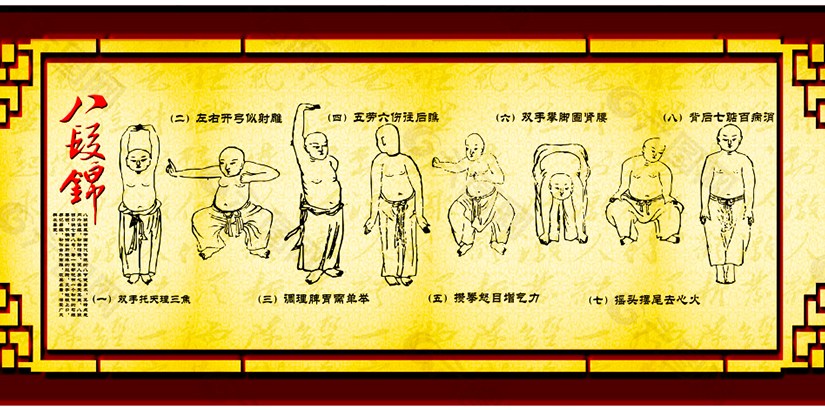
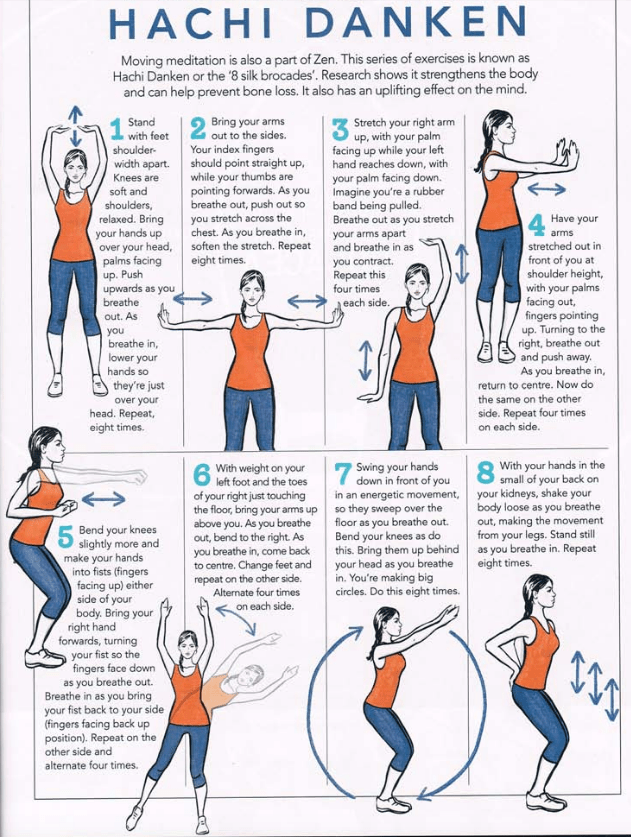


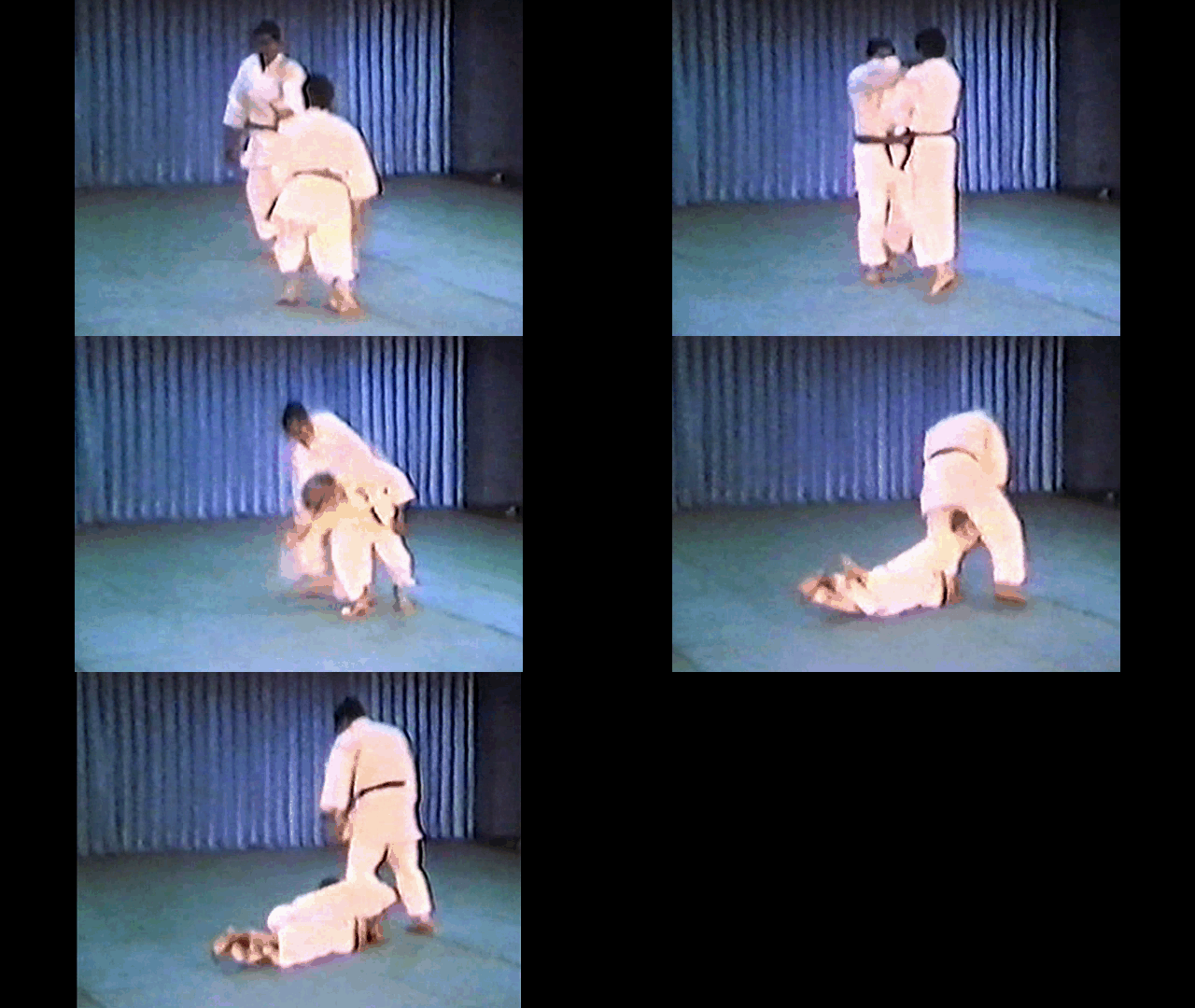

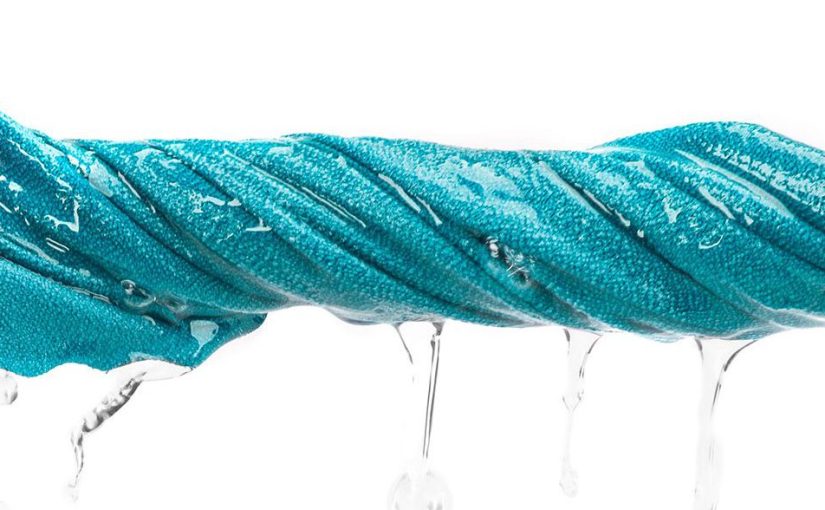


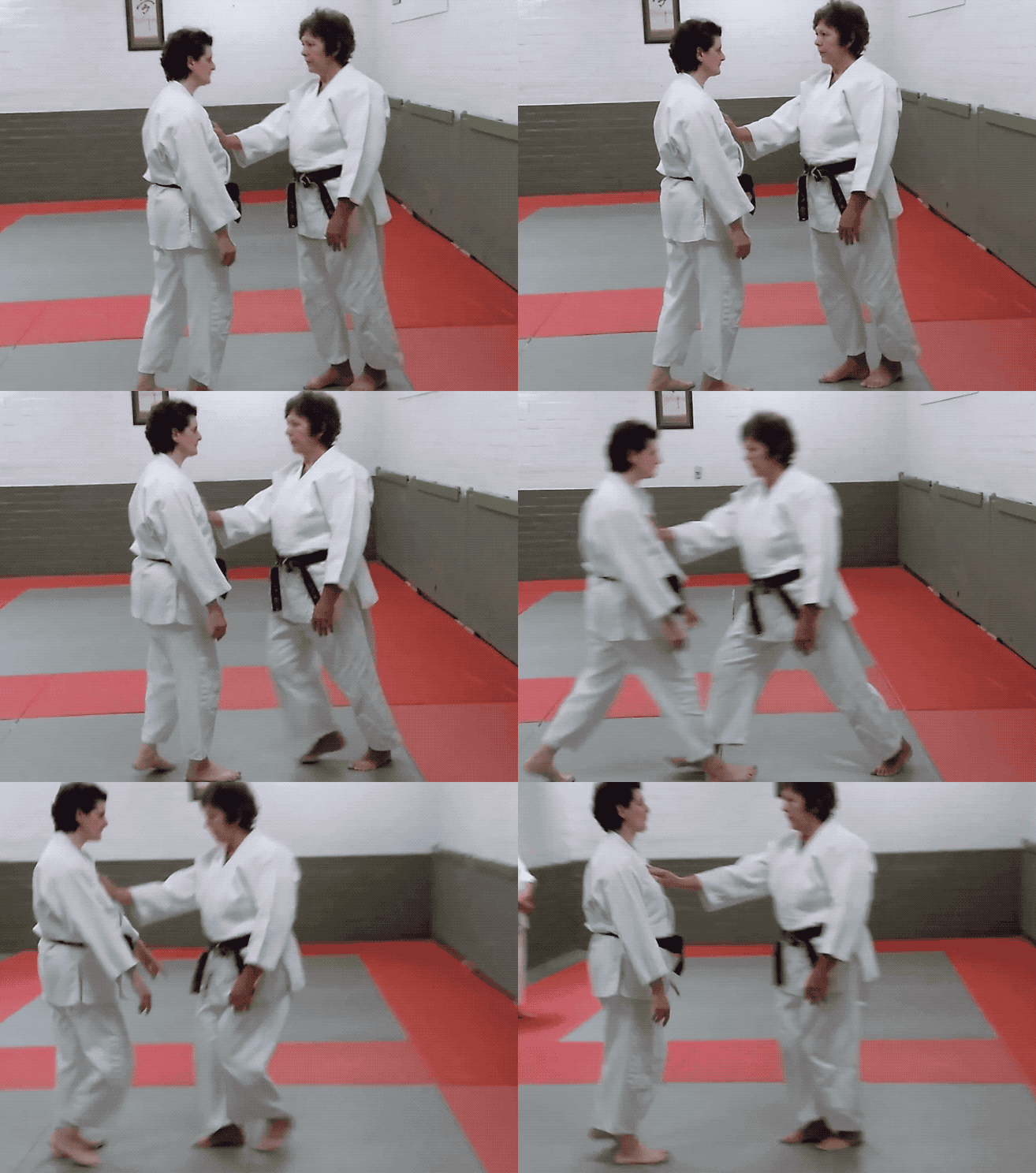


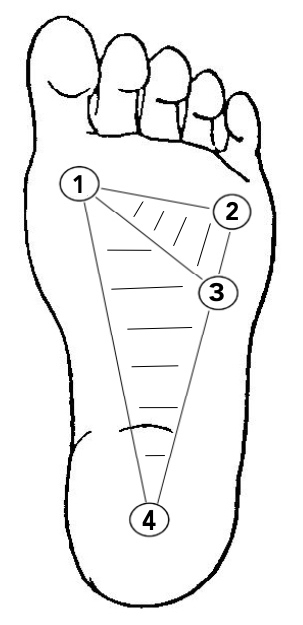




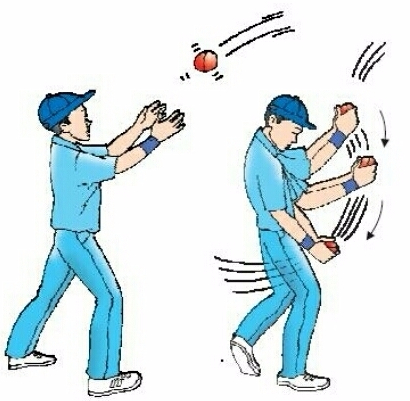
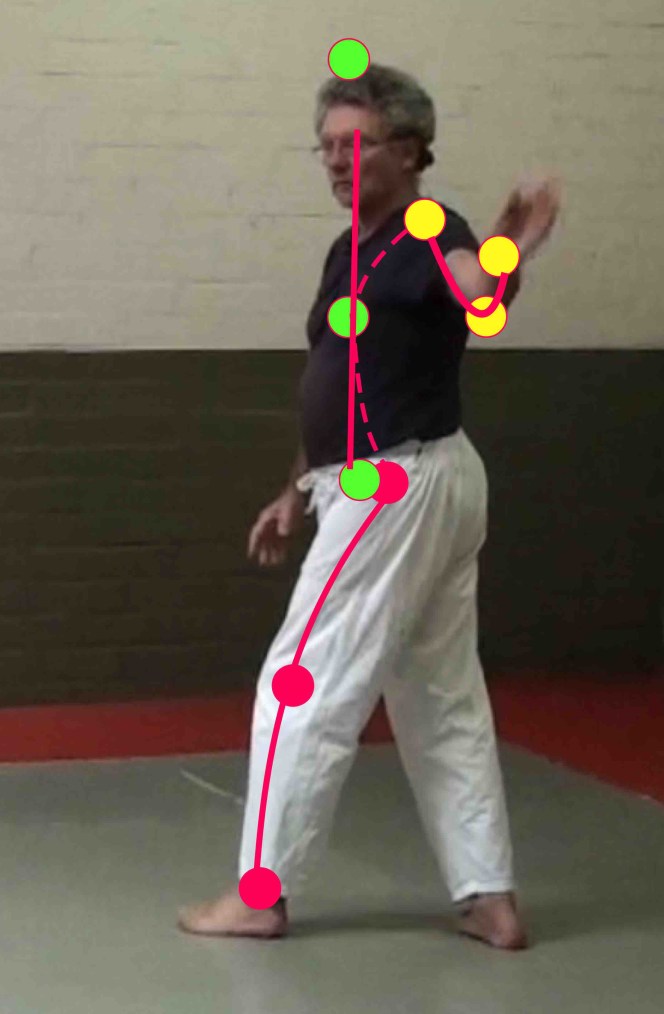

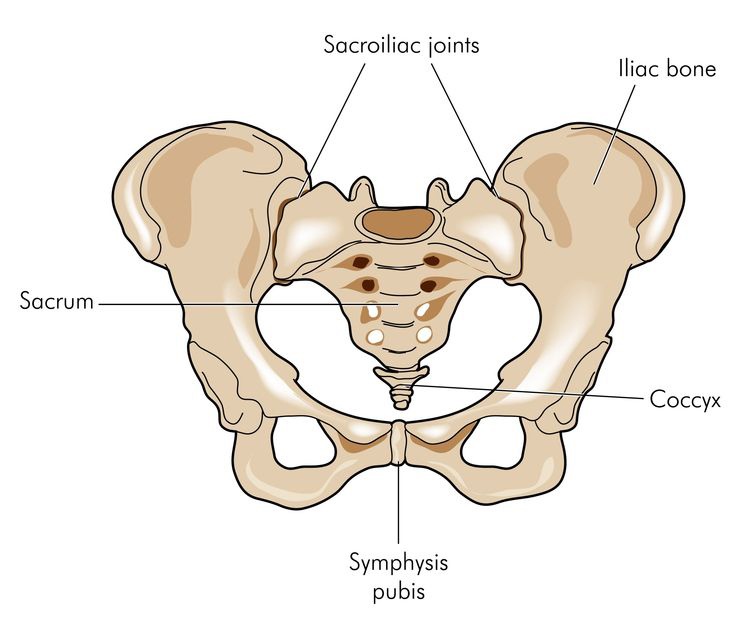

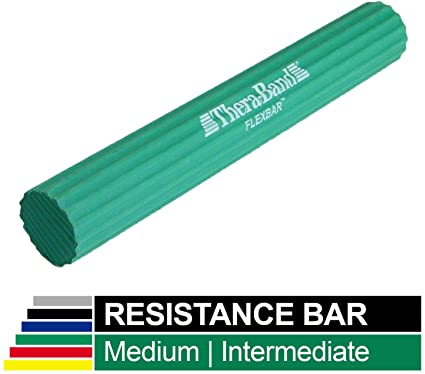
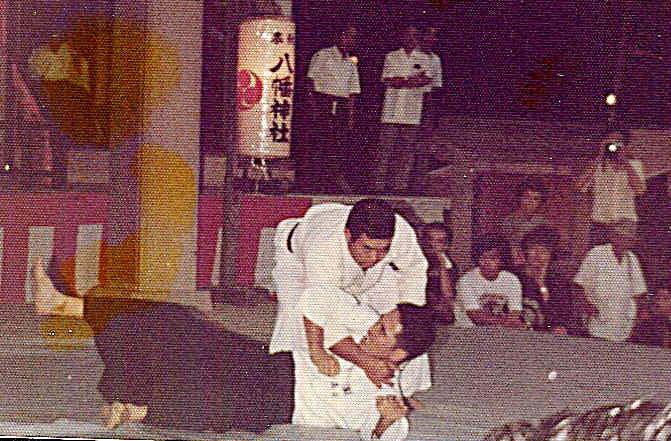
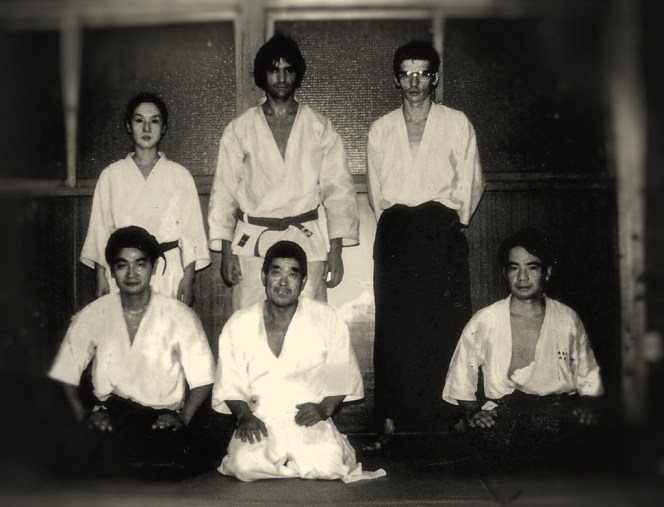


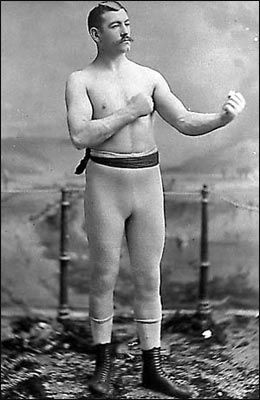


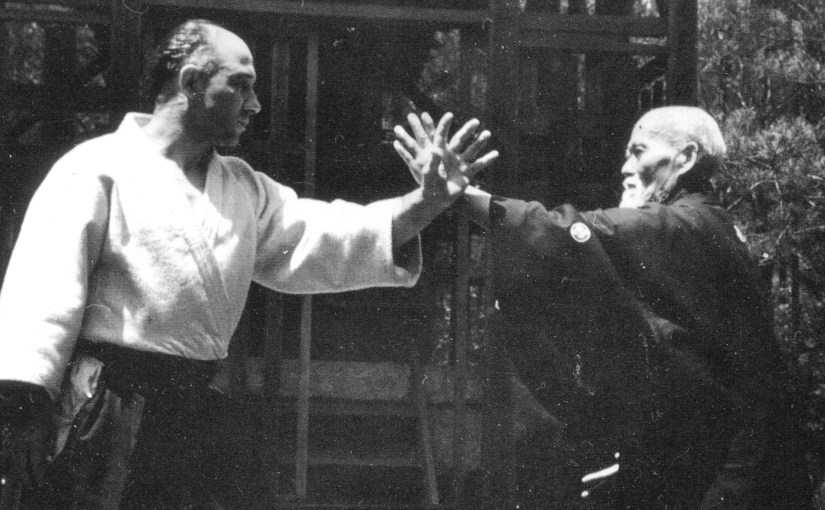


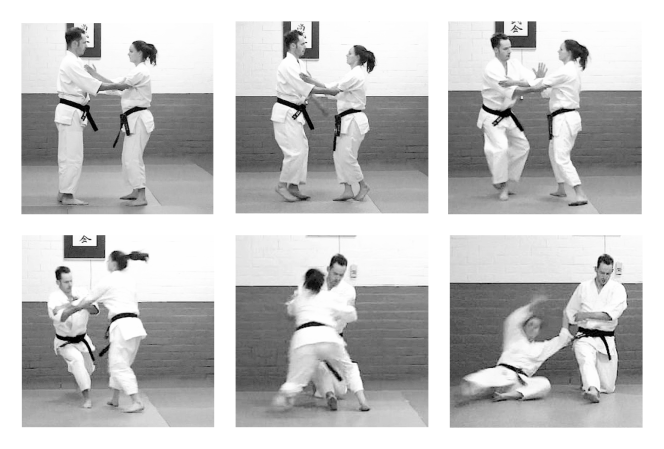
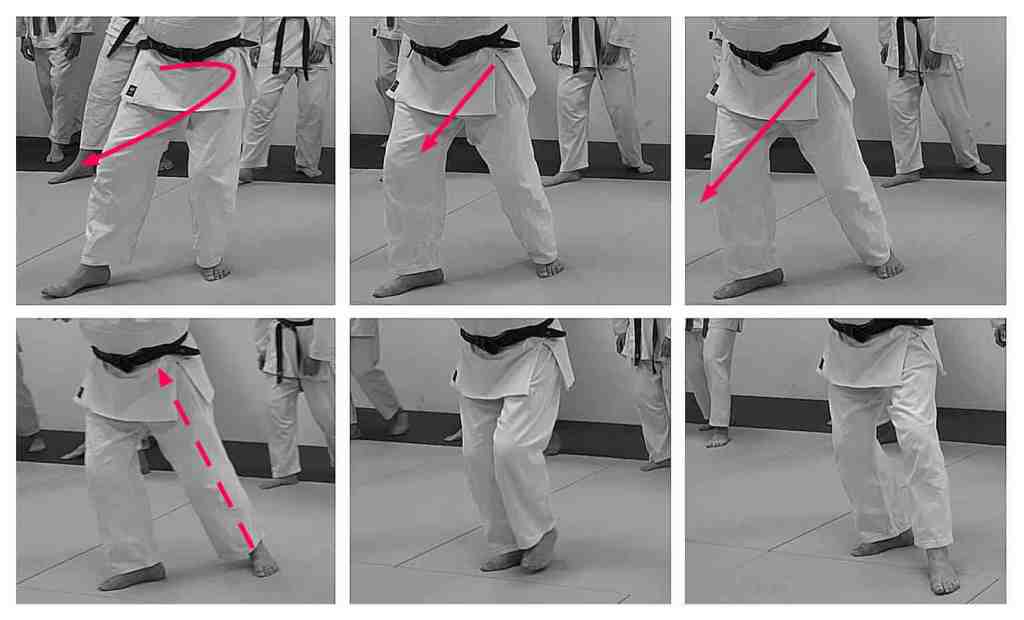

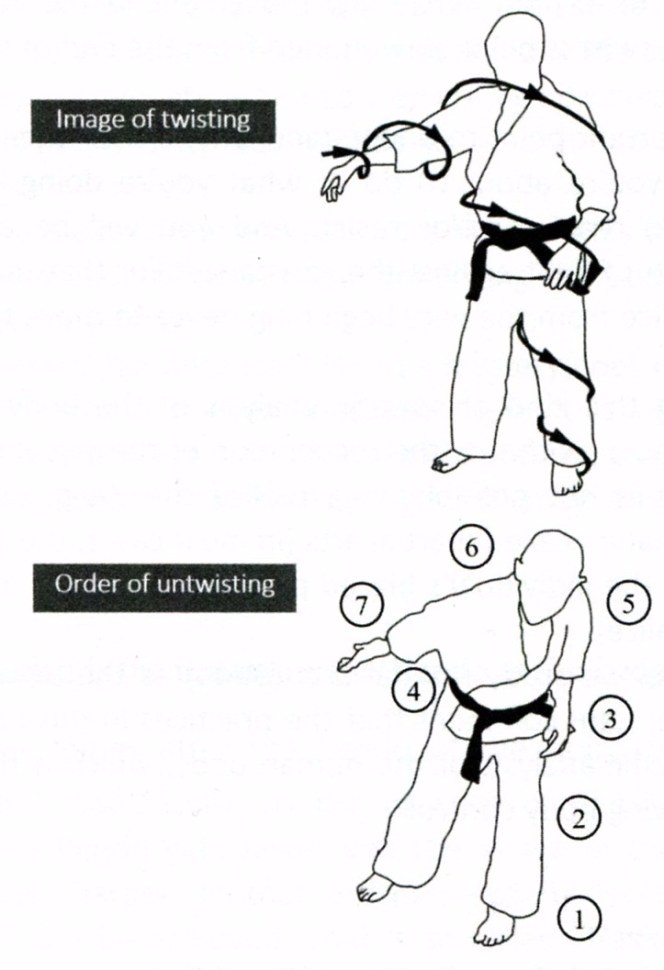
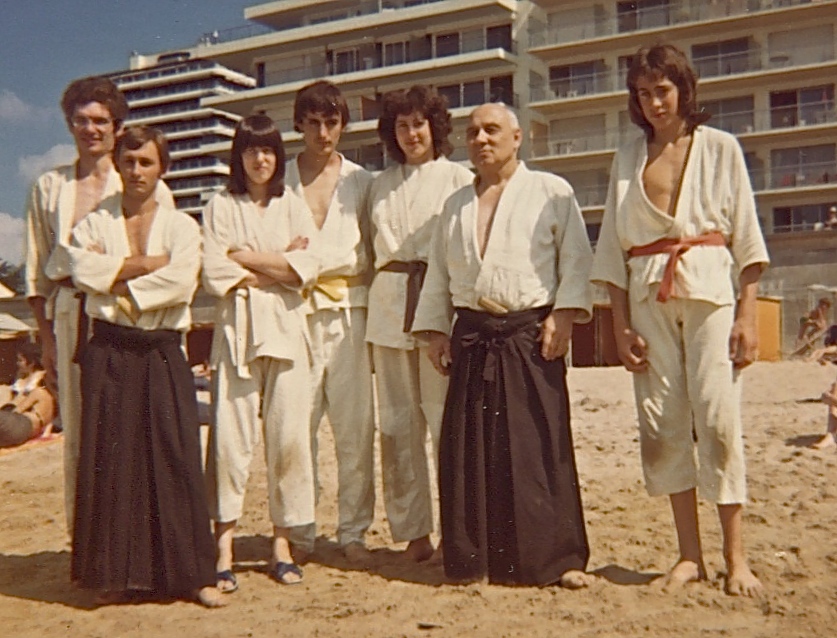



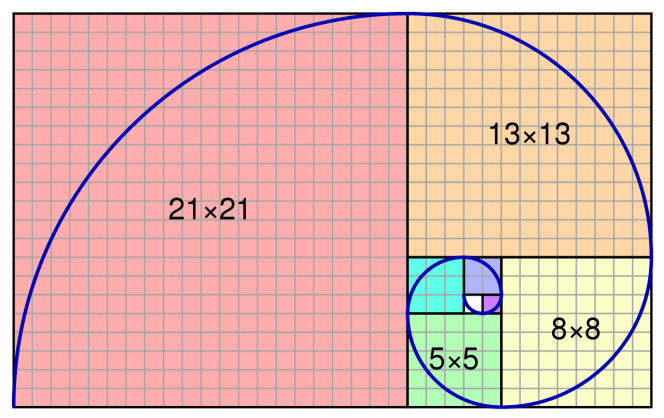
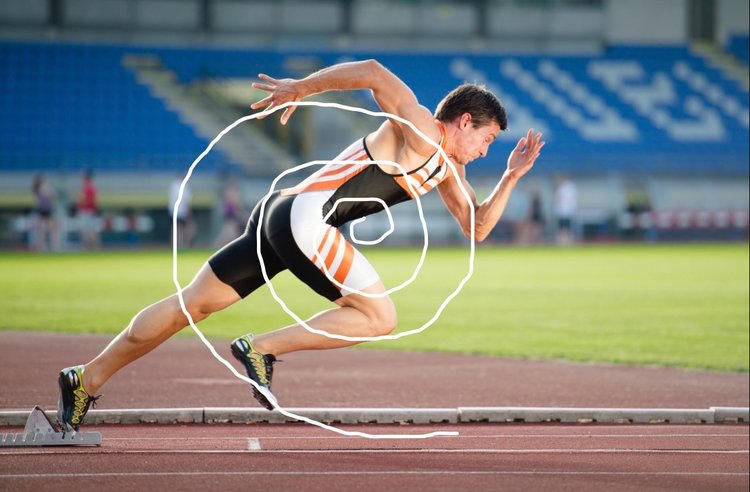
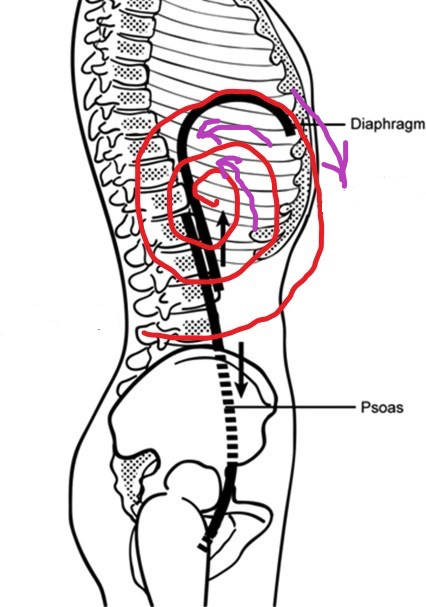

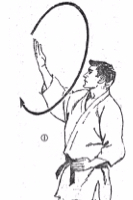


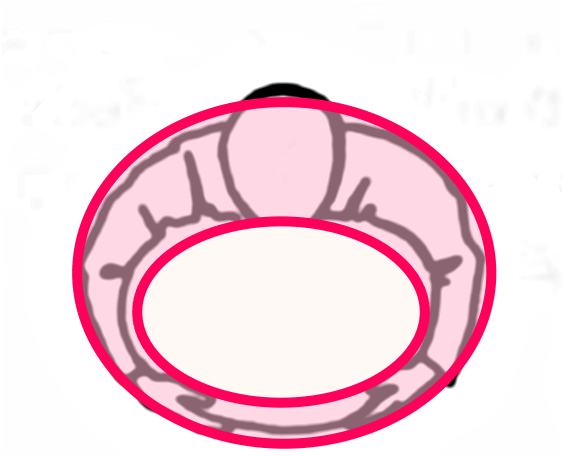


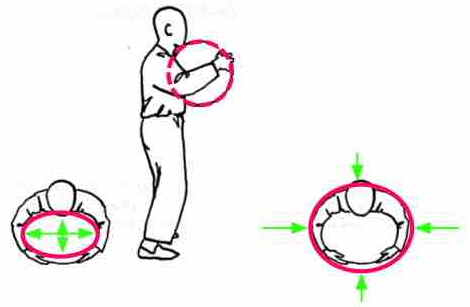

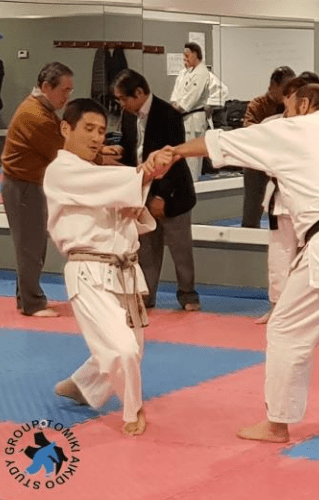
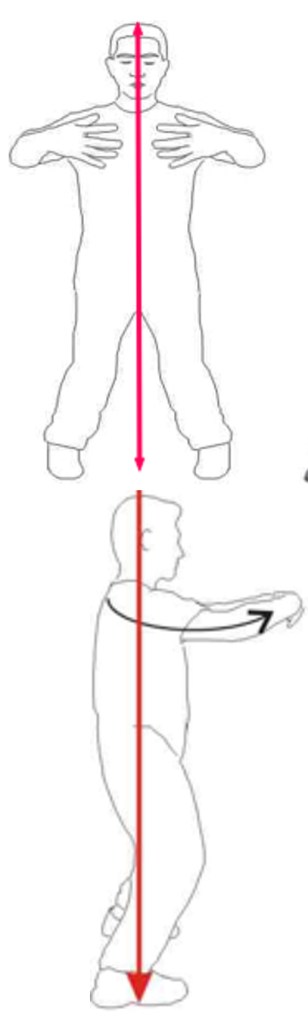




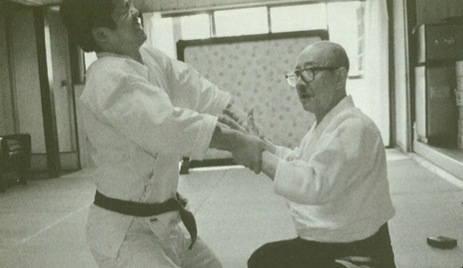
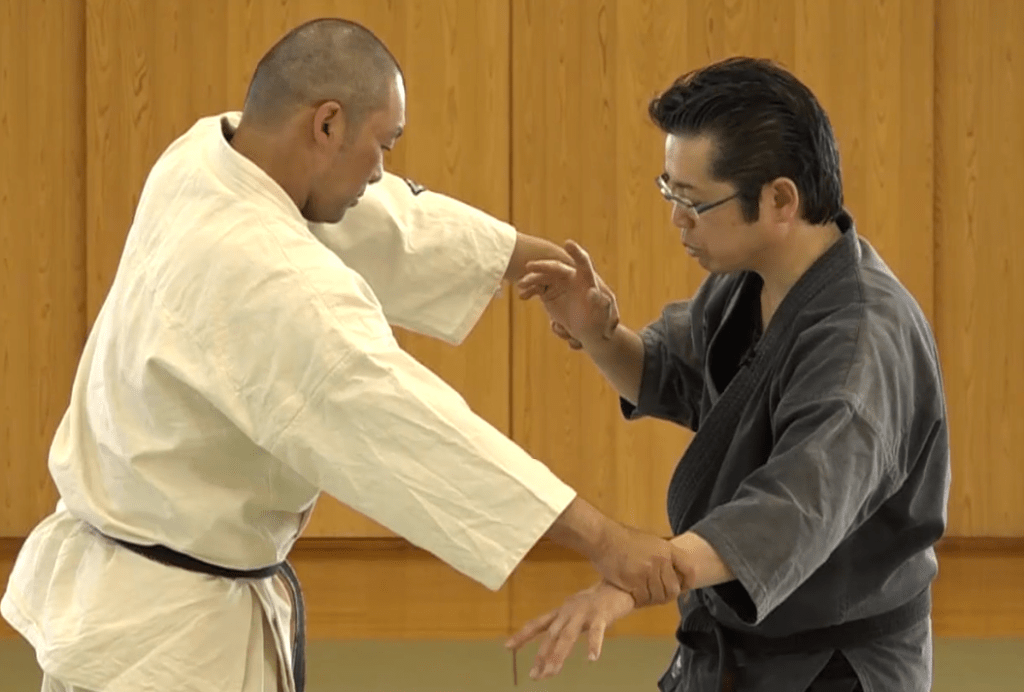


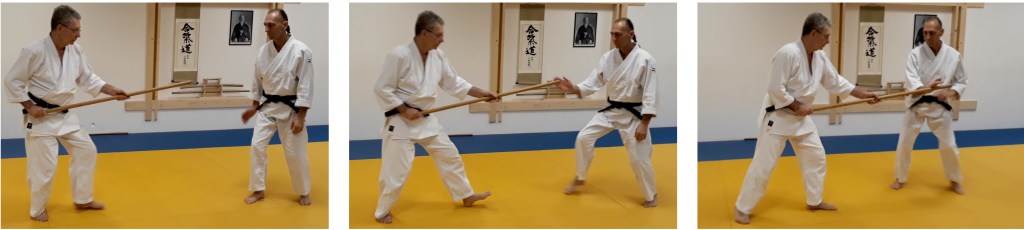


 Jodan aigamae & Jodan gyakugamae
 Study Group Tomiki Aikido